- Route
- Kristiansand – Vennesla (Grovane) – Evje – Byglandsfjord – Bygland – Ose – Rysstad – Valle – Bykle – Hovden (Rv 9, side trip on Fv 405)
- Length
- about 210 km from Kristiansand to Hovden, and the same distance home. The Setesdalsbanen detour adds just over 20 km.
- Driving time
- Around 3.5 hours each way without stops
- Recommended number of days
- 2–4
- Best season
- June–August. The Rv 9 is open all year, but most museums, the steamboat and heritage railway operate only in summer.
- Difficulty
- Easy. The Rv 9 is a good two-lane road all the way to Hovden, without ferries or hairpin bends. It is the side roads that are narrow.
- Last checked
- October 2026
Why this route?
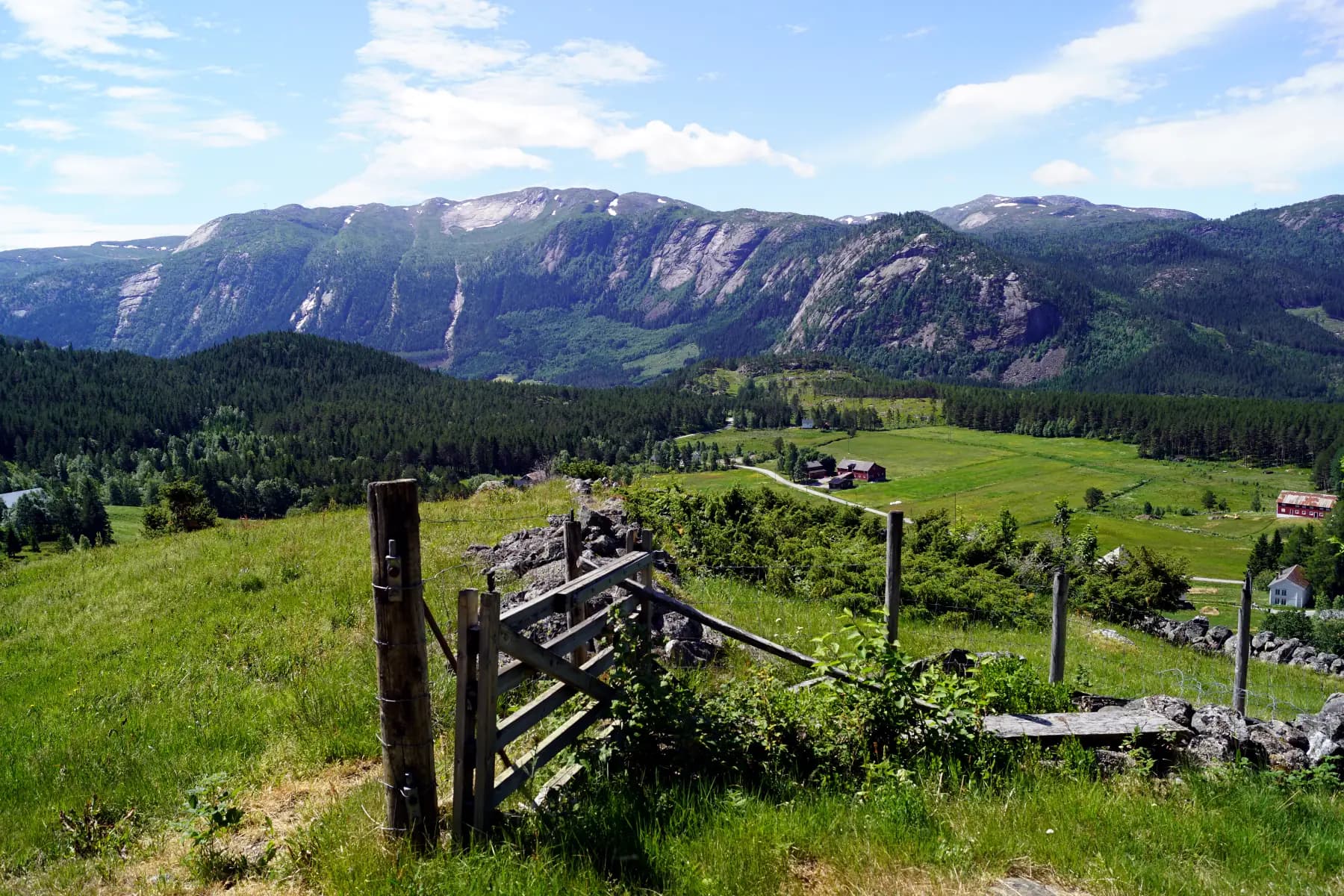
Setesdal is the valley of the Otra, Southern Norway's longest river. The Rv 9 follows the valley from Kristiansand, where the river reaches the sea, to Hovden almost 800 metres above sea level — first through forest, then along long, narrow lakes and finally between tall, steep rock walls. The valley has preserved log houses from the 1500s and 1600s, decorative rose painting and the Hardanger fiddle, and Setesdalsmuseet has farmsteads and houses all the way from Iveland in the south to Hovden in the north.
For a motorhome this is a gentle road. The route ends at Hovden, and you return the same way: the valley looks different downhill, and you can visit the stops you skipped. With more days, continue to Telemark or over Haukelifjell.
Stops along the route
1. Grovane — the steam train in Vennesla
At Grovane in Vennesla, steam locomotives stand ready in summer. The train travels the eight kilometres to Røyknes on narrow gauge — just under half an hour each way, with a café break before returning. The locomotives are over a hundred years old. The line ran all the way to Byglandsfjord from 1896 to 1962, and heritage trains were already running here in 1964, the first in Norway.
Don't miss: Sunday trains in summer — in 2026 from 7 June to 6 September, plus Saturdays in July. Buy tickets in advance, as they often sell out.
Motorhome tip: Leave the Rv 9 at Mosby and follow the Fv 405 through Vennesla, around ten kilometres. Parking at the station is free and spacious, including for large vehicles. You can continue along the Fv 405 and Fv 403 beside the Otra through Iveland to rejoin the Rv 9 at Hodnesund, around ten kilometres south of Mineralparken. This is shorter than returning to Mosby, but the road is mostly under six metres wide.
2. Evje and Hornnes — search for crystals
The rock around Evje and Iveland is full of rare minerals, and nickel was mined here from 1872 to 1946. Mineralparken by the Rv 9 at Hornnes has its exhibition in halls inside the mountain, treasure hunts for children and a water park in summer. Evje mineralsti passes five old mines, and in summer the museum brings out freshly blasted rock you can chip for crystals and green amazonite. Helmets and safety glasses are compulsory; equipment can be borrowed.
Don't miss: Geomuseet at Fennefoss, with the valley's largest mineral collection. It opens in midsummer.
Motorhome tip: For the mineral trail, follow signs from Evje kyrkje up the Fv 3782 towards Flatebygd, a country road mostly around five metres wide. We do not know how much space there is at the mines; with a long motorhome, Mineralparken by the Rv 9 is easiest. Odden Camping lies by the river within walking distance of central Evje, with over a hundred paved pitches and a dump station.
3. Byglandsfjord — the steamboat “Bjoren”
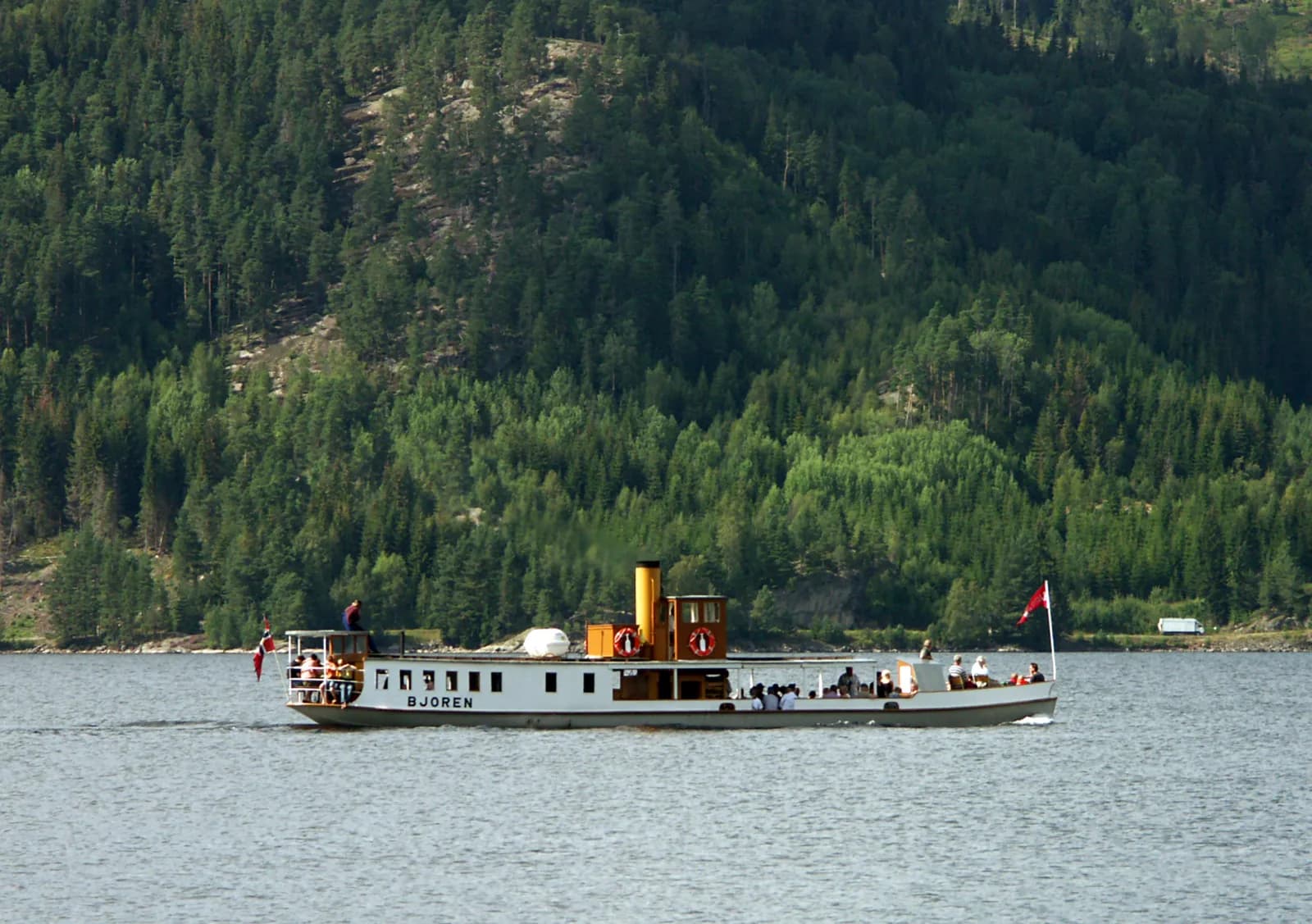
This was where the railway ended and boats took over. “Bjoren” arrived as a kit from Akers mekaniske verksted in Oslo in 1867, was assembled on site and initially sailed on Kilefjorden. In 1897, the year after the train arrived, it was moved up here. When scheduled service stopped in 1957, the boat was laid up and later used as a café. It returned to the water in 1994. It is still wood-fired, and in 2026 it was protected by the Norwegian Directorate for Cultural Heritage.
Don't miss: A trip on “Bjoren”. In summer, Sunday cruises of around two hours leave from the quay here or at Bygland and return to the same quay. There are only 55 places, so buy online when the sailing schedule appears in early summer. Dogs are not allowed aboard.
Motorhome tip: Neset Camping, a couple of kilometres north of the village, has 70 paved motorhome pitches with electricity and water, some right beside the lake. Between Evje and Byglandsfjord, Syrtveitfossane is a large rest area with room for four large vehicles.
4. Bygland and Ose — hearth house, lock and waterfall
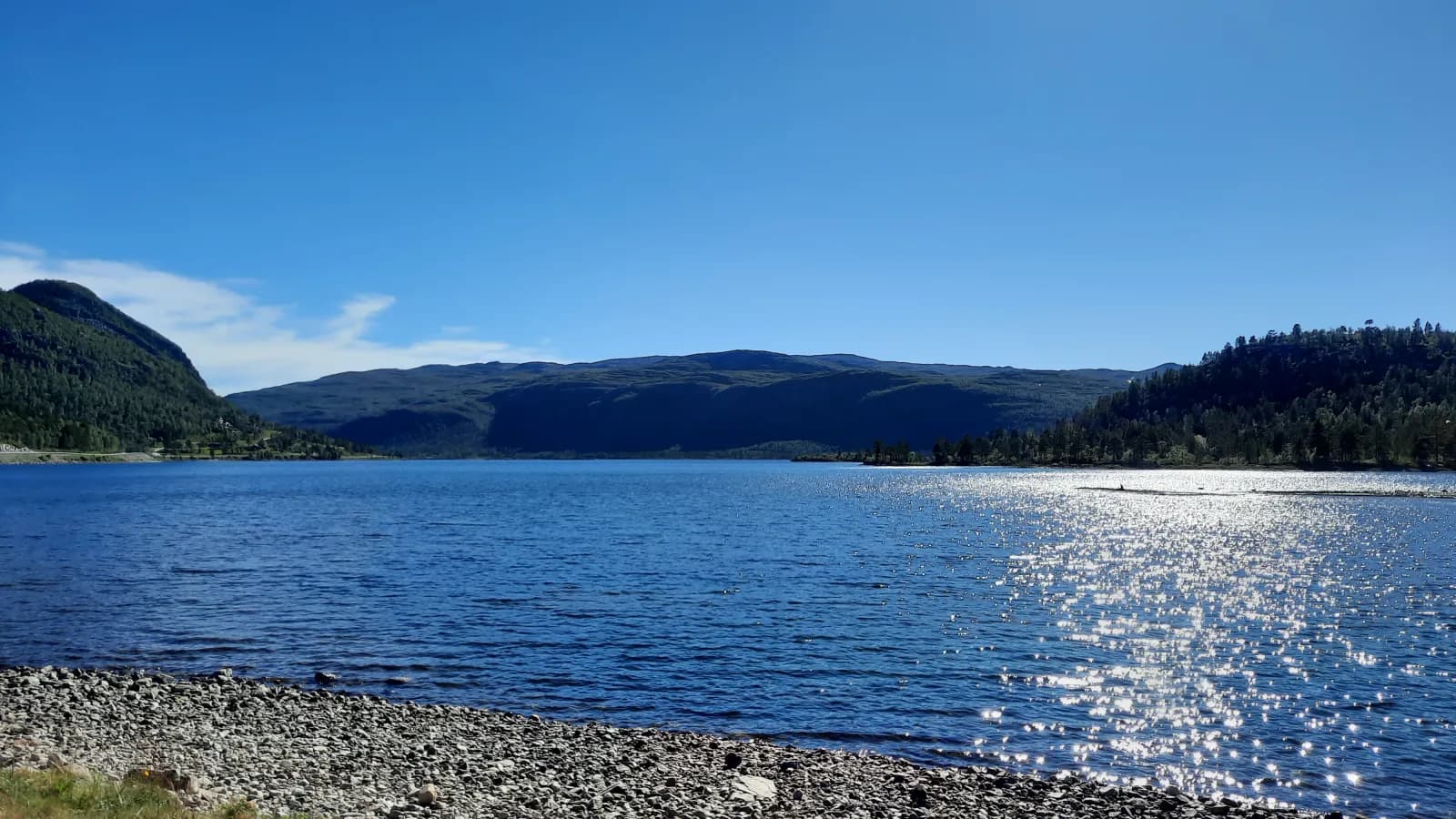
Byglandsfjorden is 37 kilometres long, and the Rv 9 follows its eastern side all the way to Ose. Bygland museum lies down by the water. It grew around the old municipal hall, a hearth house from the 1600s with a fireplace in the middle of the floor. Outside is a bathing beach, and there is a café at the quay where “Bjoren” docks.
Don't miss: Storstraumen, a few kilometres north of Bygland. Two lakes met here before water regulation, and the lock from 1869 through which the boats passed has been restored. Further north, at Ose, Reiårsfossen falls right beside the road.
Motorhome tip: South of Bygland, the Rv 9 passes through Fånefjelltunnelen from 1963: 600 metres long, only six metres wide and signed at 4.2 metres — the lowest signed height on the Rv 9. Storstraumen rest area has space for four large vehicles and is open in winter. Støylen Camping lies beside the fjord just south of Ose and opens from around 1 May to 30 September.
5. Rysstad — Setesdalsmuseet
Rysstad houses the main building of Setesdalsmuseet, with permanent exhibitions and others changing from summer to summer. In summer it opens daily, in spring and autumn on weekdays, and the rest of the year by arrangement.
Don't miss: The via ferrata on Straumsfjellet just south of Rysstad, a secured climbing route with cable and steps in the rock. Helle Camping offers guided trips.
Motorhome tip: Helle Camping has a dump station for guests. A little north of Rysstad the Fv 450 branches west towards Suleskard — read “Combine with” before turning there.
6. Valle — Tveitetunet and Rygnestad
At Tveitetunet south of the centre, the farmhouse bears the year 1596. Sheriff Olav Knutsson Tveiten lived here and went to Eidsvoll on behalf of the valley in 1814. His memorial stone stands at Valle kyrkje. North of the centre lies Rygnestad, with timber from before 1350 in the oldest part of the farmhouse and a three-storey loft building — no others like it remain in the valley.
Don't miss: Tveitetunet, open daily for a few weeks in midsummer. Rygnestad was closed for restoration in 2026 — check setesdalsmuseet.no before driving there.
Motorhome tip: Valle Camping is a short distance from the shops in Valle, and the municipal grey-water and toilet disposal facility is on site. Flateland Camping, seven kilometres north at Rotemo, accepts motorhomes without reservations and in 2026 opened from 19 May to 23 August — check this year's dates. Just north of Valle, Honnevje is a large rest area with room for four large vehicles.
7. Bykle — Byklestigen and the rose-painted church
At Byklestigen the Rv 9 slips through the mountain in two short tunnels. Before the carriage road arrived in the late 1870s, everyone travelling between Valle and Bykle had to climb this steep passage with steps in the rock, high above the Otra. Today it has been restored as a walking trail. The church in Bykle is tiny, under 70 square metres, and has stood since around 1620. Its walls are round logs, and the decorative rose painting inside dates from 1826. On the slope above is Huldreheimen, old houses collected by a doctor and an actor as a holiday retreat overlooking the village.
Don't miss: The church, open daily from late June to mid-August. Huldreheimen has no attendants; in summer you walk around and look inside on your own.
Motorhome tip: Parking at the Byklestigen information board, between the two tunnels, is small — stop only if there is room. The tunnels from 1983 have no signed height; Statens vegvesen gives around 4.4 metres.
8. Hovden — at the top of the valley
Hovden lies almost 800 metres above sea level, where the valley opens towards the mountains, with Hartevatn beside the road just south of the village. In Viking and medieval times, bog iron was smelted up here, and some of the iron in the Gokstad ship appears to come from Agder. Jernvinnemuseet is built around an old smelting site and is unstaffed: call Setesdalsmuseet to gain entry.
Don't miss: The chairlift up Storenos, almost 1,200 metres above sea level, when it runs in summer. If it rains, Hovden Fjellbad has pools and water slides.
Motorhome tip: Hovden Fjellstoge, three kilometres north of the centre, has a campsite as well as rooms and cabins. We have not found a dump station in Hovden, so empty and refill water in Valle. Day parking at cross-country ski trails is free; at the alpine ski centre it costs money. It is around 50 kilometres back to Flateland and Valle.
Practical info for motorhomes
Roads: The Rv 9 is open all year and permits vehicle combinations of 19.5 metres all the way from Kristiansand to Haukeligrend (Statens vegvesen's road database). Between Kristiansand and Hovden it is mostly around seven metres wide, without hairpin bends, and the steepest gradients are around seven per cent. The lowest signed height is 4.2 metres, in Fånefjelltunnelen. North of Hovden, the mountain stretch towards Haukeli is one of Statens vegvesen's mountain crossings, with convoy driving or closure in bad winter weather. Check vegvesen.no/trafikk or call 175.
Parking: Free at Setesdalsbanen, paid at Hovden's alpine ski centre. The large rest areas along the Rv 9 are listed under the stops; Statens vegvesen says rest areas are for breaks, not prolonged camping.
Overnight stays: The Outdoor Recreation Act's rules for tents on uncultivated land — at least 150 metres from an inhabited house or cabin, maximum two nights without the landowner's consent — are a useful guide. With a motorhome, stay only where parking is allowed, and never drive into the terrain. Use campsites.
Campsites:
- Odden Camping — Evje, dump station, in 2026 from 25 April to 2 October
- Hornnes Camping — Hornnes, beside the Otra, motorhome waste disposal and water
- Neset Camping — Byglandsfjord, 70 paved motorhome pitches with electricity and water
- Støylen Camping — beside Byglandsfjorden just south of Ose, about 1 May–30 September
- Helle Camping — south of Rysstad, waste disposal for guests
- Valle Camping — central Valle, municipal dump station on site
- Flateland Camping — Rotemo north of Valle, no reservations, May–August
- Hovden Fjellstoge — three kilometres north of central Hovden
Fuel: Stations at Evje, Grendi north of Byglandsfjord, Bygland, Ose, Rysstad, Valle, Bykle and Hovden, so they are never far apart.
Waste disposal: Odden Camping, Hornnes Camping, Helle Camping (for guests), Valle municipality's facility at Valle Camping and Flateland Camping (grey water, and toilet cassettes only with environmentally friendly chemicals). We have found none in Hovden.
Ferries: No ferries. “Bjoren” carries passengers only.
Combine with
- Sørlandskysten — also starts in Kristiansand and heads east along the coast to Kragerø.
- Telemarkskanalen and Vest-Telemark — from Rotemo north of Valle the Fv 450 crosses the mountains to Dalen, around 54 km. For the first roughly 20 kilometres up from Rotemo the road is 5–5.5 metres wide, narrower in places, then around six metres towards Dalen. It descends into Dalen through hairpin bends. In winter the mountain stretch may have convoy driving or closures. From Dalen it is around 215 km back to Kristiansand.
- Ryfylke and Lysefjorden and Hardanger — from Hovden it is around 30 km to Haukeligrend and then 60 km over Haukelifjell on the E134 to Røldal, where the Ryfylke route ends. Odda lies 40 km further north. Both mountain crossings may have convoy driving or close in winter, and down towards Haukeligrend the Rv 9 descends at 8–9 per cent for around three kilometres, with two hairpin bends at the bottom.
- Sirdal and Suleskarvegen — Fv 450 west across the mountains to Sirdal. It is closed from 1 November to 20 May for the sake of wild reindeer, and long stretches are only around 4.5 metres wide.
Weather
In July the normal temperature is around 16 degrees at Byglandsfjord and 15 in Valle. October is the wettest month, April the driest. Hovden lies almost 800 metres above sea level and is noticeably cooler. Check yr.no for Evje, Valle and Hovden.
This route is part of Bobilvei's hand-picked motorhome routes in Norway. Every route is quality-checked with a focus on motorhome suitability, parking and local experiences.