- Route
- Skien – Løveid – Ulefoss – Vrangfoss – Lunde – Hogga – Kviteseid – Vrådal – Dalen – Eidsborg – Morgedal – Seljord (fv. 357, rv. 36, fv. 359, fv. 3316, fv. 3310, fv. 3320, fv. 3324, rv. 41, fv. 38, fv. 450 and E134)
- Length
- about 210 km. Oslo to Skien is about 135 km, and Seljord back to Oslo about 165 km.
- Driving time
- Around 4–5 hours without stops, plus a little over 2 hours from Oslo to Skien.
- Recommended number of days
- 3–5
- Best season
- May–September. Canal boats usually run daily from mid-May to early September, with one continuing until early October.
- Difficulty
- Moderate. Good main roads, but narrow county roads along Flåvatn, a tunnel signed at 3.9 metres and steep hairpins into and out of Dalen.
- Last checked
- October 2026
Why this route?
Telemarkskanalen is a 105-kilometre waterway from Skien to Dalen, with 18 lock chambers lifting boats 72 metres. Completed in 1892, its upper section still has timber gates opened by hand. The road passes close to the locks, so you can watch the canal boat climb the staircase — and sleep a stone's throw from the water.
Skien is a little over two hours from Oslo, making this a good long-weekend route. Beyond Flåvatn the landscape steepens, and the road winds down to Dalen in hairpins. The trip ends in Seljord, beside the lake said to be home to a lake serpent.
Stops along the route
1. Skien — where the canal begins
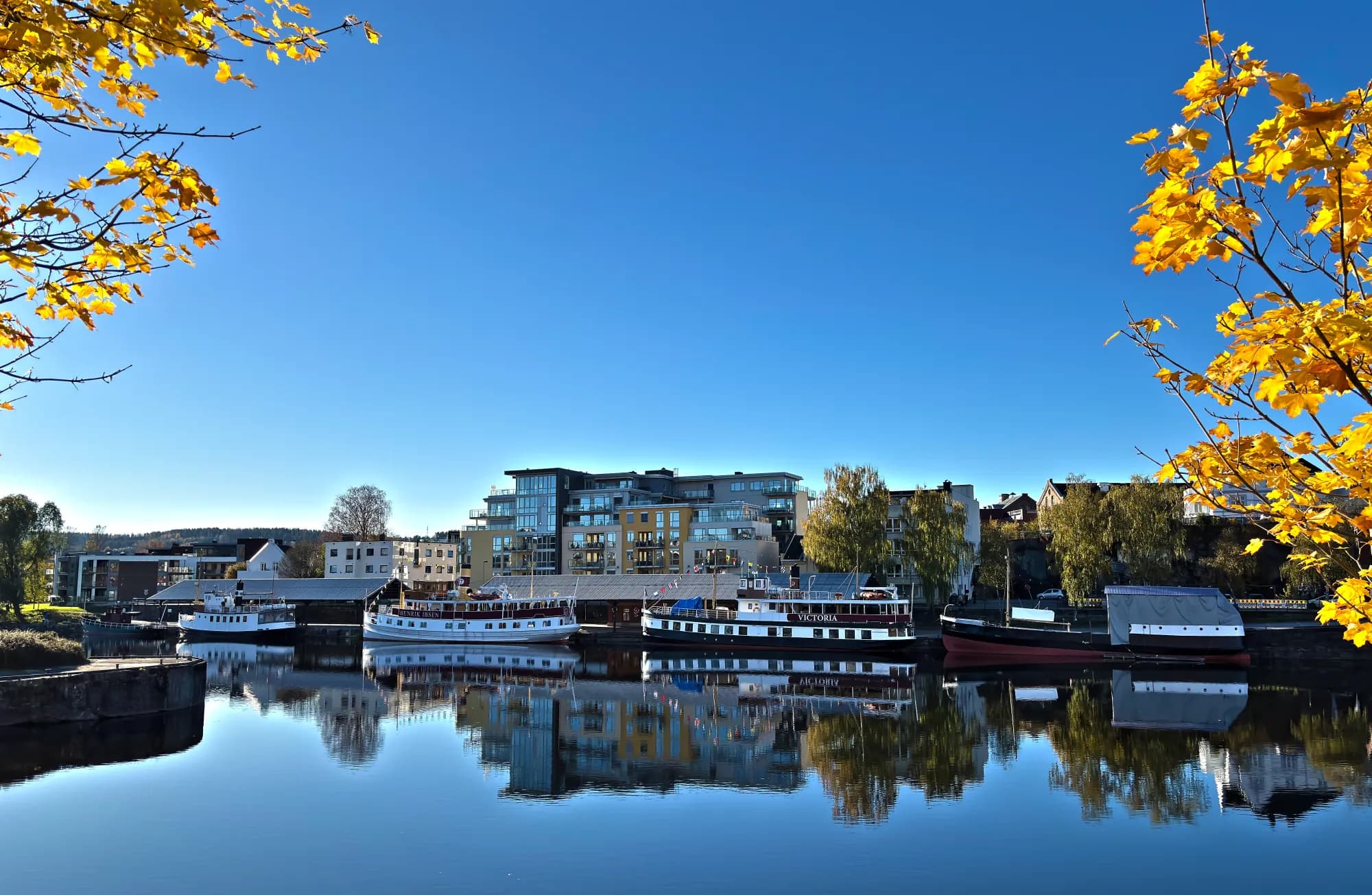
Canal boats leave Hjellebrygga in the morning. Henrik Ibsen was born here in 1828; his childhood home at Venstøp is being converted into a museum for the 2028 anniversary. Six kilometres west, at Skotfoss, the three chambers at Løveid locks raise boats just over ten metres to Norsjø.
Don't miss: Løveid locks. Parking by the lowest chamber is free.
Motorhome tip: Parking at Hjellebrygga is for canal-boat passengers. Skien fritidspark, a couple of kilometres south of the centre, has ten motorhome pitches with electricity from April to early November. Non-guests can also use its dump station for a fee.
2. Ulefoss — manor house and ironworks
Where Eidselva flows into Norsjø, the upper canal begins, built from 1887 to 1892. Ulefoss ironworks was founded in 1657. Ulefos manor acquired its white main building in 1802–1807, built from slag bricks from the works. Its dome and columns make it a major work of Norwegian Neoclassicism.
Don't miss: Ulefos Hovedgaard, which Telemark Museum opens in summer.
Motorhome tip: Ulefoss lock's address is Lannavegen 5. Search for the address, otherwise the GPS may send you somewhere completely different beside the water.
3. Vrangfoss — the canal's biggest staircase
Five successive chambers lift boats 23 metres. They lie in a rocky gorge beside the dam that replaced the waterfall. Lock keepers open the gates by hand, and crowds gather along the edge when the canal boat arrives.
Motorhome tip: Fv. 3316 to the locks is narrow, mostly less than five metres. There is free parking at the bottom of the park, with a kiosk and toilets.
4. Lunde — where the boats meet
In summer, the two canal boats on the Skien–Dalen route meet at Lunde lock every day around midday — nowhere else on the canal. To take a boat trip yourself, leave your motorhome at Ulefoss: the boat goes up through Vrangfoss to Lunde in the late morning and back down in the early afternoon. The canal bus between Lunde and Ulefoss can replace the boat one way; book it with the boat ticket.
Motorhome tip: The height under the railway in central Lunde is signed at 4.1 metres. First Camp Lunde is a few hundred metres from the lock, with over 200 pitches and emptying facilities for fixed tanks and cassettes. Fill up in Lunde — there is no fuel station along Flåvatn.
5. Kjeldal and Hogga — the last locks
Kjeldal has one chamber and a three-metre lift. Just over a kilometre upstream is Hogga, with the last two chambers. Beyond Hogga there is open water all the way to Dalen — across Flåvatn, Kviteseidvatnet and Bandak.
Motorhome tip: Hogga Bobilcamp is immediately below the locks. It is unstaffed, with electricity, toilets, coin-operated showers and sewage and grey-water emptying, from Easter until some time in October. Further on, fv. 3320 and fv. 3324 along Flåvatn and Kviteseidvatnet are around five metres wide over roughly 35 kilometres, in places less than four. Drive slowly, be ready to give way and expect cyclists. The short Fjågesundtunnelen on fv. 3324 is signed at 3.9 metres. Kilen Camping, beside a gently shelving sandy beach on the north shore of Flåvatn, has over 20 motorhome pitches.
6. Kviteseid — the church beside the waterway
Where fv. 3324 meets rv. 41 stands Kviteseid gamle kyrkje, a stone church probably from the second half of the 12th century. It stands by the waterway that carried whetstones from Eidsborg down to Skien in Viking and medieval times. Inside is decorative rose painting from the 18th century. Beside it is Kviteseid bygdetun, one of Norway's oldest open-air museums, from 1907.
Don't miss: A summer guided tour of the museum farmstead and church with Vest-Telemark museum.
Motorhome tip: There is parking and a toilet by the church. Central Kviteseid, six kilometres north, has an automatic fuel station.
7. Vrådal — between Nisser and Vråvatn
Rv. 41 takes you south to Vrådal, between two lakes. Straand Hotel has been run by the same family since 1864; in summer the historic MS Fram, a timber tug from 1909, passes through the locks up Vråvatn.
Motorhome tip: Nedre Strand Hytteutleie og Familiecamping has pitches right beside Nisser, 600 metres from the centre, from April to October. Fill up in Vrådal. Fv. 38 onwards towards Dalen is mostly over six metres wide.
8. Dalen — where the canal ends
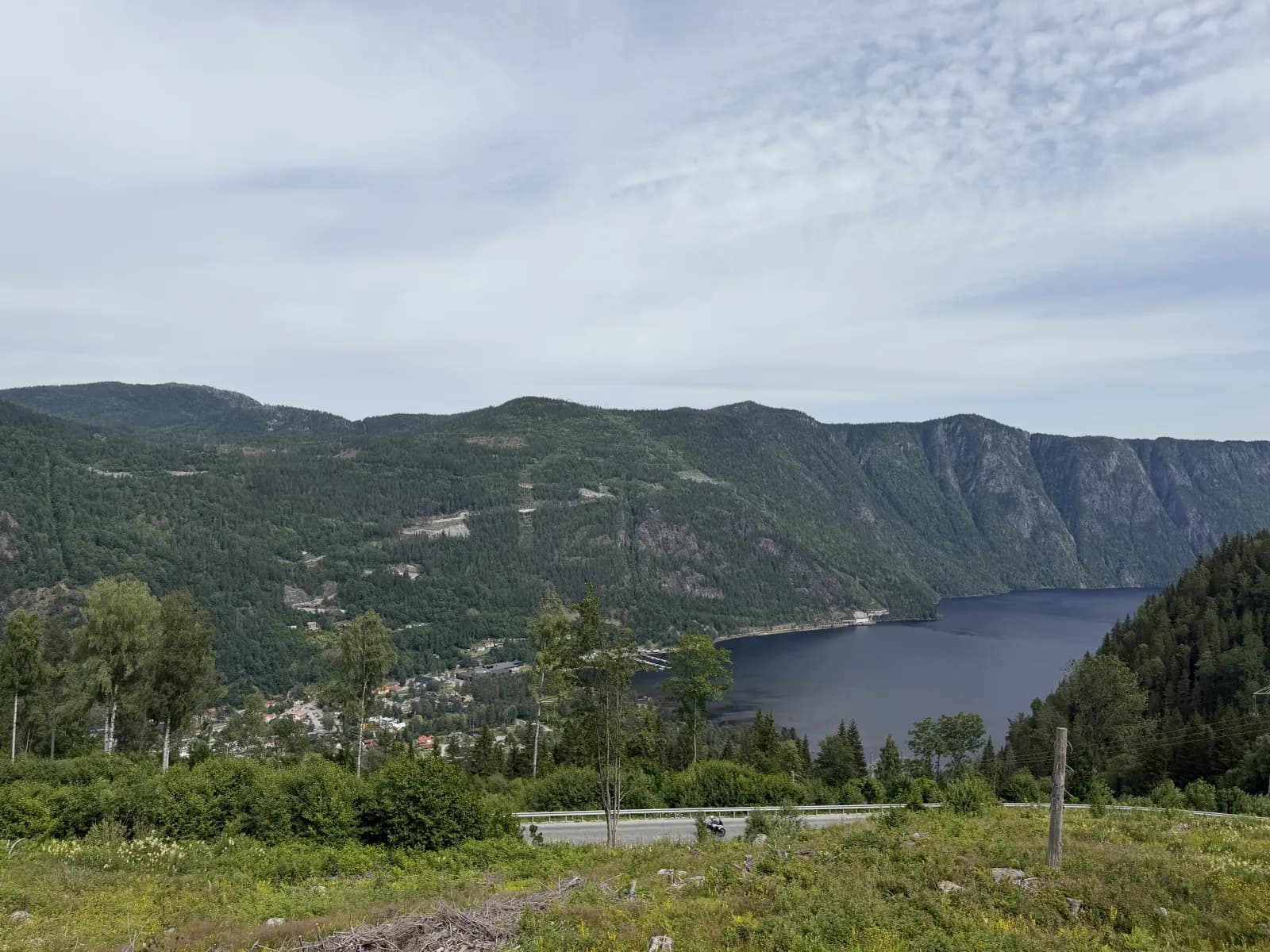
The final section is steep: from Holtebru, fv. 450 drops around 380 metres in a little over four kilometres through tight hairpins. The road is wide enough, but select a low gear and use engine braking. Below lies Dalen at the head of Bandak. Dalen Hotel opened in 1894, a large wooden hotel with dragons on its roof ridges, built for canal-boat arrivals.
Don't miss: Soria Moria, the municipal sauna outside the hotel garden.
Motorhome tip: There are motorhome pitches with electricity at the canal quay. They cannot be booked. Buøy Camping, on an islet a couple of hundred metres from the centre, accepts motorhomes on a drop-in basis only, has a minimum age of 23 and opens until 20 September.
9. Eidsborg — stave church and whetstones
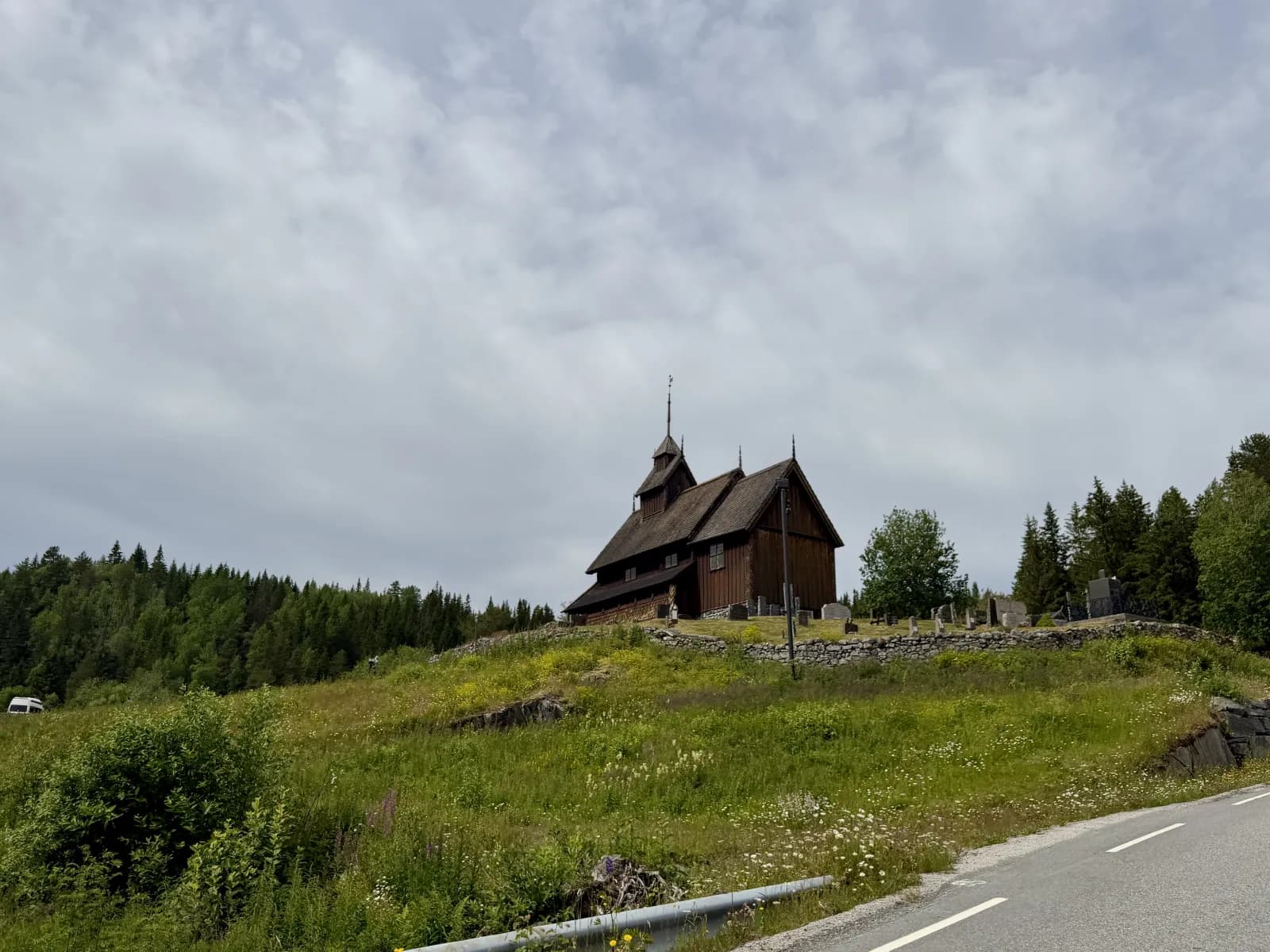
Out of Dalen, fv. 450 climbs almost 470 metres in just over six kilometres, through more hairpins. At the top, Eidsborg stave church stands on a knoll. Long thought to date from the 13th century, new samples suggest it may have been built just before 1150. Nearby is Vest-Telemark museum Eidsborg, with over 30 old houses and the story of the whetstones that travelled down the waterway to Skien and out into Europe as early as Viking times.
Don't miss: Guided tours of the stave church, three times daily from May to mid-September. The church is closed in winter.
Motorhome tip: There are car parks by the church and museum. Ravnejuv, where the cliff drops 350 metres towards Tokkeåi, lies beside the old road towards Vinje (fv. 3406). It is a steep gravel road, around four metres wide — do not drive there with a large motorhome.
10. Morgedal and Seljord — skiing and a lake serpent
Fv. 450 takes you to the E134 at Høydalsmo. Sondre Norheim was born in Morgedal, and the Olympic flame has been lit three times at his croft. Norsk Skieventyr opens from May to mid-September. Twenty minutes east lies Seljord beside a 14-kilometre lake. Tradition has it that a lake serpent lives there — it features on the municipal coat of arms.
Motorhome tip: Seljord Camping og Badeplass stands beside rv. 36, a kilometre from the centre, with a sandy beach, from Easter to 30 September. Dyrsku'n, usually on the second weekend in September, attracts around 90,000 people — space gets tight then.
Practical info for motorhomes
Roads: All roads permit vehicle combinations of 19.5 metres. The challenges are widths and gradients: fv. 3320 and fv. 3324 from Hogga to Kviteseid are around five metres wide, in places less than four. Fjågesundtunnelen is signed at 3.9 metres, and the railway underpass in Lunde at 4.1 metres. Into and out of Dalen, fv. 450 has hairpins and long slopes of around eleven per cent. In the tightest bends, with radii down to seven–eight metres, a long motorhome needs the entire road width — hold back and watch for oncoming traffic. Bends can be slippery in autumn and winter. Check vegvesen.no/trafikk or call 175.
Parking: Canal-boat passengers can park their motorhome free at the boarding point. At Hjellebrygga in Skien, a parking permit is required in the windscreen; obtain it on board or on the canal bus. Respect private quays and yards.
Overnight stays: The Outdoor Recreation Act's camping rules — at least 150 metres from an inhabited house, no more than two nights without the landowner's permission — are a useful guide. With a motorhome, stop only where parking is allowed, and never drive into the terrain. Use campsites.
Campsites:
- Skien fritidspark, motorhome parking — Skien, ten pitches, April–early November
- First Camp Lunde – Telemark — by Lunde lock, closes for winter in October
- Hogga Bobilcamp — by Hogga locks, unstaffed, Easter–October
- Kilen Camping — by Flåvatn, sandy beach
- Nedre Strand Hytteutleie og Familiecamping — Vrådal, April–October
- Buøy Camping — Dalen, drop-in only, minimum age 23, open until 20 September
- Seljord Camping og Badeplass — Seljord, Easter–30 September
Fuel: Skien, Ulefoss, Lunde, Kviteseid (automatic), Vrådal, Dalen, Høydalsmo and Seljord. There is no station between Lunde and Kviteseid, around 50 kilometres.
Waste disposal: First Camp Lunde (fixed tanks and cassettes), Hogga Bobilcamp (sewage and grey water), Skien fritidspark (also for non-guests, for a fee), and Buøy Camping for guests.
Ferries: None. Canal boats carry passengers, bicycles, canoes and kayaks, but not cars — the motorhome stays ashore. Book tickets ahead (booktelemark.no).
Combine with
- Sørlandskysten — the route ends in Kragerø, around an hour south of Skien.
- Hvaler and Fredrikstad — from Moss the ferry takes you to Horten, then it is a little over an hour to Skien.
- Hardangervidda and Haukeli — the E134 continues west from Høydalsmo over Haukelifjell, where convoy driving may be required in winter. Rauland is around 20 km north of Åmot.
- Heddal stave church — Norway's largest stave church stands beside the E134 just west of Notodden, on the way home to Oslo.
- Rjukan and Gaustatoppen — starts in Notodden and ends at Åmot on the E134, around 50 km from Seljord, where this route finishes.
Weather
Inland Telemark has warm summers: July mean temperatures in the valleys are around 16–17 degrees, and strong winds are rare. Inland, the most rain falls in summer, and August is usually the wettest month. Check yr.no for Skien, Lunde and Dalen.
This route is part of Bobilvei's hand-picked motorhome routes in Norway. Every route is quality-checked with a focus on motorhome suitability, parking and local experiences.