- Route
- Norheimsund – Eidfjord – Vøringsfossen – Kinsarvik – Odda – Utne – Kvanndal (round trip)
- Length
- about 300 km including side trips to Vøringsfossen and Låtefossen, plus one ferry. The plateau trip (stop 5) adds around 85–90 km return.
- Driving time
- 6–7 hours of driving, but plan at least four days
- Recommended number of days
- 4–6
- Best season
- May–September. Fruit trees blossom in May, and waterfalls are fullest in May and June.
- Difficulty
- Moderate. The entire loop allows vehicles of 19.5 metres, but has narrow stretches, many tunnels and a long climb up Måbødalen.
- Last checked
- October 2026
Why this route?
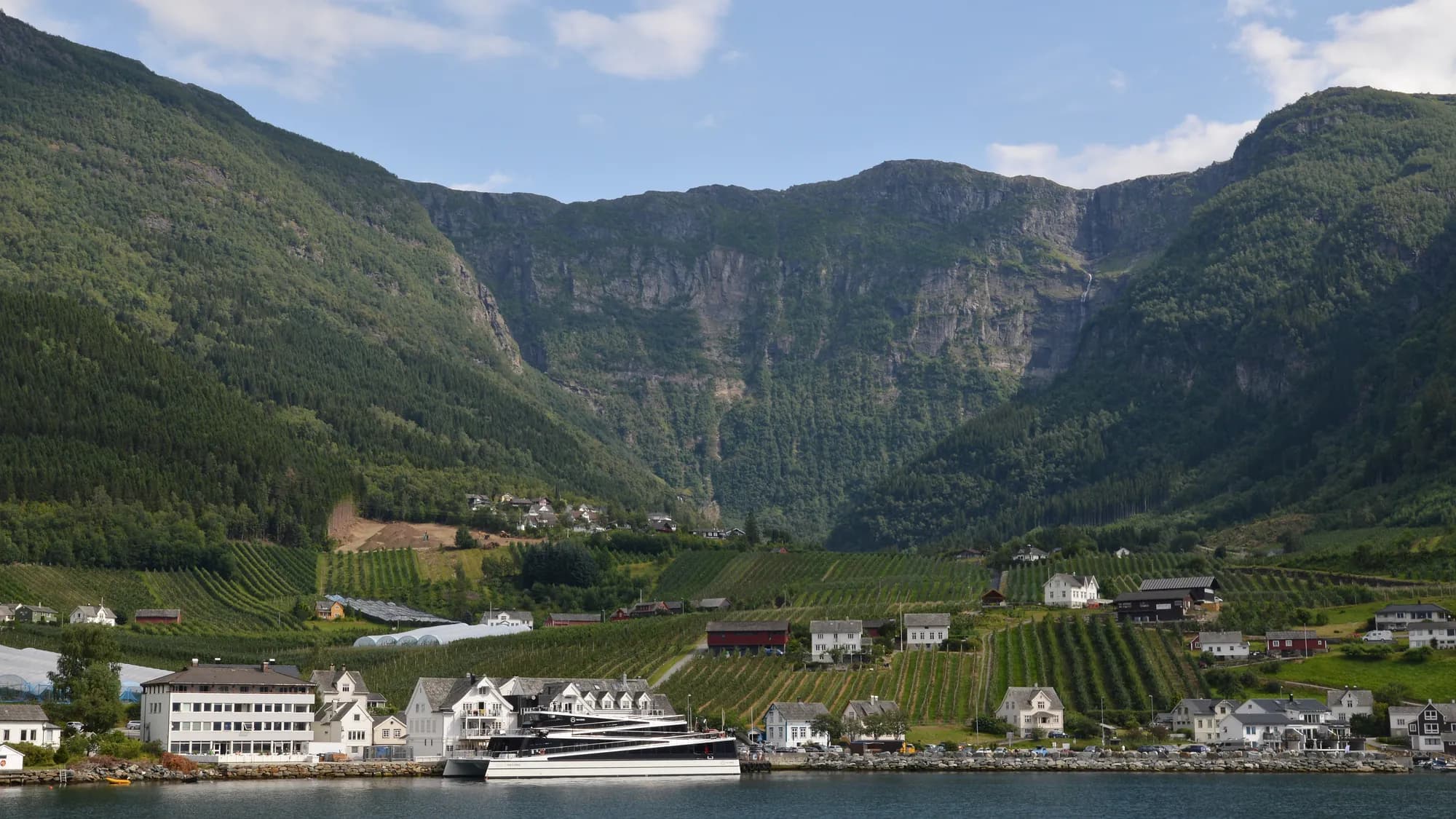
Waterfalls tumble over mountain edges, fruit trees grow right down to the water and Folgefonna shines white above Sørfjorden. Distances are short, giving you plenty of scenery per kilometre — and time to stop.
The route forms a ring: along the fjord from Norheimsund, over Hardangerbrua, up to Vøringsfossen, south along Sørfjorden to Odda and back on the western shore to Utne and the ferry. The roads accommodate a large motorhome, but here the bends and views determine the pace.
Stops along the route
1. Norheimsund and Steinsdalsfossen — the gateway to Hardanger
Around an hour and a half from Bergen. Supplies, fuel and Hardanger fartøyvernsenter, where old wooden boats are cared for in open workshops. Just west of the centre, Steinsdalsfossen falls over a rock shelf, and a path leads behind the water.
Don't miss: Seeing the valley through the waterfall. It is fullest in May and June.
Motorhome tip: Parking is free and accommodates motorhomes, but is intended for a short walk behind the falls. The toilet is not for waste disposal.
2. Øystese to Kvanndal — along Hardangerfjorden
Fv79 follows the fjord east, and the whole stretch is a Norwegian Scenic Route. At the Kabuso art centre in Øystese is Hardanger Skyspace, a light installation by James Turrell. Next come Steinstøberget rest area, overlooking Folgefonna, and Tyrvefjøra at Ålvik, with a toilet building of logs and concrete.
Motorhome tip: The road narrows towards Granvin. By Kvanndal ferry quay, where the loop ends, Kvanndal Camp is open all year.
3. Hardangerbrua and Eidfjord — across the fjord
From Granvin, Rv13 enters Vallaviktunnelen, where a roundabout inside the mountain sends you onto Hardangerbrua — 1,310 metres between the towers. At Bu on the southern side is a rest area with a footpath onto the bridge.
Don't miss: Norsk Natursenter Hardanger in Øvre Eidfjord, with a panoramic film and an exhibition about Hardangervidda.
Motorhome tip: The bridge charges tolls both ways. A motorhome over 3,500 kg pays the car rate only with an AutoPASS tag and agreement (most motorhomes are registered as M1). Without a tag it costs about three times as much. Ask the owner.
4. Måbødalen and Vøringsfossen — from fjord to plateau
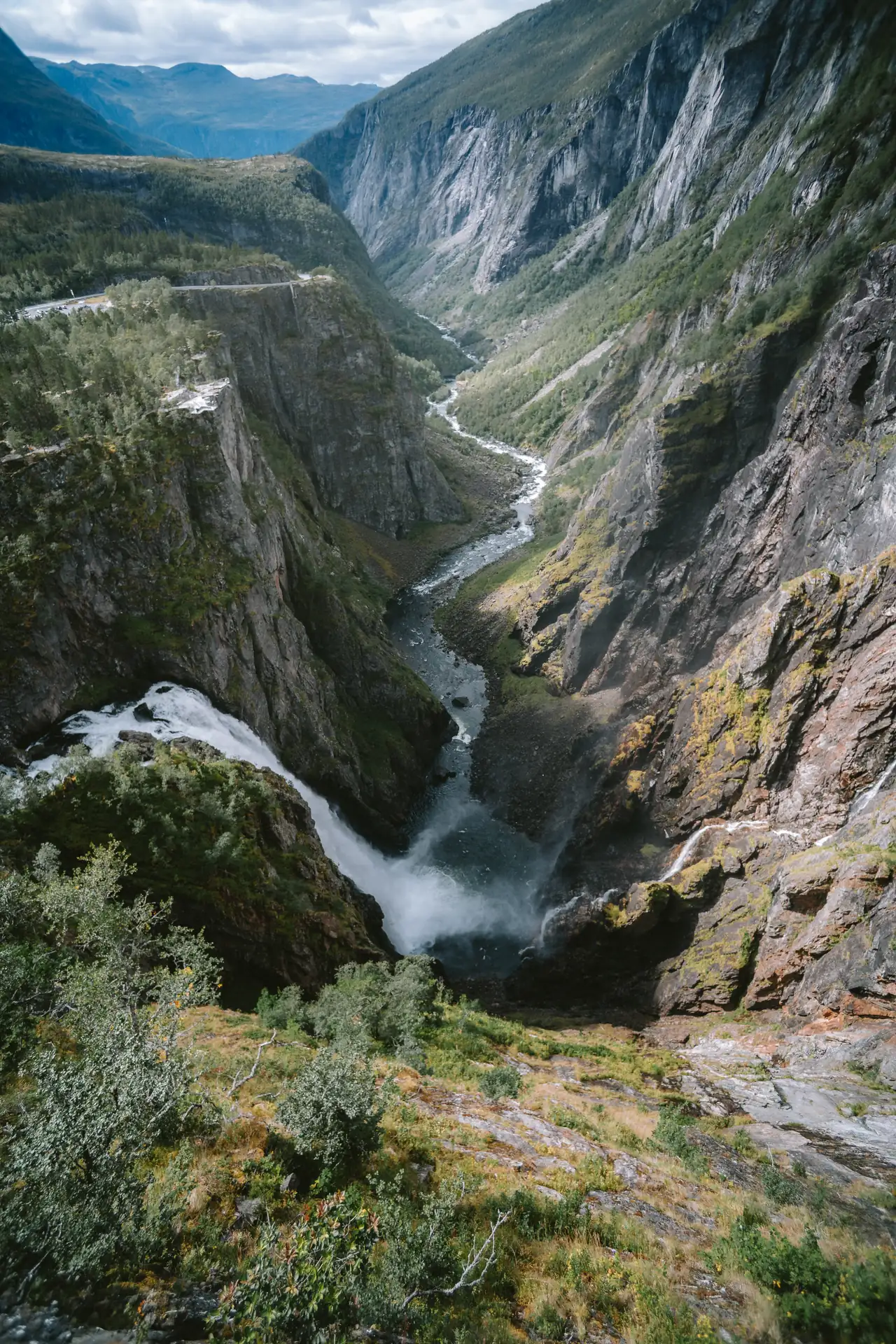
Rv7 climbs narrow Måbødalen, much of it in tunnels curving inside the mountainside. At the top, the Bjoreio plunges 182 metres into the valley. Park below at Fossatromma or above at Fossli Hotel and walk between them — over the stepped bridge, with the waterfall beneath you.
Don't miss: The viewpoints below Fossli Hotel. In July, morning and evening are quietest.
Motorhome tip: Park above at Fossli, with eight spaces for large vehicles; Fossatromma is designed for cars. Plan to spend the night elsewhere, and the toilet is not for waste disposal. Normally open April–October, snow permitting.
5. Hardangervidda — a side trip into the mountains
Above the waterfall the land levels out, and Rv7 continues towards Haugastøl to over 1,200 metres above sea level. Low mountains, shining lakes and no fruit trees.
Don't miss: Vardestopp and Ørteren rest areas, around forty kilometres from the waterfall, with benches and a path down to Ørteren lake. Both are small, with 6–7 parking spaces.
Motorhome tip: Garen Camping beside Rv7, three kilometres from the waterfall, is open all year. In winter the road may close or operate convoy driving.
6. Kinsarvik — the waterfalls of Husedalen
Kinsarvik's stone church has stood since the mid-12th century. A signposted road leads from the centre to Husedalen, where you can walk from waterfall to waterfall — four in total — all the way to the plateau's edge.
Don't miss: Tveitafossen, a short walk from the car park. Reaching the highest falls and returning takes 5–6 hours.
Motorhome tip: With a large motorhome, park in Kinsarvik and walk into the valley, adding around two kilometres each way. Kinsarvik Camping has bookable motorhome pitches and a dump station.
7. Lofthus and Espenes — Sørfjorden's orchards
Rv13 heads south through apple and sweet-cherry trees, with Folgefonna across the fjord. Lofthus has cider producers, Munketreppene and Dronningstien. A little further south is Espenes rest area beneath a long steel roof.
Don't miss: The May blossom — cherries first, apples a couple of weeks later. Ask the tourist office about this year's timing.
Motorhome tip: The road is narrow and winding, with oncoming tour buses. Central Lofthus permits short-term parking only.
8. Odda and Låtefossen — industry and twin waterfalls
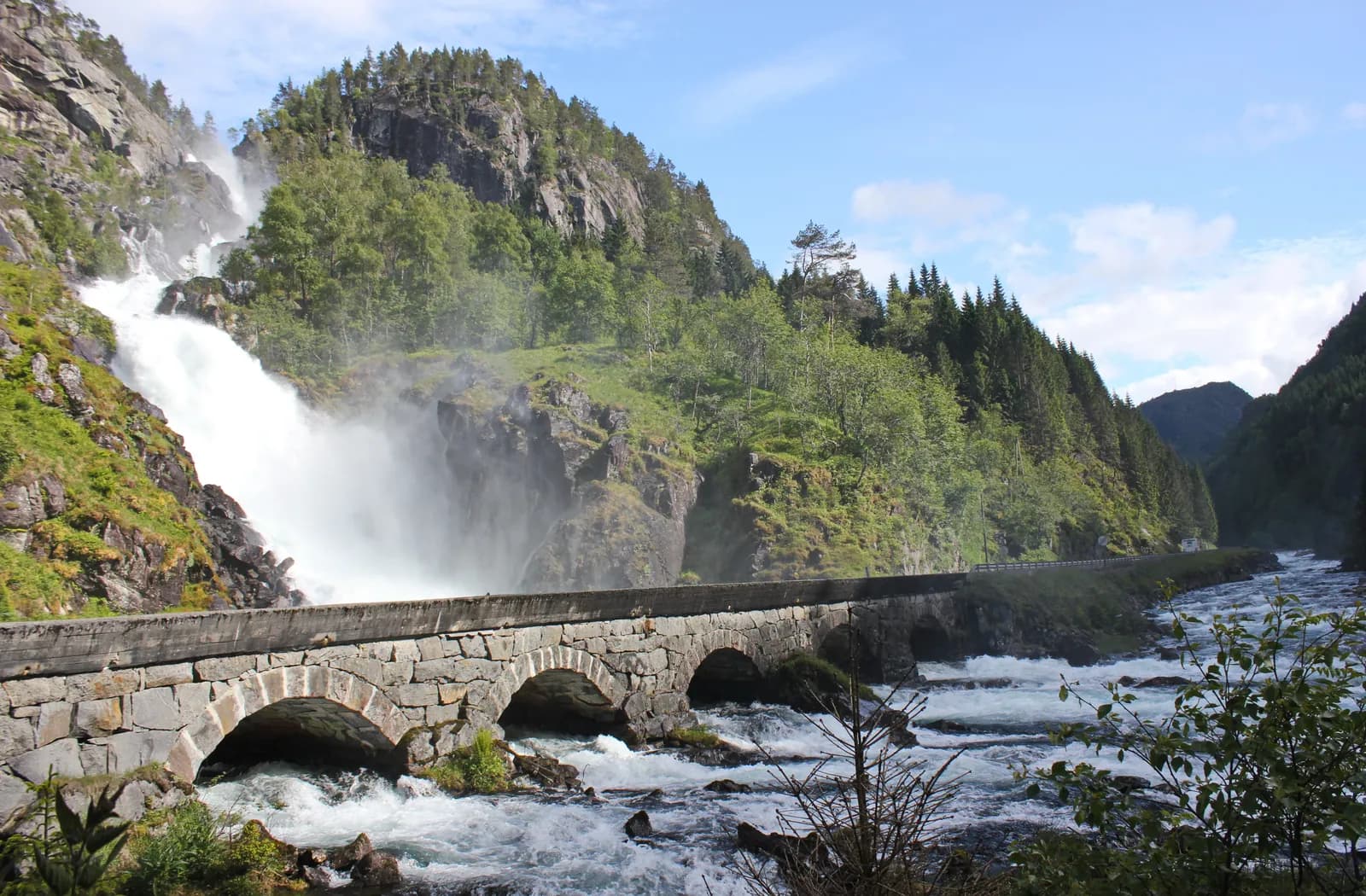
Odda grew around smelting and hydropower — Kraftmuseet in Tyssedal tells the story. A quarter of an hour south on Rv13 brings you to Låtefossen: two waterfalls side by side, 165 metres from the top to the road — so close you see the whole waterfall from the driver's seat.
Don't miss: Trolltunga, if you have a full day and strong legs. Park at P1 in Tyssedal and take the shuttle bus.
Motorhome tip: Låtefossen's car park is small. Never stop on the road or in passing places.
9. Agatunet and Utne — back along the western shore
Fv550 runs north on Sørfjorden's western side and is wider than Rv13. In Agatunet at Aga the houses stand tightly together, some medieval, and the whole farm cluster is protected. At the tip of the headland lies Utne, with Hardanger folkemuseum and Utne Hotel, welcoming guests since 1722.
Motorhome tip: Take Utne–Kvanndal back. Fv550 continuing towards Jondal past Hereiane rest area is single-track with passing places in sections and has two tunnels signed at 3.8 metres. Best for small motorhomes.
Practical info for motorhomes
Roads: No road on the loop has a length limit below 19.5 metres. Rv13 along Sørfjorden and Fv79 towards Granvin are narrow and winding. The lowest signed tunnel height is 4.0 metres at Eitrheim north of Odda — the same as on the road over Kvamskogen from Bergen.
Parking: Rest areas and waterfall car parks are for short stops. Space is tightest at Låtefossen and in Lofthus.
Overnight stays: Use campsites. The right to roam permits tents on uncultivated land at least 150 metres from inhabited houses, for up to two nights without the landowner's consent. Motorhomes must stand in legal parking spaces — never off-road in the terrain.
Campsites:
- Hardanger Feriesenter — beside the fjord just east of Norheimsund
- Kvanndal Camp — by the ferry quay, open all year
- Kjærtveit Camping — central Eidfjord, April–October
- Sæbø Camping — beside Eidfjordvatnet in Øvre Eidfjord
- Garen Camping — beside Rv7 on the plateau, open all year
- Kinsarvik Camping — motorhome pitches and dump station
- Lofthus Camping — drop-in only, closes 30 September
- Lothepus Camping, Odda — most pitches up to 8.5 metres, a few up to 15 metres
Fuel: Norheimsund, Øystese, Granvin, Eidfjord, Kinsarvik, Lofthus and Odda. Fill up in Eidfjord before the plateau.
Waste disposal: Not in toilets along the Norwegian Scenic Route. Dump stations are in Kvam (Øystese), Øvre Eidfjord, Kinsarvik and Odda, and at several campsites.
Toll roads: Hardangerbrua and toll points in Kvam. Rates depend on weight and tag — see ferde.no and autopass.no.
Ferries: Utne–Kvanndal (about 20 min, roughly hourly in daytime), Kinsarvik–Utne (about 30 min, free) and Jondal–Tørvikbygd (about 20 min). Timetables at skyss.no. Arrive early in July. Fares depend on motorhome length — the bicycle rack counts.
Combine with
- Ryfylke and Lysefjorden — from Odda it is around forty kilometres south to Røldal, where that route ends. Follow it backwards towards Stavanger.
- Sognefjellet and Jotunheimen — north from Granvin via Voss and Sognefjorden to Lustrafjorden, where that route ends.
- Ulvik — a short detour from Vallaviktunnelen, with fruit farms and cider beside the fjord.
- Across Hardangervidda — Rv 7 from Eidfjord up Måbødalen and across the plateau to Geilo.
- Rosendal and Kvinnherad — from Norheimsund it is 13 km to the Tørvikbygd ferry, used by that loop on its return from Jondal.
Weather
Two climates on one trip. Beside the fjord summer is mild — hence the thriving fruit. On the plateau weather changes quickly even in July, and at Vøringsfossen, around 700 metres above sea level, snow can linger well into spring. Check yr.no for Eidfjord and Odda, and vegvesen.no before the plateau.
This route is part of Bobilvei's hand-picked motorhome routes in Norway. Every route is quality-checked with a focus on motorhome suitability, parking and local experiences.