- Route
- Kristiansund – Krifast (Freifjordtunnelen and Bergsøysundbrua) – Tingvoll – Ålvundeid and Innerdalen – Sunndalsøra – Leikvin – Gjøra and Åmotan – Oppdal (Rv 70, for a stretch together with the E39)
- Length
- about 170 km from Kristiansund to Oppdal. The side trips come on top: around 23 km there and back to the car park for Innerdalen, and around 12 km there and back to Åmotan.
- Driving time
- Around 3 hours without stops
- Recommended number of days
- 2–3
- Best season
- June–September. The museums open for the summer, and the lodges in Innerdalen are staffed from the middle of June.
- Difficulty
- Easy. A good main road all the way and no ferries. One undersea tunnel with steep gradients, and avalanche shelters in Sunndalen with a signed height of 4.2 metres. The road in to Åmotan is narrow and steep and has a bridge signed at 3.7 metres.
- Last checked
- October 2026
Why this route?
The Rv 70 starts at Piren in Kristiansund and ends where it meets the E6 in Oppdal. In just over 170 kilometres you go from the sea to the mountains: first the clipfish town on its islands facing the open ocean, then a tunnel and a floating bridge to the mainland, then the long fjords of Nordmøre, and finally Sunndalen, narrow and steep, with mountains of up to 2,000 metres on both sides.
It is a route for people who like to stop. The town has two museums by the harbour and a boat service that has run since 1876. Tingvoll has a stone church from around the year 1200 with passages inside its walls. And from Ålvundeid it is a short detour to Innerdalen, Norway's first protected landscape, where you park and walk the last hour. Atlanterhavsvegen ends half an hour west of Kristiansund, so the two routes fit together well.
Stops along the route
1. Kristiansund — the town on four islands
Kristiansund sits on islands where the great fjords of Nordmøre meet the sea. It became a trading post in 1631 and a market town in 1742, and over time clipfish became its main trade: salted cod, dried on the bare rocks. From around 1850 no Norwegian town shipped out more clipfish than Kristiansund. In April 1940 almost the whole centre was bombed to pieces. The town was rebuilt in functionalist style, and the post-war town you walk through today is counted among the best-preserved environments of its kind in the country.
Don't miss: Sundbåten, the harbour boat. It has carried people between the four «lands» — Kirkelandet, Innlandet, Nordlandet and Gomalandet — since 1876, and the company calls itself the world's oldest public transport company in continuous operation. The boat runs on weekdays, it is free to ride, and a full round takes about 20 minutes.
Motorhome tip: Atlanten Turistsenter in Dalaveien, a kilometre and a half from the centre, takes motorhomes round the clock without booking. It has 60 pitches with electricity and its own waste disposal point. Leave the motorhome there and walk into town. Byskogen Camping is a little further out and open all year. As you drive out of town on the Rv 70, you pass two toll points, on Nordsundbrua and Omsundet bru (see Practical info).
2. Milnbrygga and Mellemværftet — clipfish and wooden ships
Two branches of Nordmørsmusea lie by the harbour. The Norwegian Clipfish Museum (Norsk klippfiskmuseum) is housed in Milnbrygga, a warehouse with an outside gallery from the middle of the 18th century. It was put up by William Gordon, one of the pioneers of the clipfish trade, but it is named after a later owner, Walter Miln. Around the wharf lies the bare rock where the fish was laid out to dry, one of the largest in the country. Inside, the interior is untouched, and it still smells of salt. In 2026 the museum was open for the summer from 20 June to 31 August, Tuesday–Sunday. The rest of the year you can arrange a guided tour.
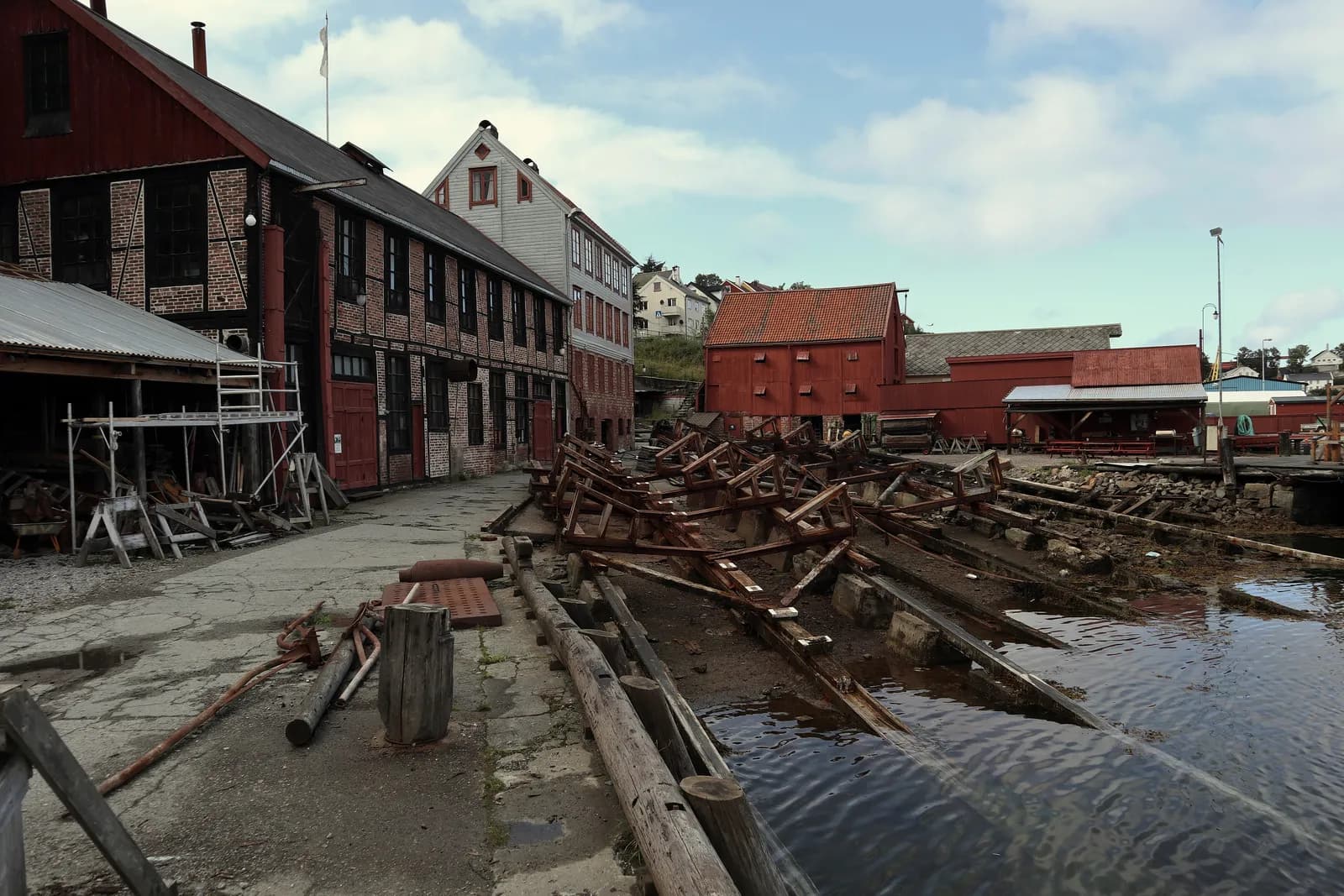
A little way off lies Mellemværftet. The yard dates from the 1800s, and it is still working: craftsmen and volunteers from the vessel-preservation society keep the smithy, the workshop and the slipways busy, and the slipways take vessels of up to 90 feet. In the old days the job was keeping Nordmøre's many small sailing ships seaworthy. Today the yard is protected and run as the only museum shipyard in the country.
Don't miss: A walk round the slipways at Mellemværftet. You can move freely around the yard all year, except when a boat is being hauled up or launched.
Motorhome tip: In summer Sundbåten also runs straight to the Clipfish Museum on weekdays, so you need not hunt for parking for the motorhome by the harbour.
3. Krifast — under the fjord and over the floating bridge
Until 1992 Kristiansund depended on ferries. Then Krifast opened, around 25 kilometres of tunnel and bridges linking the town to the mainland. The Rv 70 first runs through Freifjordtunnelen: just over five kilometres under the Freifjord, down to 130 metres below the sea. Out of the tunnel you are on Bergsøya, and here the Rv 70 runs together with the E39. Soon after, you cross Bergsøysundbrua, a 931-metre floating bridge of steel, and then Straumsundbrua towards Tingvoll.
Don't miss: The feeling of driving on a bridge that floats on the sea. Bergsøysundbrua was built the same year as the tunnel.
Motorhome tip: The tunnel has an official gradient of 8.8 per cent. Use a low gear on the way down so the brakes do not overheat, and expect a long climb back up. There are no tolls on Krifast.
4. Tingvoll — the «cathedral» of Nordmøre
At Øydegard the Rv 70 leaves the E39 and carries on to Tingvoll, at the head of Tingvollvågen. The name says what the place was: this is where the assembly (ting) for Nordmøre was held. The church was begun some time after 1150, and by around 1200 it was finished. It was the main church for the whole of medieval Nordmøre, and it is unusually large. The corners and window frames are white marble. Inside the walls narrow passages run round the church, something not preserved in any other church in Norway. Behind the altar sits a runic inscription in which the builder tells us his name was Gunnar.
Don't miss: The chancel arch, eleven metres high and pointed. It gives the church a height you do not expect from outside.
Motorhome tip: The church stands by the old rectory, about a kilometre west of the centre. If you want to go inside, check the opening with the church office first. Tingvoll Camping has motorhome pitches and is close enough to the centre to walk. It has been family-run since 1961. There is a filling station in Tingvoll and an unmanned one at Meisingset, around eleven kilometres further on.
5. Ålvundeid and Innerdalen — the last stretch on foot
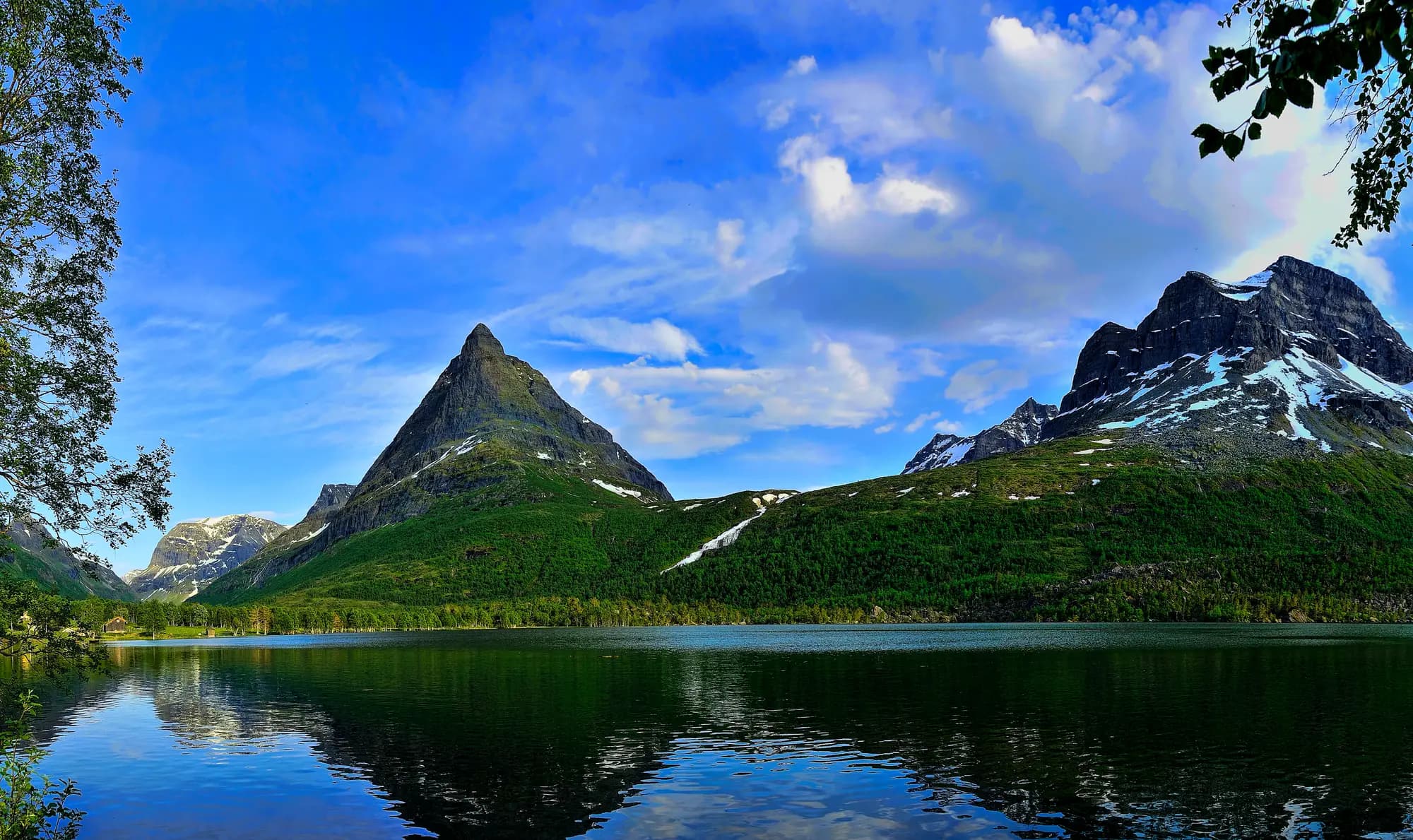
From Tingvoll the Rv 70 follows the fjords inland by way of Meisingset. At Ålvundeid, about 37 kilometres from Tingvoll and twelve kilometres before Sunndalsøra, Innerdalen is signposted. No valley in Norway was protected as a landscape before this one, and it has a name as one of the most beautiful mountain valleys in the country. Above the summer farms Innerdalstårnet rises like a sharp cone, 1,452 metres high, and Skarfjellet, the valley's other well-known peak, reaches more than 300 metres higher.
You drive 10–12 kilometres on a small paved road through Viromdalen to the car park at Nerdalen. From there you walk a 3.5-kilometre gravel road, steep in places, in to the summer farms. Allow about an hour each way. Inside the valley there are two places to stay: the private Renndølsetra and the trekking association's lodge Innerdalshytta. In 2026 Innerdalshytta was staffed from 19 June to the middle of September and self-service otherwise. Check the opening on ut.no before you set off.
Don't miss: Innerdalsvatnet with Innerdalstårnet reflected in it on a still evening.
Motorhome tip: The road in to Nerdalen is a municipal road open to vehicles of 19.5 metres in the road authority's database, but it is small, so use the passing places. The car park is large but can fill up on fine summer days: the municipality itself writes that it is busy at times. Follow the signs for payment. We found no rules that allow staying overnight here (October 2026), so plan to sleep at Sunndalsøra.
6. Sunndalsøra — where the Driva meets the fjord
On towards Sunndalsøra the Rv 70 runs through Oppdølsstrandtunnelen, 7.6 kilometres long and almost flat. Sunndalsøra lies at the head of Sunndalsfjorden, where the salmon river Driva flows out. The town is built round Hydro's aluminium plant, and the plant makes the harbour the second-largest export port in the county.
From Sunndalsøra the Aursjøvegen climbs up Litldalen, over the mountain past Aursjøen and down Eikesdalen. It is spectacular, but not for larger motorhomes, and Fjord Norway advises against it with a caravan as well. Several stretches are narrow gravel through very steep terrain, in places without crash barriers, and on the slope down towards Eikesdalen there is a spiral tunnel with no lighting at all. It is a toll road paid through passpay.no, and it is usually open from around 1 June until the first snow in October.
Don't miss: An evening walk along the Driva, through the centre and down towards the fjord.
Motorhome tip: The motorhome parking at Industrivegen 48, by the grounds of Sunndal JFF and within walking distance of the centre, has room for eight motorhomes, with electricity and a toilet. There is a charge, and it cannot be booked. Next to it, at Håsøran by Driva bru, is the public waste disposal point, which anyone can use. Sunndal småbåtlag (the small-boat club) also has motorhome pitches at the small-boat harbour. Sunndalsøra has several filling stations — fill up here.
7. Leikvin — the salmon lords of Sunndalen
For a hundred years, from around 1850, British salmon lords came to Nordmøre to fish. Bygdemuseet Leikvin at Grøa, about eight kilometres up the valley, tells their story, and above all the story of Barbara Arbuthnott, who is still talked about in the valley. The museum is an open-air museum with old houses and exhibitions on the history of Sunndal. In 2026 it was open for the summer from 19 June to 15 August, four days a week, and otherwise on request.
Don't miss: The heritage park round the museum, which is open and free all year. The garden left by Etelbert Lort-Phillips is laid out on British lines, and from it a path leads down to Løykja. The grave field there is among the largest from the Iron Age in this country.
8. Gjøra and Åmotan — where the rivers meet
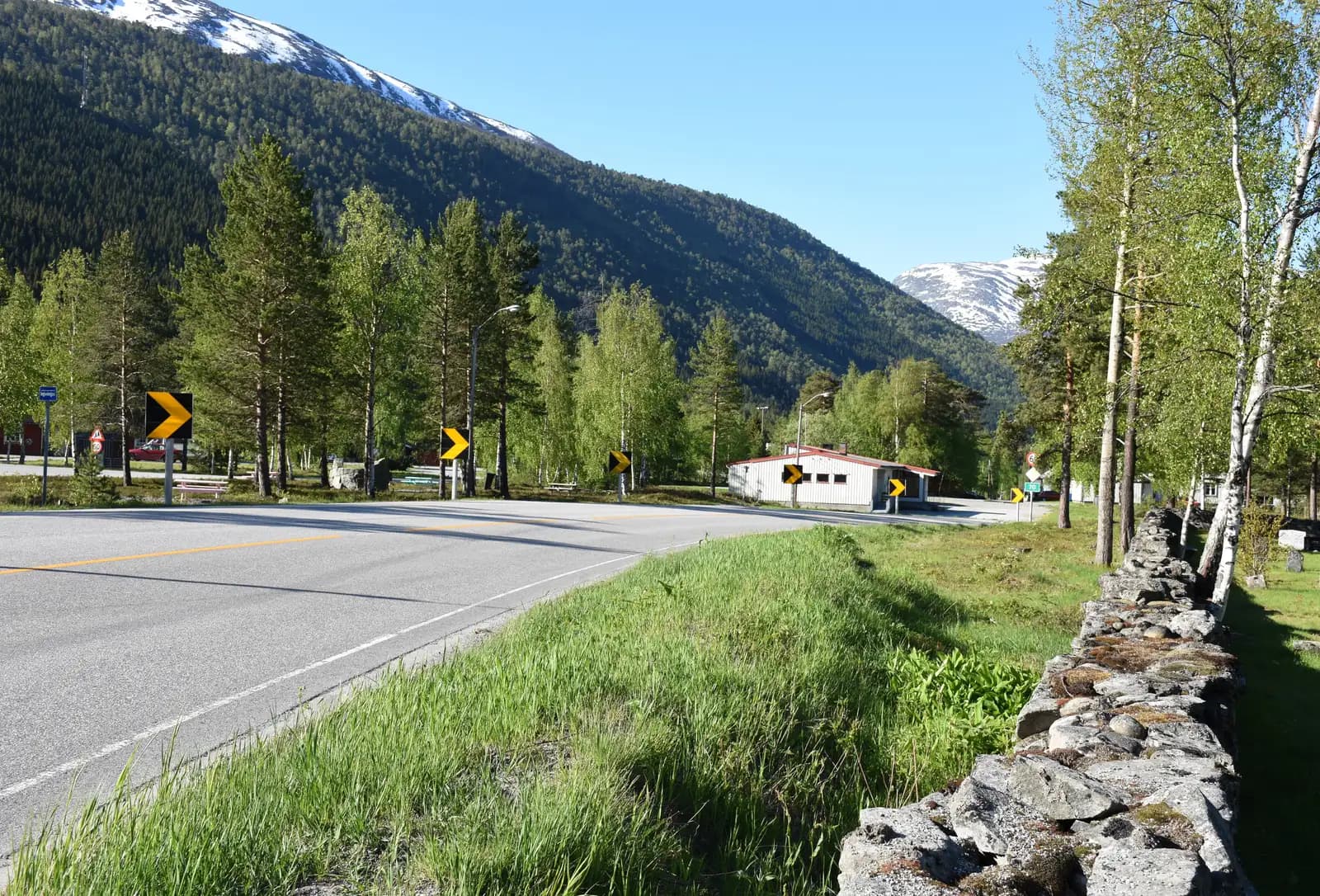
Further up Sunndalen the valley narrows. The road runs under several avalanche shelters, and on each side the mountains rise towards 1,500–2,000 metres. At Gjøra, about 27 kilometres from Leikvin, you turn off for Åmotan, a gorge where rivers from six valleys meet, at the entrance to Dovrefjell-Sunndalsfjella National Park. Three of them plunge into the gorge. Svøufallet has a free fall of 156 metres, Lindalsfallet of 110. In the spring flood it is a tremendous sight.
Don't miss: The view from the car park at Svisdalen, right above Svøufallet. You see Lindalsfallet from Ørnsnydda on the Jenstad side, a fair walk from the car park. Maps of the paths are at the car park and at Sunndalsporten.
Motorhome tip: The Fv 6142 in to Åmotan is in practice a single lane with passing places and is approved only for vehicles up to 12.4 metres. Just after the turn-off from the Rv 70 it crosses the Driva on Nisjabrua, a steel bridge with bracing over the carriageway, signed at 3.7 metres. Check your motorhome's height before you turn off. Both car parks lie high on the slope, 5–7 kilometres in: the side road up to Jenstad climbs about 200 metres in two kilometres, and the Fv 6142 up towards Svisdalen is just as steep. If your motorhome is large or you are unsure, leave it at Gjøra Camping and walk or cycle in. Gjøra Camping is about a kilometre in, just after the bridge, and takes motorhomes. At Sunndalsporten in Gjøra there is a shop and a YX filling station.
9. Oppdal — where the Rv 70 meets the E6
Over the last 35 kilometres the valley opens out towards Oppdal, with Trollheimen to the north and Dovrefjell to the south. In the centre the Rv 70 meets the E6. Just south of the church from 1651 lies Vang, with around 750 burial mounds gathered in one place. In the open-air museum in the middle of the village stand old farm buildings, and one of the exhibitions is about skiing.
Motorhome tip: Trollheimsporten Turistsenter lies by the Rv 70 at Festa, 13 kilometres before Oppdal centre. It is open all year and has more than 200 pitches with electricity for caravans and motorhomes, 150 of them seasonal pitches. There is disposal for chemical toilets. Oppdal has several filling stations.
Practical info for motorhomes
Roads: The Rv 70 is open to vehicles of 19.5 metres and heavy vehicles (Bk10/50 tonnes) all the way from Kristiansund to Oppdal (the road authority's database), and the same goes for the E39 over Krifast. The asphalt is mostly 6.5–9 metres wide. The lowest signed height is 4.2 metres, in the avalanche shelters at Klinghammaren and Flatvadurin in Sunndalen. Gyltunnelen near Tingvoll is signed at 4.3 metres. Freifjordtunnelen is undersea with an 8.8 per cent gradient, and Oppdølsstrandtunnelen is 7.6 kilometres long. The route crosses no mountain passes, but through Sunndalen the road runs under avalanche shelters. Check the traffic reports on vegvesen.no before you drive, especially in winter. The side roads are narrower: Virumdalsvegen to Innerdalen is open to vehicles 19.5 metres long, but the Fv 6142 to Åmotan is in practice a single lane, approved only for 12.4 metres, has a bridge signed at 3.7 metres and steep climbs (around 10 per cent) up to both car parks. The Aursjøvegen is not recommended for larger motorhomes.
Tolls: Since 1 June 2026 Bypakke Kristiansund has had two AutoPASS toll points on the Rv 70 in town, on Nordsundbrua and Omsundet bru. Without an agreement a passage costs NOK 34 for vehicles up to 3,500 kg and NOK 68 for heavier ones (Vegamot, 2026). If you have an AutoPASS agreement and a tag, a motorhome over 3,500 kg registered in vehicle category M1 pays the rate for light vehicles. The package has an hour rule: if you pass several times within 60 minutes, you pay for only one passage. The rest of the Rv 70 and Krifast have no tolls. The Aursjøvegen is a toll road, partly on private land, paid through passpay.no.
Parking: In Kristiansund the easiest is to leave the motorhome at the campsite and walk or take Sundbåten in to the harbour. For Innerdalen you park at Nerdalen and walk the rest. At Sunndalsøra there is dedicated motorhome parking in Industrivegen. Never park in passing places, and especially not on the narrow roads to Innerdalen and Åmotan.
Overnight stays: The right to roam gives you the right to pitch a tent, not to leave a motorhome anywhere you like. If you stay outside the campsites, use public places where no sign forbids it, and never private land without permission. We found no rules that allow overnight stays at the Nerdalen car park. There are campsites or motorhome pitches in all the larger places along the route.
Campsites:
- Atlanten Turistsenter, Kristiansund — drop-in round the clock, 60 pitches with electricity, waste disposal point
- Byskogen Camping, Kristiansund — open all year, pitches for motorhomes and caravans
- Tingvoll Camping, Tingvoll — motorhome pitches, walking distance to the centre
- The motorhome parking in Industrivegen, Sunndalsøra — eight pitches, electricity, waste disposal point next door
- The motorhome pitches at the small-boat harbour, Sunndalsøra — run by Sunndal småbåtlag
- Gjøra Camping, Gjøra — motorhomes, caravans, tents and cabins, a kilometre in on the Fv 6142, past Nisjabrua (3.7 metres)
- Trollheimsporten Turistsenter, Festa in Oppdal — open all year, by the Rv 70
Fuel: Kristiansund and Sunndalsøra have several stations. Tingvoll has one, and there is an unmanned station at Meisingset and a truck station at Øydegard. Between Sunndalsøra and Oppdal there is only YX at Sunndalsporten in Gjøra and Driv just before Oppdal, so fill up at Sunndalsøra. Oppdal has several stations.
Waste disposal: Atlanten Turistsenter in Kristiansund has a waste disposal point. At Sunndalsøra there is a public waste disposal point at Håsøran by Driva bru, next to the motorhome parking. Trollheimsporten has disposal for chemical toilets.
Ferries: No ferries. Krifast replaced the ferry to Kristiansund in 1992.
Combine with
- Atlanterhavsvegen — that route ends at Kårvåg on Averøy, about 30 km from Kristiansund through the undersea Atlanterhavstunnelen, which has gradients of up to 10 per cent. Drive it in reverse from Kårvåg towards Bud before or after this one.
- Trondheim – Røros — from Oppdal the E6 runs north to Støren, about 67 km, where that route leaves the E6 and follows Gauldalen towards Røros.
- Dovrefjell and Romsdalen — from Oppdal the E6 runs south over Dovrefjell to Hjerkinn, about 48 km, and on to Dombås.
- Hitra and Frøya — from Kristiansund it is about 190 km along the coast through Aure and Hemne to Sandstad on Hitra, with the Tømmervåg–Seivika ferry.
Weather
At Sunndalsøra July is the warmest month, with a normal of around 15 degrees, and February the coldest at around 1 degree. May is the driest month and December the wettest, and it rains steadily right through the autumn. Check yr.no for Kristiansund, Sunndalsøra and Oppdal.
This route is part of Bobilvei's hand-picked motorhome routes in Norway. Every route is quality-checked with a focus on motorhome suitability, parking and local experiences.