- Route
- Fredrikstad – Hvaler (Skjærhalden) – back to Fredrikstad – Oldtidsveien – Halden (Fv 108, Fv 130 and E6)
- Length
- about 105 km. Oslo to Fredrikstad is about 100 km, mostly on the E6, and Halden to Oslo about 120 km.
- Driving time
- Around 2–2.5 hours without stops, plus an hour and a half to two hours each way to and from Oslo
- Recommended number of days
- 2–3
- Best season
- May–September. Hvaler is crowded during the main summer holiday period. Most rock carvings are covered November–March.
- Difficulty
- Easy. Wide roads, no mountain passes and no car ferries on the route. Watch the steep subsea tunnel, toll points and July parking on Hvaler.
- Last checked
- October 2026
Why this route?
An hour and a half from Oslo lie a moated fortress town, an island realm with smooth rocks and sandy beaches, and plains full of rock carvings. Stages are short, roads wide and there are no ferry queues.
Collecting the motorhome in Oslo, take the E6 south to Fredrikstad. The route goes out to Hvaler and back, along Oldtidsveien and down to Fredriksten in Halden — then straight home on the E6. One thing to know: Hvaler has Norway's densest concentration of holiday cabins. In July parking, rather than the road, is the challenge.
Stops along the route
1. Gamlebyen in Fredrikstad — the fortress town
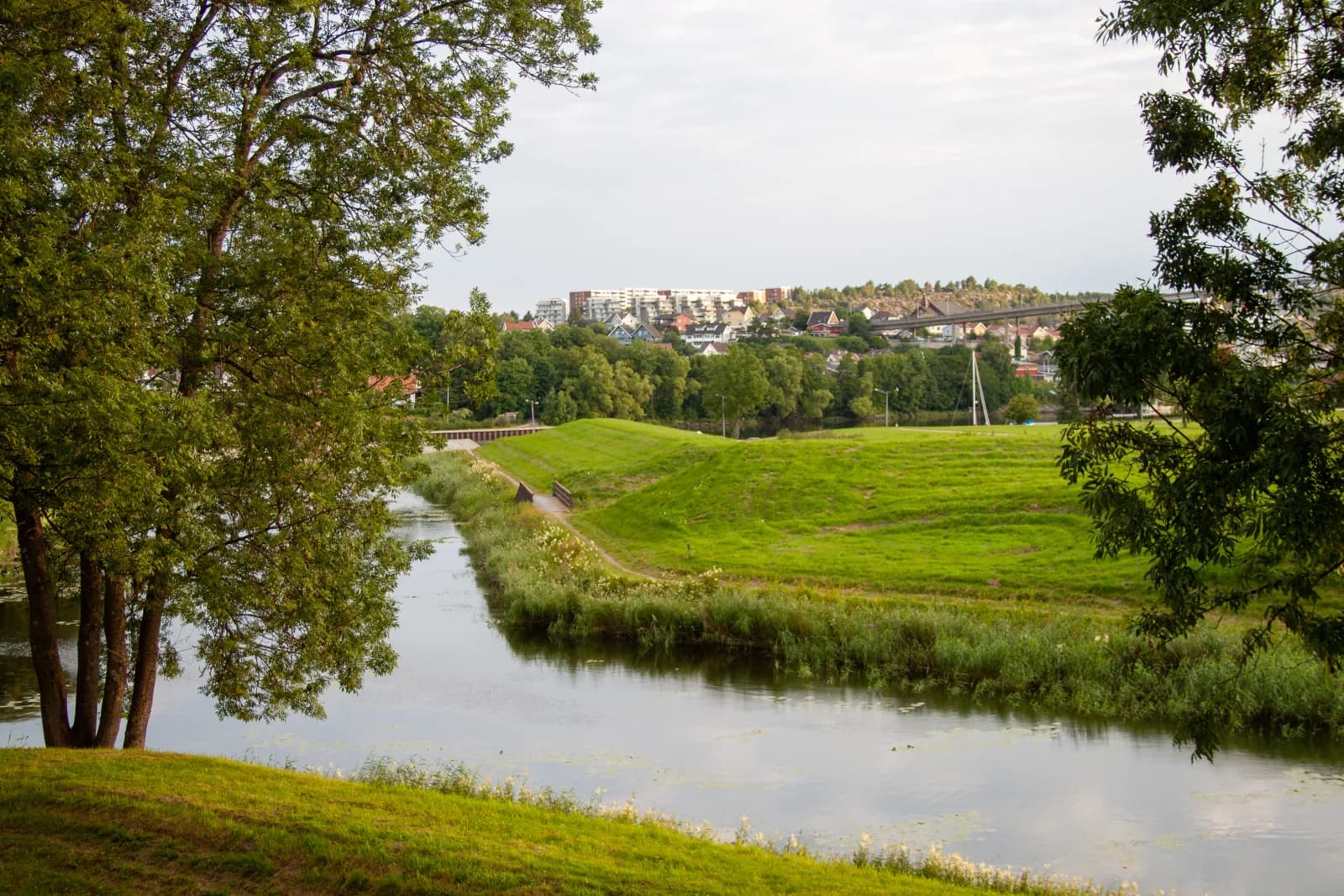
The town was founded in 1567, and the fortifications followed in the 1660s. Inside the ramparts lie cobbled streets, workshops and cafés, still home to just under 300 people. A star-shaped moat surrounds it all, still full of water. No other Norwegian fortress has such a preserved moat.
Don't miss: Gamlebyferga, taking you directly across the river to Cicignon in a minute or two, free. Also Kongsten fort from 1685, just southeast of the ramparts.
Motorhome tip: Do not drive into Gamlebyen — spaces are few, and the municipality recommends Kongsten parking. There is also Aktivitetsbyen Gamle Fredrikstad, ten minutes' walk from the square, with 65 year-round motorhome and caravan pitches. The barrier is locked from 23:00 to 06:00.
2. Byferga and Isegran — Fredrikstad from the river
The free Byferga runs from Gamlebyen via Smertu and the centre to Værste, Gressvik and Ålekilen, carrying bicycles too. From Smertu, Isegran is ten minutes on foot, where the river divides. The navy anchored off this small island until 1680, and Tordenskiold stayed here while fighting the Swedes.
Don't miss: The museum harbour and fortification remains on Isegran.
Motorhome tip: For a riverside stay, Borg Havn has 30 motorhome pitches at Odden by Værste on Kråkerøy — listed for vehicles up to 10 metres long and 2.5 metres wide. The city ferry is just over a kilometre's walk away.
3. The bridges to Hvaler — sound after sound
Fv 108 hops between islands over Kjøkøysund, Puttesund and Asmalsund. Bridges arrived between 1964 and 1971, finally giving islands west of Løperen a fixed road to town. Hvaler has over 550 islands and islets, most low and almost treeless.
Motorhome tip: Hvaler has no motorhome dump station — empty at your Fredrikstad overnight stop before driving out. Hvaler Camping beside Fv 108 on Spjærøy offers overnight motorhome pitches April–September. Værstebrua and old Kråkerøybrua are bascule bridges opening for boats at set times — expect a few minutes' wait.
4. Hvalertunnelen and Hvaler church — under Løperen to Kirkøy
From Asmaløy the road descends beneath Løperen, the main shipping channel into Fredrikstad. The tunnel is almost four kilometres long, reaches 120 metres below sea level and has a ten per cent gradient. On Kirkøy stands Hvaler church, a medieval stone church probably built before 1100. The church gave the island its name.
Motorhome tip: Select a lower gear before entering and let the engine brake. Clearance is at least 4.5 metres. Hvaler golfklubb offers motorhome pitches with electricity beside its Kirkøy course; clubhouse toilets are open around the clock.
5. Skjærhalden — the island realm's centre
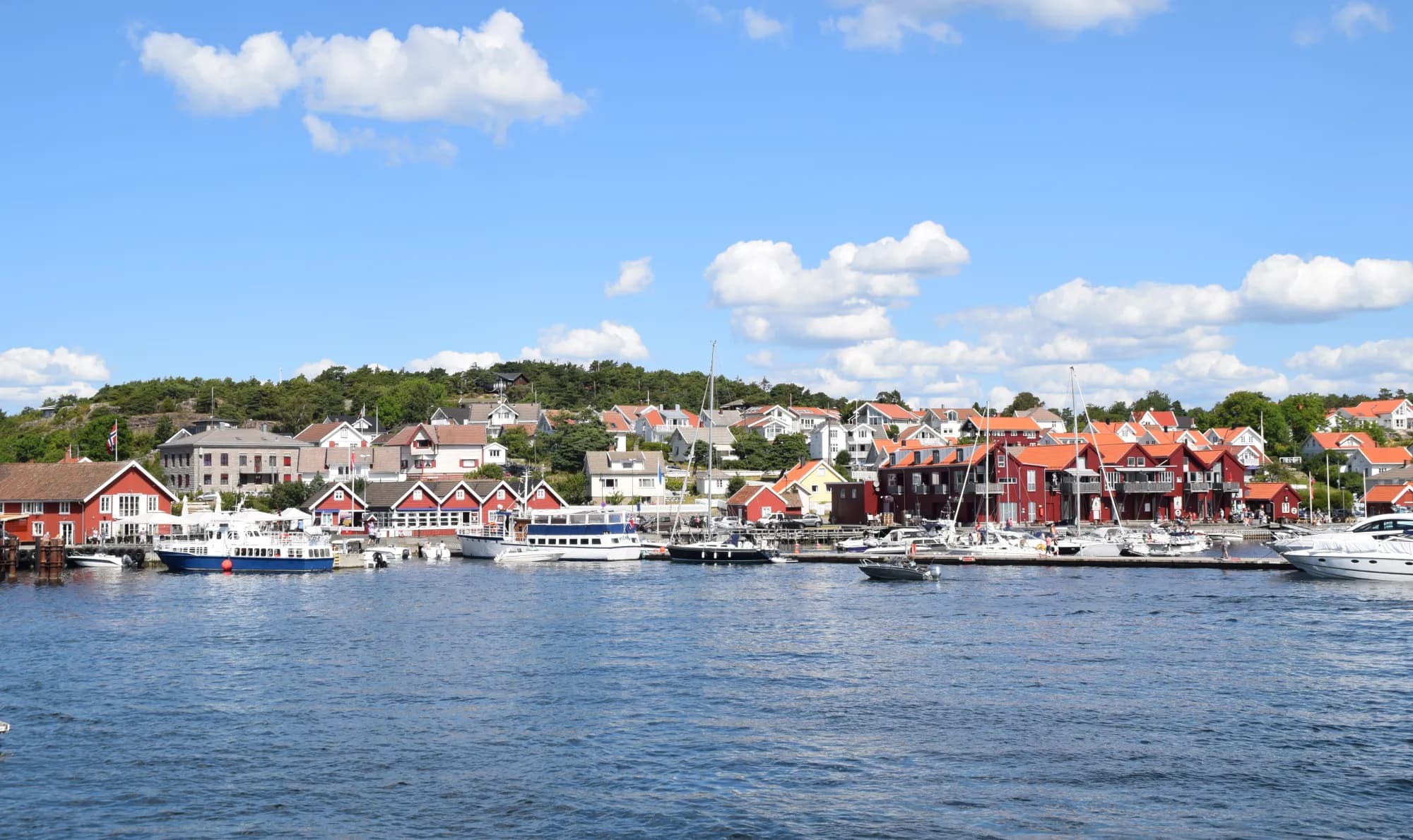
The municipal centre lies in southeastern Kirkøy, with a guest harbour, shops and small town beach, Kroksand. Kornmagasinet by the square houses the national park visitor centre, free and open on weekdays.
Don't miss: Hvalerferga to Søndre and Nordre Sandøy, Herføl and Lauer, free for passengers. Leave the motorhome: there are few roads and almost no parking out there.
Motorhome tip: Park at the town hall before descending to the harbour; boards on the main road display free-space numbers. In season charges apply from the first hour there. At the church and Storesand the first three hours are free, but you must still register your number plate.
6. Storesand and Ytre Hvaler national park
Just over a kilometre west of Skjærhalden lies Storesand. The sandy beach is half a kilometre long and shallow enough to wade far out; its southwestern aspect gives sun well into the afternoon. The coastal path follows smooth rocks past remains of houses probably from the Iron Age. Around you lies Ytre Hvaler, Norway's first marine national park, established in 2009. Almost all of it is sea.
Motorhome tip: Use the recreation car park a few hundred metres above the beach. The tent site is closed to cars, and overnight stays in the recreation area are allowed only on marked tent pitches. Leaving a motorhome in the national park itself is prohibited.
7. Oldtidsveien — the Bronze Age along Fv 130
Return to Fredrikstad and follow Fv 130 east towards Skjeberg. First comes Begby, with rock carvings on both sides, including “Begbymannen” and “Danseren”. At Hunn, Fv 130 — itself called Oldtidsveien — crosses a much older road: a trace of riders perhaps two thousand years ago, worn so deeply into the ground that it resembles a ditch. At Solberg walk straight from the roadside to the carvings; look for the wagons. Most carvings are covered November–March against frost damage.
Don't miss: Hunn, where burial monuments cover the forest floor. The stone circles stay in your memory.
Motorhome tip: Begby and Hunn car parks are small — arrive early. For Solberg, park at Solbergtårnet, the E6 rest area at Solbergkrysset, and walk a quarter of an hour. It has bus parking, drinking water and toilets; the 30-metre tower overlooks the whole plain.
8. Fredriksten fortress — Halden
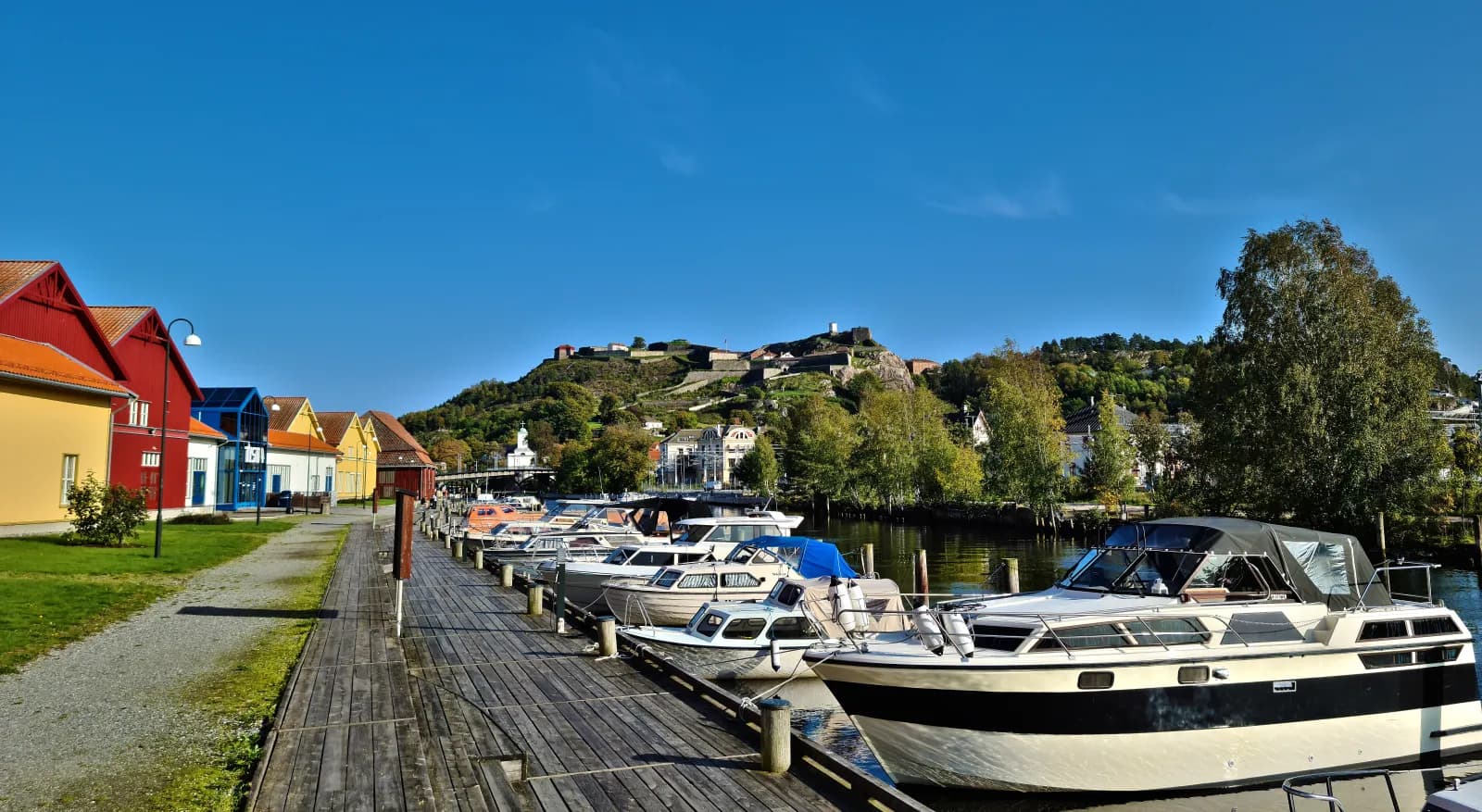
Follow the E6 and Rv 204 south to Halden, around 20 minutes. Fredriksten commands the hill above town and has never been taken by force. Sweden's Karl XII tried in 1716 and 1718; in December 1718 a bullet killed him in a trench before the walls.
Motorhome tip: Fredriksten Camping lies on the fortress grounds, eight minutes' walk from the inner fortress. Its price list covers motorhomes up to 10 metres, and the season normally runs late March through September.
Practical info for motorhomes
Roads: The E6 is motorway from Oslo. Fv 108 and Fv 130 allow vehicle combinations of 19.5 metres and are mostly 6.5–7.5 metres wide (Statens vegvesen's road database). The lowest signed height on Fv 108 is 4.4 metres under a bridge on Asmaløy. Hvalertunnelen is steep, with a ten per cent gradient. No route roads close for winter.
Tolls: Bypakke Nedre Glomma has toll points around Fredrikstad and Sarpsborg, including Rv 110 and Oldtidsveien. Oslo also has toll points. A motorhome over 3,500 kg registered as M1 gets the light-vehicle rate only with an AutoPASS agreement and tag.
Parking: Gamlebyen has few spaces — park at Kongsten. On Hvaler, motorhomes too large for one marked space pay as a car with a trailer. The main summer holiday period is crowded.
Overnight stays: Hvaler municipality permits sleeping in motorhomes at most municipal car parks, but sleeping, not camping. Keep chairs and tables inside and the awning retracted, and follow signs. The right to roam permits tents on uncultivated land at least 150 metres from an inhabited house or cabin, at most two nights without the landowner's consent, but does not apply to motorhomes: park only where permitted and never drive off-road into the terrain.
Campsites:
- Aktivitetsbyen Gamle Fredrikstad, Kongsten — beside Gamlebyen, open all year
- Bobilparkering Odden, Kråkerøy — Borg Havn, maximum 10 x 2.5 metres, book through Havneweb
- Fredrikstad Båt & Bobilpark, Mosseveien — 18 waterside pitches, water, electricity and disposal
- Hvaler Camping, Spjærøy — April–September
- Hvaler golfklubb, motorhome parking on Kirkøy — while the golf course is open
- Fredriksten Camping, Halden — at the fortress, late March–September
Fuel: Many stations in Fredrikstad and Halden. Fill up in Fredrikstad before going to Hvaler.
Waste disposal: No motorhome dump station on Hvaler. Aktivitetsbyen, Fredrikstad Båt & Bobilpark and Odden have disposal for guests. Guests at Hvaler Camping may empty toilet cassettes there.
Ferries: The route uses no car ferries. Fredrikstad's city ferries carry passengers and bicycles only. Hvalerferga from Skjærhalden carries vehicles only by prior booking — travel as a passenger. Departures marked “b” in the timetable require booking, including for passengers, and the municipality says the return from the islands must be booked. Timetables from Østfold kollektivtrafikk (ostfold-kollektiv.no) and entur.no.
Combine with
- Sørlandskysten — Moss–Horten ferry (about 35 minutes) and E18 south. Horten is around two hours from Kragerø, where you follow the route in reverse.
- Telemarkskanalen and Vest-Telemark — from Horten it is just over an hour to Skien, where the canal begins.
- Strömstad and Kosterhavet — across the border from Halden, about 35 km. Kosterhavet national park on the Swedish side adjoins Ytre Hvaler. Check with the owner that the motorhome may go to Sweden.
- Vestfoldkysten — Moss–Horten crosses the fjord in 30–35 minutes to Horten, where that route begins.
- The Halden Canal and Indre Østfold — starts in Halden, where this route ends, and follows the canal inland to Ørje.
Weather
July's daily mean is 16–17 degrees, with summer breezes from the sea to the south and southwest. Rain comes mainly in August and into autumn, and fog often rolls in during the dark season. Check yr.no for Fredrikstad, Skjærhalden and Halden — it also lists bathing temperatures.
This route is part of Bobilvei's hand-picked motorhome routes in Norway. Every route is quality-checked with a focus on motorhome suitability, parking and local experiences.