- Route
- Horten – Borre – Åsgårdstrand – Tønsberg – Tjøme – Verdens Ende – Sandefjord – Stavern – Mølen (Rv 19, Fv 325, Fv 311, Fv 308, Fv 300, E18, Fv 301 and Fv 2970)
- Length
- about 145 km from the ferry quay in Horten to the car park at Mølen, including the drive out to Verdens Ende and back. The side trip to Hvasser adds around 13 km. From Oslo to Horten is around 100 km, and from Mølen back to Oslo around 150 km.
- Driving time
- Around 3–3.5 hours without stops, plus an hour and a half from Oslo and just over two hours home
- Recommended number of days
- 2–3
- Best season
- May–September. The museums are open every day from 1 June to 31 August. In summer, parking is tight in Stavern and on Hvasser.
- Difficulty
- Easy. Good roads, no mountain passes and no ferry on the route itself. What needs care is parking in the small town centres in summer, and a 3.3-metre railway underpass in Larvik if you go there to empty your toilet (see Roads).
- Last checked
- October 2026
Why this route?
An hour and a half from Oslo lies a coast where the powerful of the Viking Age were buried in mounds, where the navy built its shipyards and where Munch had his summer house. Between the towns lie smooth coastal rocks, islets and little seaside resorts, and hardly a single leg takes more than an hour.
The route has a pleasing symmetry. Just after the start comes Borre, where Raet — the great moraine that was once the main road through Vestfold — runs out into the Oslofjord, and it ends at Mølen, where Raet disappears into the sea. Both places have large Iron Age burial monuments. Along the way you also follow the navy: from Horten, its main base from 1850, to Stavern, where it was based for the hundred years before.
The roads hold nothing a motorhome can't handle. What takes planning is where to stay when everyone else is out too — see the motorhome tips under each stop.
Stops along the route
1. Horten — Karljohansvern
The ferry from Moss docks right in the middle of town. Horten grew up around the naval shipyard founded in 1819. Behind a canal lies Karljohansvern, with brick barracks, a large dry dock and the Norske Løve fort from 1859.
Don't miss: Marinemuseet, the naval museum, founded in 1853 and among the oldest naval museums in the world. Open every day in summer.
Motorhome tip: The motorhome parking is at Horten havn, in Tollbugata. You can stay for up to three days, and there is cassette emptying in the same street. There is building work on the harbour, so the spaces may move — check horten.kommune.no. Karljohansvern is a 20-minute walk.
2. Borre — the mounds by the fjord
Four kilometres south of the harbour, Borrehaugene lie on a slope running down to the fjord. Few places in Northern Europe have so many large burial mounds from the Viking Age and the centuries before gathered together, the largest up to 45 metres across. Road workers digging fill from one of the mounds came upon the Borre ship in 1851. The archaeologists arrived the following year, and never before had specialists investigated a Viking-age ship burial.
Don't miss: Midgard vikingsenter and Gildehallen, a feasting hall built in 2013 the way experts believe such halls looked.
Motorhome tip: Good parking in front of the Viking centre, tour coaches included. The coastal path runs south from here to Åsgårdstrand, through what is probably Scandinavia's largest continuous ash forest.
3. Åsgårdstrand — Munch's summer town
Åsgårdstrand has been a holiday spot since the 1880s and soon drew painters. Edvard Munch bought a small house here in 1897, and it has been a museum since 1947. You will recognise the pier in the harbour from «The Girls on the Bridge».
Don't miss: Munchs hus. The house is closed out of season, so check vestfoldmuseene.no.
Motorhome tip: Don't drive into the narrow streets. The Fv 311 into town has a maximum length of 12.4 metres, so a motorhome towing a car may be too long. The museum has no parking of its own; use the car park by the harbour.
4. Tønsberg — Slottsfjellet
In the middle of town rises Slottsfjellet. Here King Håkon Håkonsson built the castle of Tunsberghus, and today its ruins stand alongside a stone lookout tower from 1888. The municipality counts 871 as the year the town was founded, but archaeologists only find firm traces of a town from the 11th century.
Don't miss: The view from the tower over the waterfront. The tower is closed out of season.
Motorhome tip: The municipality has three open motorhome sites, for motorhomes only, not caravans. Fjordgaten (23 spaces) is a stone's throw from Slottsfjellet and Stensarmen (14) lies by the harbour entrance, both open all year. Storgaten has eight spaces from 15 March to 30 October. The town's only waste disposal point is at Stensarmen 9.
5. Nøtterøy, Tjøme and Hvasser — the islands
The Fv 308 runs through Slottsfjelltunnelen, over Kanalbrua and south to Vrengen bru. The first bridge here dated from 1932, and when it opened there was no longer suspension bridge in Northern Europe. Today's bridge is from 1981. Tjøme is low and hilly, with cabins packed close along the shore.
Don't miss: Hvasser and the harbour at Sandøsund, a side trip of around 13 km there and back.
Motorhome tip: Røssesund bru on the way to Hvasser is signed at 4.0 metres. In Sandøsund you may park for only one hour during the day from 15 June to 15 August. On the free car park at Fynsletta, motorhomes are banned from midnight to 6 am.
6. Verdens Ende — the tipping beacon
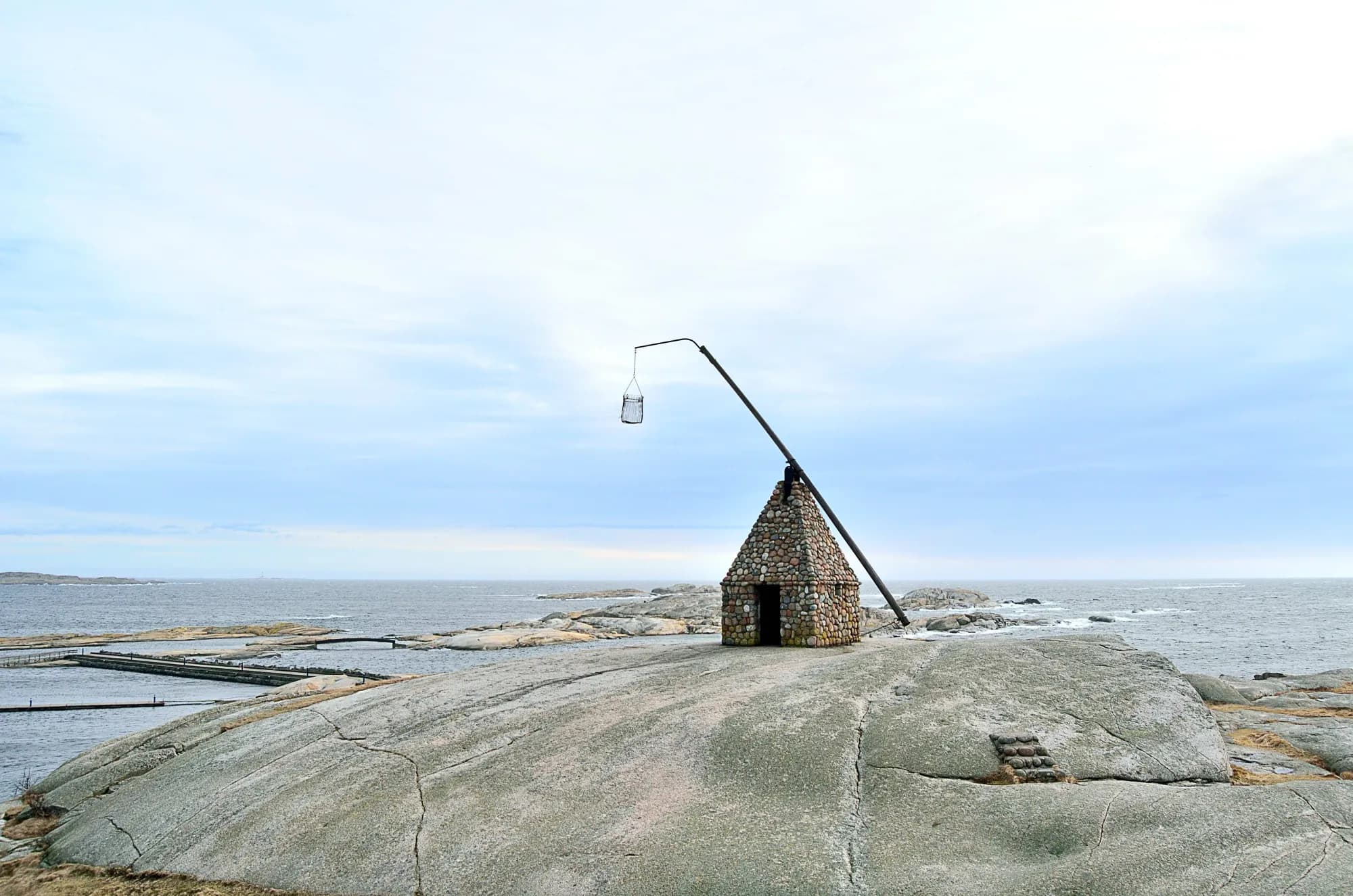
The Fv 308 comes to an end, and ahead of you there is nothing but bare rock and sea. Far out you can make out Færder lighthouse. The tipping beacon on the rock is not a real lighthouse but a monument, built in stone in 1932. The name isn't old either: the headland was called Helgerødtangen until visitors in the early 1900s began calling it Verdens Ende — "the world's end". All around you lies Færder National Park, which is almost all sea.
Don't miss: The national park visitor centre, and the coastal path across Moutmarka, one of the most important areas for insects in Norway.
Motorhome tip: The municipality has motorhome parking on the large car park, with a daily rate all year, but no electricity or water point; you can get water at the municipal toilets. Verdens Ende Camping, half a kilometre away, has 15 pitches with hook-ups and waste disposal. In the national park dogs must be on a lead from 1 April to 15 October, fires on the bare rock are forbidden, and the beach stones must stay where they are.
7. Sandefjord — the whaling town
From the islands you drive back through Tønsberg and on along the E18. In 1917 the shipowner Lars Christensen gave Sandefjord a museum of whales and whaling. What everyone remembers is the blue whale: a full-size model, and from the gallery you can take in the whole animal. No other museum in Europe is devoted to whaling alone.
Don't miss: Kongshaugen at Gokstad, three kilometres north-east of the centre, where the world's largest preserved Viking ship was dug out in 1880.
Motorhome tip: Sandefjord bobilhavn, the motorhome harbour, is on Hjertnesstranda by the marina, with electricity, water and waste disposal all year, around a kilometre's walk from the museum.
8. Stavern — Fredriksvern and Minnehallen
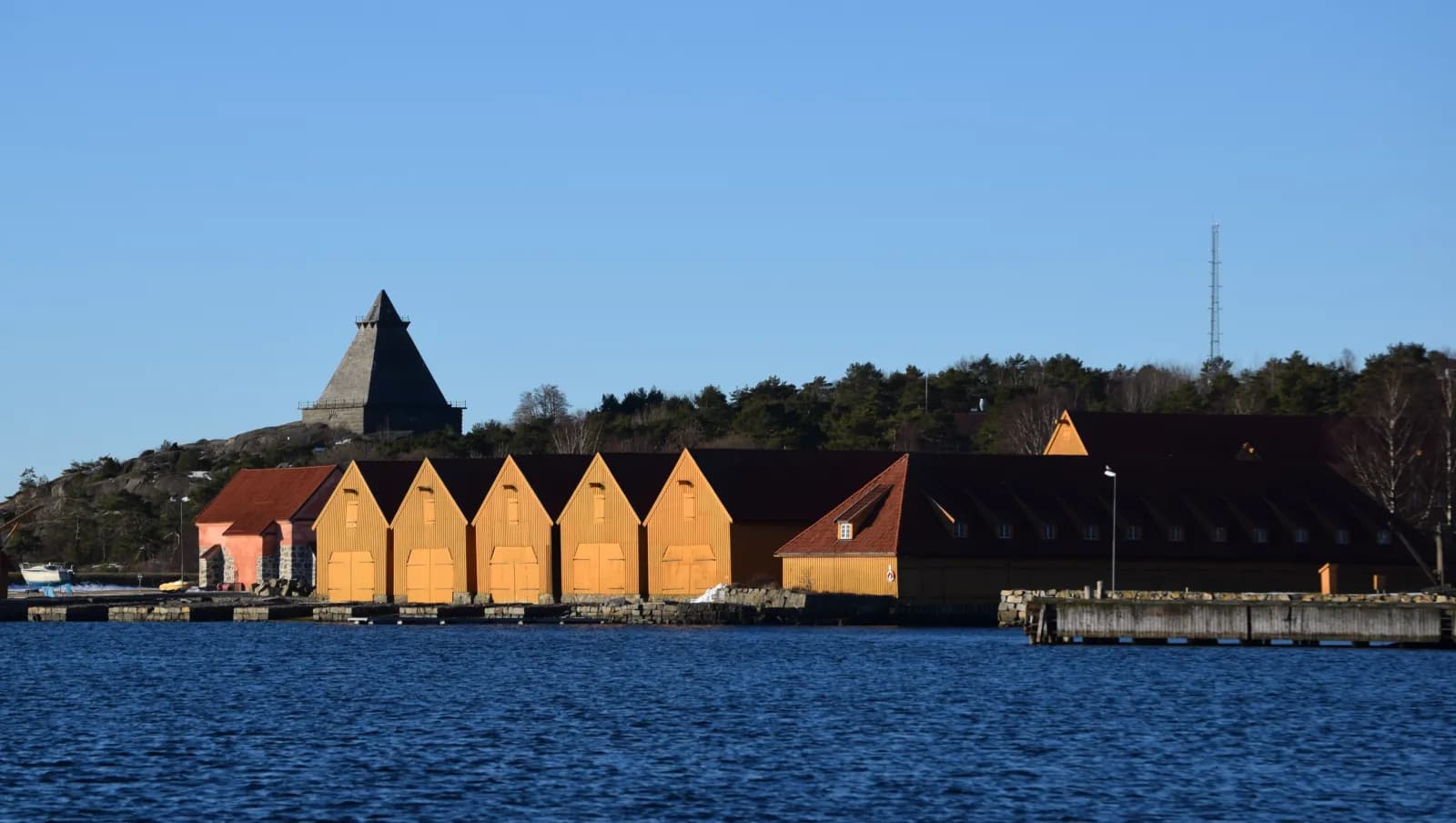
The E18 and the Fv 301 take you through the edge of Larvik and down to Stavern. From 1750 to 1850 Fredriksvern verft was the navy's main base. Nowhere else in Norway are there sheds built for galleys, and most of what was built in the 18th century is still standing. On the rock just to the south stands Minnehallen from 1926, a 22-metre stone pyramid bearing the names of more than 8,000 seafarers lost in the two world wars.
Don't miss: The coastal path west towards Helgeroa.
Motorhome tip: From 10 June to 20 August much of the centre is residents' parking and pedestrian streets, where visitors cannot park. Solsiden Bobilpark by the sea has hook-ups, water and waste disposal, and pitches are booked online. The price list goes up to 9.9 metres; if your motorhome is longer, get in touch first.
9. Mølen — where Vestfold ends
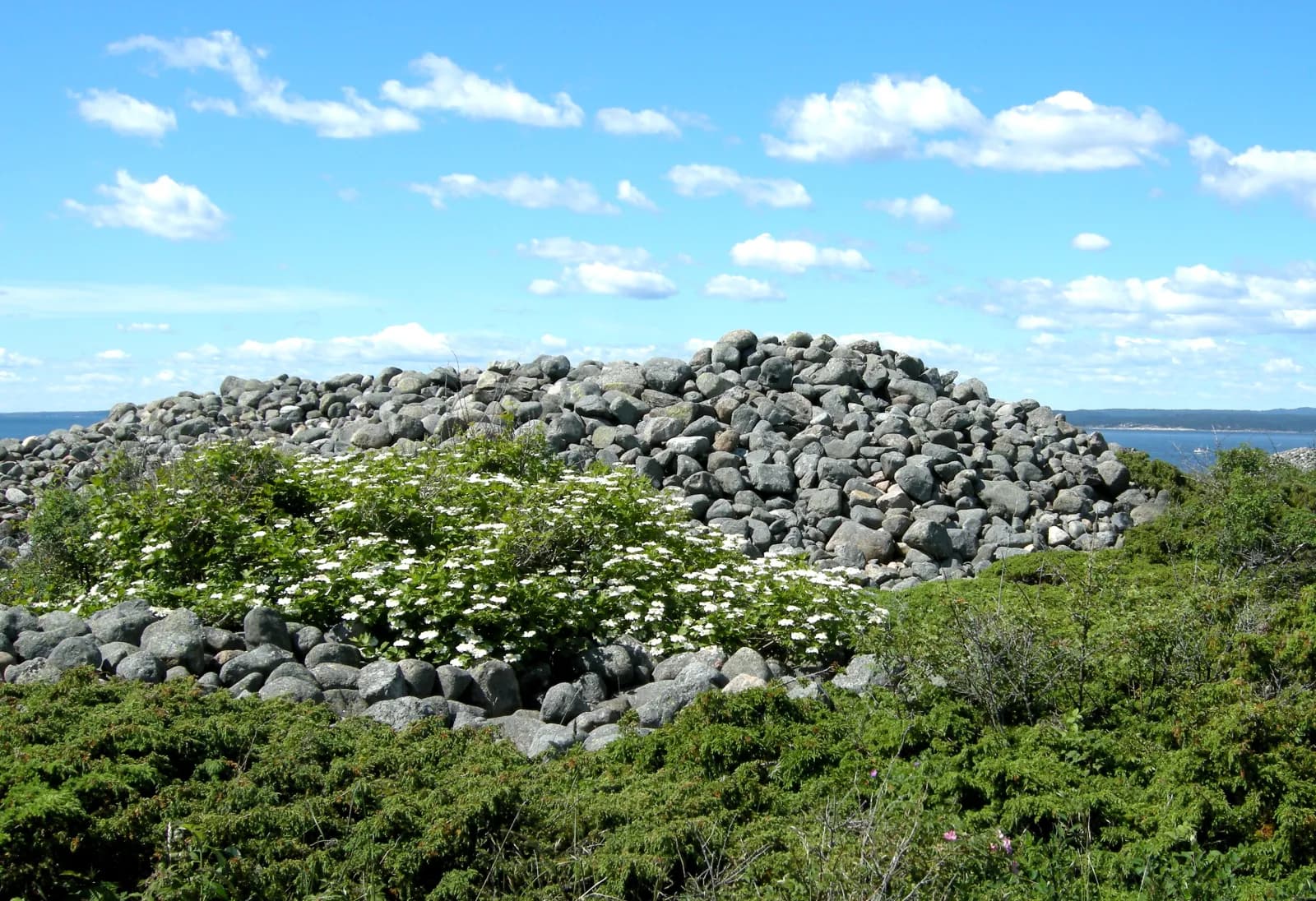
At the far end of Brunlanes, Raet runs into the sea, and the waves have washed the moraine into a broad belt of rounded stones. On the ridge lie at least 230 cairns and stone settings, the largest seven metres high. Many believe a powerful family of the late Iron Age was buried here, but only one cairn has been excavated. Mølen is also a bird sanctuary and part of Gea Norvegica Geopark.
Don't miss: The evening light over Langesundsfjorden.
Motorhome tip: The last kilometre and a half out to Mølen is a private road, mostly gravel, with a car park at the end. On busy days the municipality recommends parking in Nevlunghavn or at Sørskogen and walking; at Omrestranda in Nevlunghavn the municipality has a fairly large free car park, open all year. The cairns are protected monuments: don't take stones away, and don't build cairns of your own. KNA Oddane Sand Camping in Nevlunghavn has 31 touring pitches.
Practical info for motorhomes
Roads: The national and county roads are open to vehicles and combinations up to 19.5 metres, except the Fv 311 into Åsgårdstrand (12.4 metres). The last stretch out to Mølen is a private road. The lowest signed height on the route is 4.4 metres in Slottsfjelltunnelen, and Røssesund bru towards Hvasser is signed at 4.0 metres (Statens vegvesen's road database). The railway underpass on Storgata (Fv 303) at Torstrand, east of Larvik centre, is signed at 3.3 metres. The route does not go there, but if you empty your toilet at Øya 57, drive back to the E18 and turn off for Stavern from there — not west through the town. No roads are closed in winter.
Tolls: Bypakke Tønsberg-regionen has had toll stations since 1 July 2026, and the route passes three of them: on the Fv 308 at Kjelle and on Kanalbrua, and on the Fv 300 towards the E18. The E18 through Vestfold is tolled too. A motorhome over 3,500 kg registered as M1 only pays the car rate with an AutoPASS agreement and tag.
Parking: Hardest in summer in Stavern, in Sandøsund and at Mølen — see under each stop.
Overnight stays: The local bylaws in Horten, Sandefjord and Larvik ban camping in parks, green spaces and recreation areas, and on or beside roads and squares in built-up areas, unless signs say otherwise. Use the motorhome sites. The Outdoor Recreation Act lets you pitch a tent on uncultivated land at least 150 metres from an inhabited house or cabin, but gives the motorhome no rights of its own: it stays where parking is allowed. Never drive off-road.
Campsites:
- Motorhome parking in Tollbugata, Horten havn — municipal, up to three days
- Tønsberg's municipal motorhome sites — Fjordgaten, Stensarmen and Storgaten
- Bobilparkering Rosanes, Nøtterøy — Færder municipality, no water or electricity
- Bobilparkering Verdens Ende — Færder municipality, all year, no water or electricity
- Verdens Ende Camping, Tjøme — season May–September, phone outside it
- Sandefjord bobilhavn, Hjertnesstranda — all year
- Solsiden Bobilpark, Stavern — by the sea
- KNA Oddane Sand Camping, Nevlunghavn — usually April–September
Fuel: Filling stations are plentiful in the towns and along the E18. On Tjøme there is only one unmanned pump, so fill up in Tønsberg or at Teie. The nearest to Mølen is an unmanned pump in Helgeroa.
Waste disposal: Stensarmen 9 is Tønsberg's only disposal point, and it also takes fixed tanks. Færder municipality has points at Kjøpmannskjær on the Fv 308 and at Fjærholmen (cassettes only), open from 1 May until the frost comes. Horten has cassette emptying in Tollbugata, and Sandefjord at the motorhome harbour. Larvik municipality's point at Øya 57 is open all year.
Ferries: None on the route. From Østfold, Moss–Horten is the quick way across the fjord: 30–35 minutes, no advance booking, and the fare depends on vehicle length. Timetables at torghatten.no. From Sandefjord, Color Line sails to Strömstad, and from Larvik to Hirtshals.
Combine with
- Hvaler and Fredrikstad — the Horten–Moss ferry takes you across the fjord in 30–35 minutes. Or take the ferry from Sandefjord to Strömstad and drive over the border to Halden; check with the rental owner that the motorhome may be taken into Sweden.
- The Telemark Canal and West Telemark — from Mølen it is around 40 km to Skien, where the canal begins.
- The Sørland Coast — from Mølen it is around 70 km to Kragerø, where you can drive that route in reverse.
- Denmark — Color Line sails from Larvik to Hirtshals in 3 hours 45 minutes.
Weather
October is the wettest month here and March the driest. Summers are mild: in July the average in Tønsberg is around 17 degrees, a little warmer than out by the open sea. Check yr.no for Horten, Tjøme and Stavern — you will find sea temperatures there too.
This route is part of Bobilvei's hand-picked motorhome routes in Norway. Every route is quality-checked with a focus on motorhome suitability, parking and local experiences.