- Route
- Halden – Brekke locks – Aremark – Strømsfoss – Ørje – Rødenes church – Høytorp fort at Mysen (Fv 21, Fv 128, Fv 1308 and E18)
- Length
- about 110 km from Halden to Høytorp fort, including the detour in to Brekke locks (around 5 km there and back). From Oslo to Halden it is about 120 km on the E6, and from Mysen back to Oslo about 65 km, mostly on the E18.
- Driving time
- Around 2.5 hours without stops
- Recommended number of days
- 2–3
- Best season
- May–September. The locks are staffed from the last Saturday in May to the last Sunday in August, and that is when most boats are out. The roads are open all year.
- Difficulty
- Easy. Good county roads through forest and villages, no mountain passes, no ferries and no toll points on the route itself.
- Last checked
- October 2026
Why this route?
The Halden Canal is the opposite of a fjord route. There are no cliffs and no ferry queues, just long, narrow lakes in the forest, small villages on the necks of land between them, and locks that have lifted timber, goods and people since the 19th century. From Femsjøen near Halden to Skulerud in Akershus the waterway has been made navigable for 75 kilometres, with three lock sites: Brekke, Strømsfoss and Ørje.
The Fv 21 follows the waterway from Halden to Ørje, so you can stop at every lock, take a boat trip at one and spend the night at another. After Ørje the route calls at the medieval church by Rødenessjøen and ends at Høytorp fort in Mysen, close to the E18 — and from there it is around an hour home to Oslo.
Stops along the route
1. Halden — the town at the mouth of the Tista
Halden lies where the Tista river runs out into Iddefjorden, with the Swedish border to the south. The town received its charter in 1665 and was called Fredrikshald until 1928, and it is the only Norwegian town named in the national anthem. Above the centre stands Fredriksten fortress, which we describe in Hvaler and Fredrikstad — this route starts where that one ends.
As you drive out of town on the Fv 21, you follow the Tista upstream. The Saugbrugs paper mill sits on the north bank, just above the centre, and the road passes under the mill's pipeline and bridges. Saugbrugsforeningen was founded in 1859, shortly before the old sawmill privileges came to an end.
Don't miss: Empirebyen on the south side of the Tista. This is where the town first stood, and some of the old buildings remain, such as Toldboden, the old customs house.
Motorhome tip: Fredriksten Camping sits up on the fortress and is usually open from late March to late September. Fill up in Halden or in Tistedal: along the canal, filling stations are far apart.
2. Brekke locks — the staircase in the forest
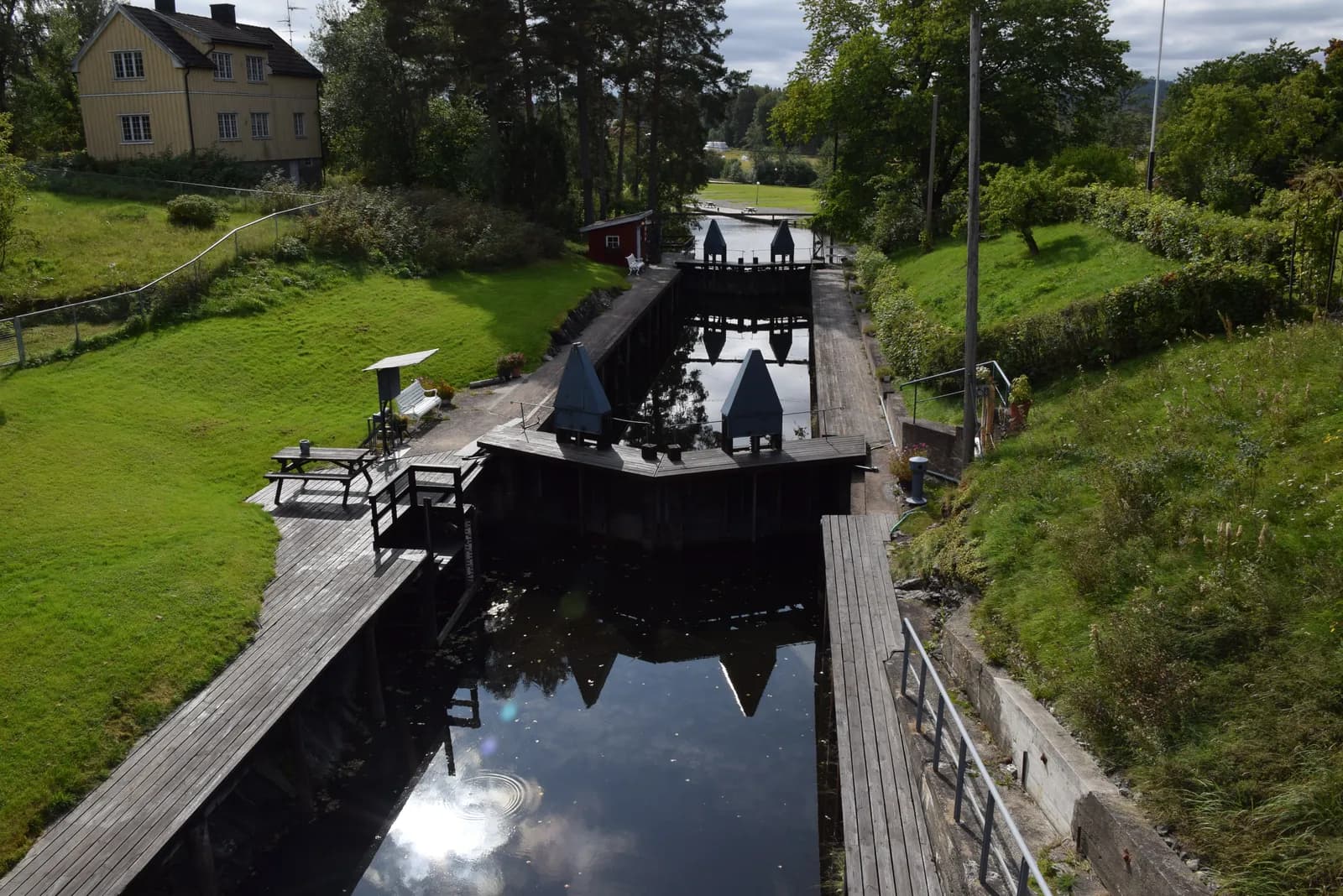
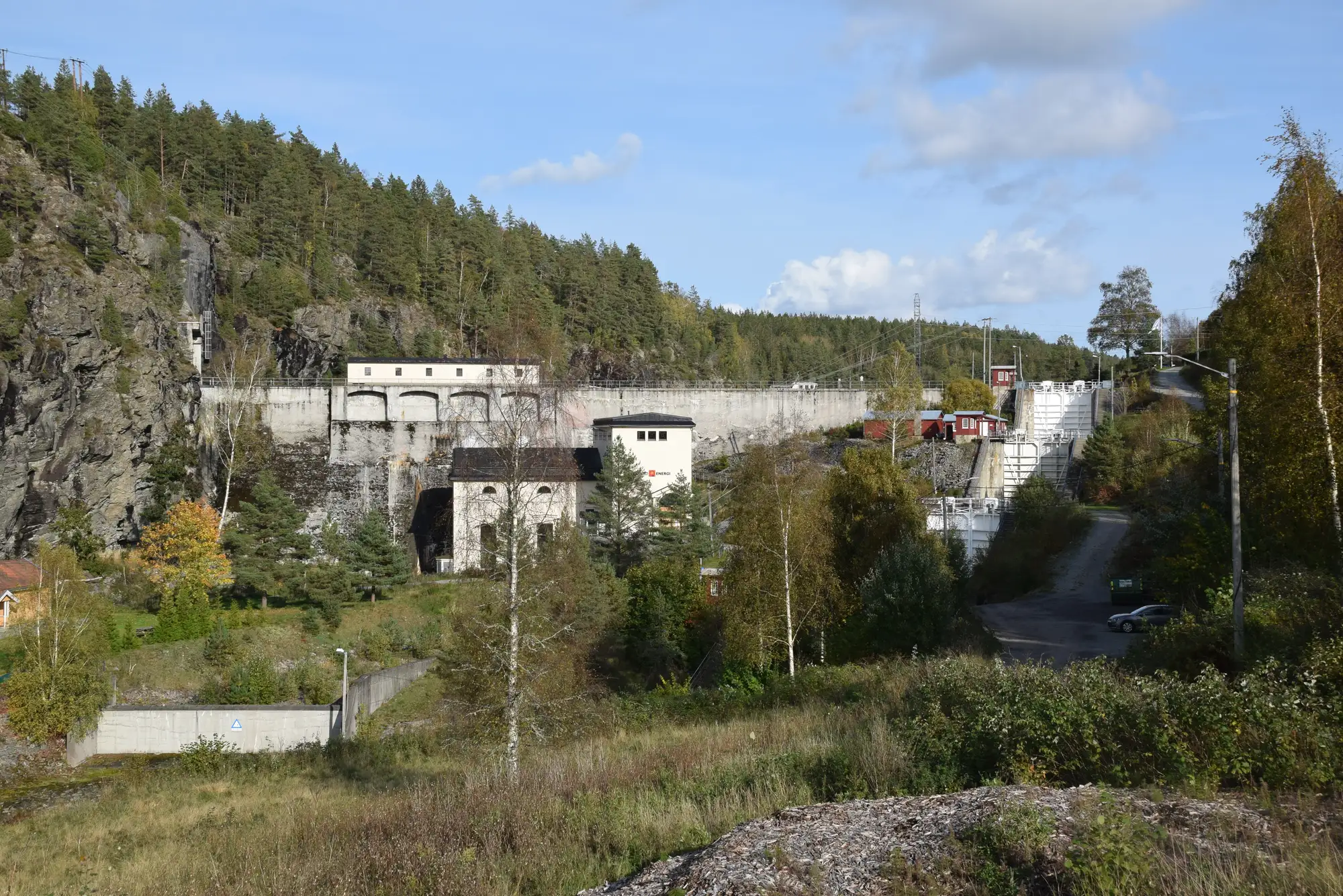
At Tistedal, three or four kilometres from the centre, the Tista flows out of Femsjøen, and this is where the canal boats used to set off northwards. The Fv 21 carries on eastwards, and around six kilometres after Tistedal you turn off onto Brekkeveien. After a couple of kilometres through the forest you stand below a concrete dam and four lock chambers climbing the hillside like a staircase. Brekke locks lift boats 26.6 metres from Femsjøen up to the level of Aspern, and no other continuous lock staircase in Northern Europe is higher. Engebret Soot built the first locks here in the 1850s, at two sites, Brekke and Krappeto. The flood of 1861 destroyed them, they were rebuilt in 1873–1877, and in 1924, when the power station came, everything was gathered into a single staircase.
Don't miss: A trip on MS Brekke, whose home port is at the locks. The round trip goes through all four chambers, past Krappeto and out onto Aspern and back, and takes about three hours. In 2026 the boat sailed from 21 May to 6 September, on Wednesdays, Fridays and Saturdays. Tickets for 2027 go on sale on 1 November 2026; check opplevhaldenkanalen.no.
Motorhome tip: Brekkeveien is a municipal road of around 2.5 kilometres, approved for vehicles up to 19.5 metres long. By the locks there is a small motorhome parking area with four spaces with electricity and, according to its booking listing, waste disposal. Water and toilets are available only from May to October. The spaces can be booked on Campcation. They are small and may slope, and the operator gives no maximum length, so with a long motorhome check before you book. There is no bus out here, so the boat passengers come by car, and on sailing days the motorhome spaces may be taken by cars. Go back the same way to the Fv 21.
3. Aremark — the church by Aremarksjøen
Further north the Fv 21 runs through forest to Fossby, the administrative centre of Aremark. Nearly four fifths of the municipality is forest, and today Aremark has no urban settlement (tettsted) by Statistics Norway's definition. The village lies along Aremarksjøen, and that is also where Aremark church from 1861 stands, between the road and the water. A memorial stone by the church recalls the theologian Ole Hallesby, who came from a farm in the parish.
Don't miss: A swim from Kirkeng Camping's own sandy beach on Aremarksjøen. The water stays fairly shallow a long way out, and it is good for children.
Motorhome tip: Kirkeng Camping lies on the Fv 21, close to the church, and is open all year. Most of its pitches are seasonal, but there are overnight pitches for motorhomes and caravans down by the water. YX in Fossby is the last filling station before Ørje.
4. Strømsfoss — lock, mill and village shop
Around eight kilometres north of the church you turn off onto the Fv 124 and down to Strømsfoss, where the Strømselva runs from Øymarksjøen down into Aremarksjøen. The lock was built in the years up to 1860, at the same time as the locks at Ørje, and it has only one chamber: the difference in level is a couple of metres. Around it lies a small cluster of buildings with the lock keeper's house, a power station, an old village shop and Strømsfoss mill. The mill ground grain for the parish for almost seventy years, from 1897 to 1966, with power from its own small plant in the building. Since 1995 it has been Norway's museum of mills.
Don't miss: The locking. In the season boats are locked through here at four fixed times a day, in 2026 at 10 am, 1 pm, 4 pm and 7 pm. Boats must give notice in advance, so a boat does not come through every time. Check haldenkanalen.no for this year's times.
Motorhome tip: The six motorhome spaces by the veteran-boat quay are booked on Campcation. For now there is no electricity (2026), but you get water from a hose at the lock, and the service building at Kanaltangen has toilets and showers from 1 May to 31 October. Go back to the Fv 21 to carry on north.
5. Ørje — the lock town by the border
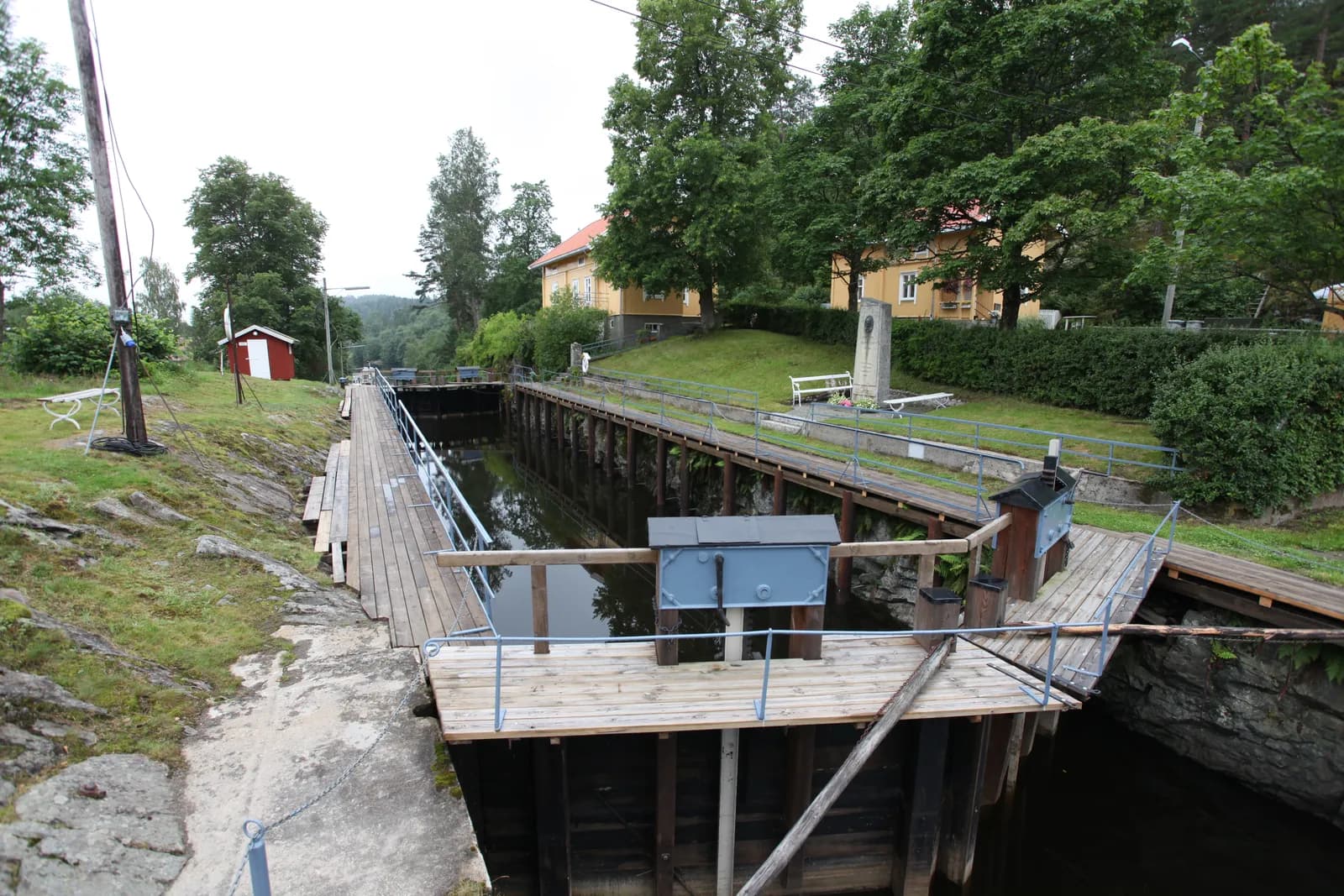
From Strømsfoss the Fv 21 follows the east side of Øymarksjøen for around 25 kilometres to Ørje, where the E18 crosses the canal on its way to Sweden. The Ørje locks from 1860 have three chambers and lift boats just over ten metres up to Rødenessjøen. The locks are still worked by hand, and it takes three quarters of an hour to pass through all three chambers. Beside the locks is Ørje Brug, a wood-grinding mill from 1886. Since 2001 it has housed the Haldenvassdraget canal museum, about timber floating, building the canal and the wildlife of the waterway. Just before the union with Sweden was dissolved, Ørje got two forts, Nordre and Søndre fort. They were built around 1903 and demolished in 1906, after the agreement between Norway and Sweden at Karlstad. Nordre fort was partly restored in the 1990s.
Don't miss: A lock trip. Sluseporten in Ørje runs lock trips on MS Yrja in summer, and tickets are booked at booking.sluseporten.no. The D/S Engebret Soot foundation in Ørje hires out its steamboats to groups, but D/S Turisten, which used to run scheduled trips on the canal, was not available for sailing in October 2026.
Motorhome tip: Book one of the six spaces with electricity at Tangen, by the quay, on Campcation; they are for motorhomes only, not caravans. From May to September there is full service: a toilet and emptying for cassettes and grey water in the service house by the spaces, water at the red house by Båtcafeen, and showers from 15 June to 15 August, when the tourist office on the quay is open. From 1 October to 1 May the toilet is closed. Outside the summer the canal museum only opens for events, so check ostfoldmuseene.no first. Circle K and Driv have filling stations in Ørje.
6. Rødenes church — the Middle Ages by Rødenessjøen
Follow Vestre Rødenesveien north from Ørje, first as the Fv 128 and from Kallak as the Fv 1308. There is more farming here, with farms and fields running down to Rødenessjøen, and just under two kilometres in from the road, on the west side of the lake, stands Rødenes church. Its walls are Romanesque and medieval; early in the 18th century the church was extended, and around 1950 it was restored.
Motorhome tip: The Fv 128 and Fv 1308 are wide enough for a motorhome and approved for vehicles up to 19.5 metres. The last stretch in to the church, Rødenes kirkevei, is a municipal road of just under two kilometres, also approved for 19.5 metres. Be considerate if there is a service or a funeral, and turn where there is plenty of room.
7. Høytorp fort — the defences that came after 1905
Go back to Kallak and take the Fv 128, Kallakveien, west to the E18 and on towards Mysen. The fort stands on Vardåsen, a kilometre or so north-east of the centre, and much of it you cannot see: the gun positions lie inside the rock, behind a deep ditch. It was built in 1912–1918 as the main fort of the Fossumstrøket fortress, because the Karlstad agreement of 1905 had forced Norway to demolish several forts that were almost new. In 1940, when Germany attacked, there was fighting here, and several soldiers fell. Today the site is a protected monument, and a society, Foreningen for Høytorp fort, runs a museum there.
Motorhome tip: Several of the roads inside the fort area are private, and we have not been able to confirm where a motorhome can park there. Park where the signs allow it. We have not found fixed opening hours for the museum and the guided tours. From Høytorp it is around 65 km to Oslo, mostly on the E18.
Practical info for motorhomes
Roads: The Fv 21 from Halden to Ørje, the Fv 124 down to Strømsfoss, the Fv 128, the Fv 1308 and the E18 are open to vehicles up to 19.5 metres long, and so are the municipal roads in to Brekke locks and Rødenes church (Statens vegvesen's road database). The Fv 21 is mostly 6.5–8 metres wide, and the Fv 1308 around 6.5 metres. The road database has no signed height limit on the route. None of these roads closes in winter, but check vegvesen.no before you drive.
Tolls: There are no toll points on the route itself, and the tolls on the Svinesund bridge ended in 2021. If you drive the E6 or the E18 in and out of Oslo, you pass Fjellinjen's toll points. In Sarpsborg there are tolls on the on- and off-ramps of the E6 (Bypakke Nedre Glomma), not on the E6 itself. The rates are published by Fjellinjen and Vegfinans.
Parking: At Brekke, Strømsfoss and Ørje there are dedicated motorhome spaces by the locks, but only four to six at each. If you come in the July holidays or on a day with boat departures, book ahead. Otherwise park where the signs allow it.
Overnight stays: The right of access lets you pitch a tent on uncultivated land at least 150 metres from an inhabited house or cabin, for no more than two days without the landowner's consent. A motorhome is a vehicle, and it can only stand where parking is allowed. Driving off-road is forbidden. Use the motorhome spaces by the locks and the campsites.
Campsites:
- Fredriksten Camping, Halden — on the fortress, usually late March–late September
- Brekke locks motorhome parking, Tistedal — four spaces with electricity, booked on Campcation
- Kirkeng Camping, Aremark — by Aremarksjøen, open all year
- Strømsfoss motorhome parking, Aremark — six spaces, for now without electricity (2026), booked on Campcation
- Ørje motorhome parking, Tangen — six spaces with electricity, motorhomes only
Fuel: Halden has plenty of filling stations, and there is a YX in Tistedal. Along the canal, YX in Fossby is the only one until you reach Ørje, where Circle K and Driv have stations. Fill up in Halden or Tistedal.
Waste disposal: Ørje motorhome parking lists emptying for toilet cassettes and grey water in its service house (full service May–September) and a disposal point at the rest area by Norgesporten bridge, across the E18 from Circle K. The motorhome parking at Brekke locks lists disposal at the spaces. Both come from the places' booking listings, not their own websites, so outside the season check before you go. Elsewhere on the route we have not found a public disposal point we can confirm.
Ferries: None.
Combine with
- Hvaler and Fredrikstad — ends at Fredriksten in Halden, where this route begins. Together they make a trip of four to six days through much of Østfold.
- Telemarkskanalen and Vest-Telemark — the other great canal of eastern Norway, with 18 lock chambers from Skien to Dalen. From Oslo it is just over two hours to Skien.
- Solør and Finnskogen — the Fv 21 carries on north from Ørje to Skotterud, and from there you can drive on towards Kongsvinger and the forests along the border.
Weather
Winters are colder here inland than out on the coast: in January the average temperature is minus 3 to minus 5 degrees, against around minus one degree at the outermost coast. In July it is 16–17 degrees. Most rain falls in late summer and autumn, and in autumn and winter there is often fog. Check yr.no for Halden, Aremark and Ørje.
This route is part of Bobilvei's hand-picked motorhome routes in Norway. Every route is quality-checked with a focus on motorhome suitability, parking and local experiences.