- Route
- Sogndal – Sogndalsdalen – Fjærland (Norsk Bremuseum, Mundal, Supphellebreen, Bøyabreen) – Skei on the Rv 5, with a side trip from Sogndal via Gaupne to Breheimsenteret and Nigardsbreen (Fv 55 and Fv 604)
- Length
- about 80 km from Sogndal to Skei including the detours to Mundal, Supphellebreen and Bøyabreen (the Rv 5 alone: around 60 km). The side trip to Nigardsbreen is about 135 km there and back from Sogndal, about 75 km from Gaupne.
- Driving time
- Around an hour and a half without stops from Sogndal to Skei, plus around two and a half hours for the side trip to Jostedalen
- Recommended number of days
- 2–4: two without Jostedalen, three or four with it
- Best season
- May–September. The glacier museum is open every day from April to October, Breheimsenteret and the book town from May. The Brevegen road to Nigardsbreen is normally open April–October, and the boat across the glacier lake usually runs from late May to September.
- Difficulty
- Easy. The Rv 5 is wide and open to vehicles and combinations up to 19.5 metres, with no ferries and no mountain passes, but with four long tunnels. The side roads to Supphellebreen and along the fjord beyond Mundal have stretches where 12.4 metres is the maximum length.
- Last checked
- October 2026
Why this route?
Jostedalsbreen is the largest glacier on the European mainland. On the Sogn side it sends arms of ice down into the valleys, and you can drive almost all the way up to several of them. This route takes you close to three — Nigardsbreen in Jostedalen, and Supphellebreen and Bøyabreen in Fjærland — and then under the ice on the way out towards Skei.
Above all, this is a trip to Fjærland. The village had no road until 1986. Today it has a glacier museum designed by Sverre Fehn, a book town with shelves along the fjord and two glacier arms seven kilometres from the museum. With a motorhome you can stay a couple of nights and take the days at the village's pace. Jostedalen is a side trip that deserves a day of its own — that is where you can join a guide out onto the blue ice.
Stops along the route
1. Sogndal — shops and a full tank
This is where people in inner Sogn come to shop, and three main roads cross in the town: the Rv 5, the Rv 13 and the Fv 55. Stock up before you set off — Fjærland and Jostedalen each have just one Joker shop.
Don't miss: Kaupanger, a quarter of an hour to the east, with its stave church and the Sogn folk museum.
Motorhome tip: Fill up in Sogndal, for example at St1 on Stedjevegen. Kjørnes Camping lies three kilometres out along the Rv 5 towards Kaupanger and has 80 asphalt pitches for motorhomes, all with hook-ups.
2. Gaupne — gateway to Jostedalen
The side trip starts on the Fv 55 heading north past Hafslovatnet. After about 30 kilometres you reach Gaupne, at the head of Gaupnefjorden. Look out for Gaupne gamle kyrkje, a timber church from the 1640s. The doorway and several other parts of the building were taken from the stave church that stood there before.
Motorhome tip: If you are coming down from Sognefjellet, this is where you turn off. Norway's National Tourist Routes list Gaupne as a place to empty your toilet. The tunnels on the Fv 55 between Sogndal and Gaupne are signed at 4.3 metres.
3. Jostedalen and Breheimsenteret
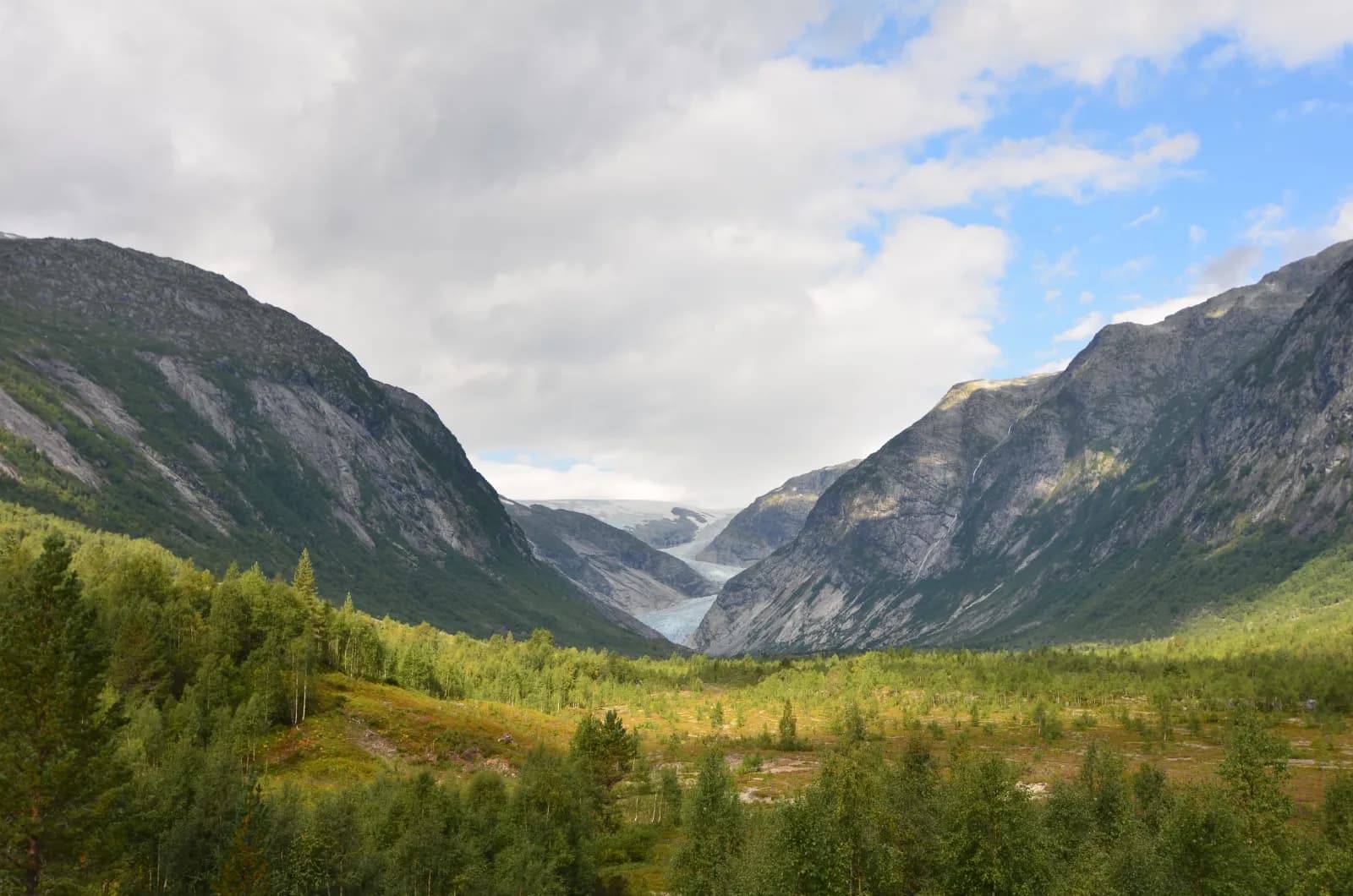
The Fv 604 follows the Jostedøla river up the valley. On the way you pass Jostedal kyrkje, a timber church from 1660. After 33 kilometres you reach Breheimsenteret, which tells the story of both the Jostedalsbreen and the Breheimen national parks. From here you can see the icefall of Nigardsbreen at the head of the valley. The centre opens for the season on 1 May.
Motorhome tip: The Fv 604 is open to combinations up to 19.5 metres all the way to Breheimsenteret, and the asphalt is mostly 5.5–6.5 metres wide. The four short tunnels are narrow, only 4–5 metres wide, and signed at 4.2–4.3 metres high. The first, Haukåstunnelen, is only 4.2 metres wide — wait rather than meet another vehicle inside. Jostedal Camping at Gjerde, three minutes before the centre, has a motorhome service point and is normally open from 1 May to 15 October. The Joker shop next door has a fuel pump.
4. Nigardsbreen — the boat across the glacier lake
At the centre a private toll road leaves the Fv 604. The Brevegen runs three kilometres into a landscape the glacier has left behind and ends at Nigardsbrevatnet. In summer small boats shuttle across the lake, and from the jetty on the far side you walk over smooth rock towards the glacier front. The glacier takes its name from the farm of Nigard, which the ice buried in the 1700s. Back then the front reached 4.5 kilometres further down the valley than it does now.
Don't miss: The blue ice with a guide. Jostedalen Breførarlag offers everything from short walks for children aged eight and up to long days on the ice. Tours are booked online.
Motorhome tip: The toll station reads your number plate automatically, and motorhomes pay the same as cars. Boat tickets are bought at the jetty — seats cannot be booked. In the nature reserve it is forbidden to park overnight or to camp. Never go out onto the ice without a guide, and stay behind the barriers: ice can fall from the front without warning. Since 1986 six people have died when ice broke away at the glacier's snout.
5. Norsk Bremuseum — Fehn's concrete on the valley floor
Back in Sogndal, take the Rv 5 towards Fjærland. The road climbs Sogndalsdalen and runs through Frudalstunnelen and Bergstunnelen. Before 1994 there was no road here from Sogndal — from this side, cars came by ferry from Hella and Dragsvik. The museum sits by the road where you come out. Sverre Fehn designed the building, which opened in 1991, and the Ulltveit-Moe climate centre was added in 2007. In the exhibition you can get your hands on ice brought down from Supphellebreen, a few kilometres away.
Don't miss: The panorama film about Jostedalsbreen National Park.
Motorhome tip: The museum is open every day from April to October. At the junction by the museum there is an unmanned fuel pump that takes cards only. Bøyum Camping is right next door, with motorhome pitches with hook-ups and emptying for cassette toilets.
6. Mundal — the book town by the fjord
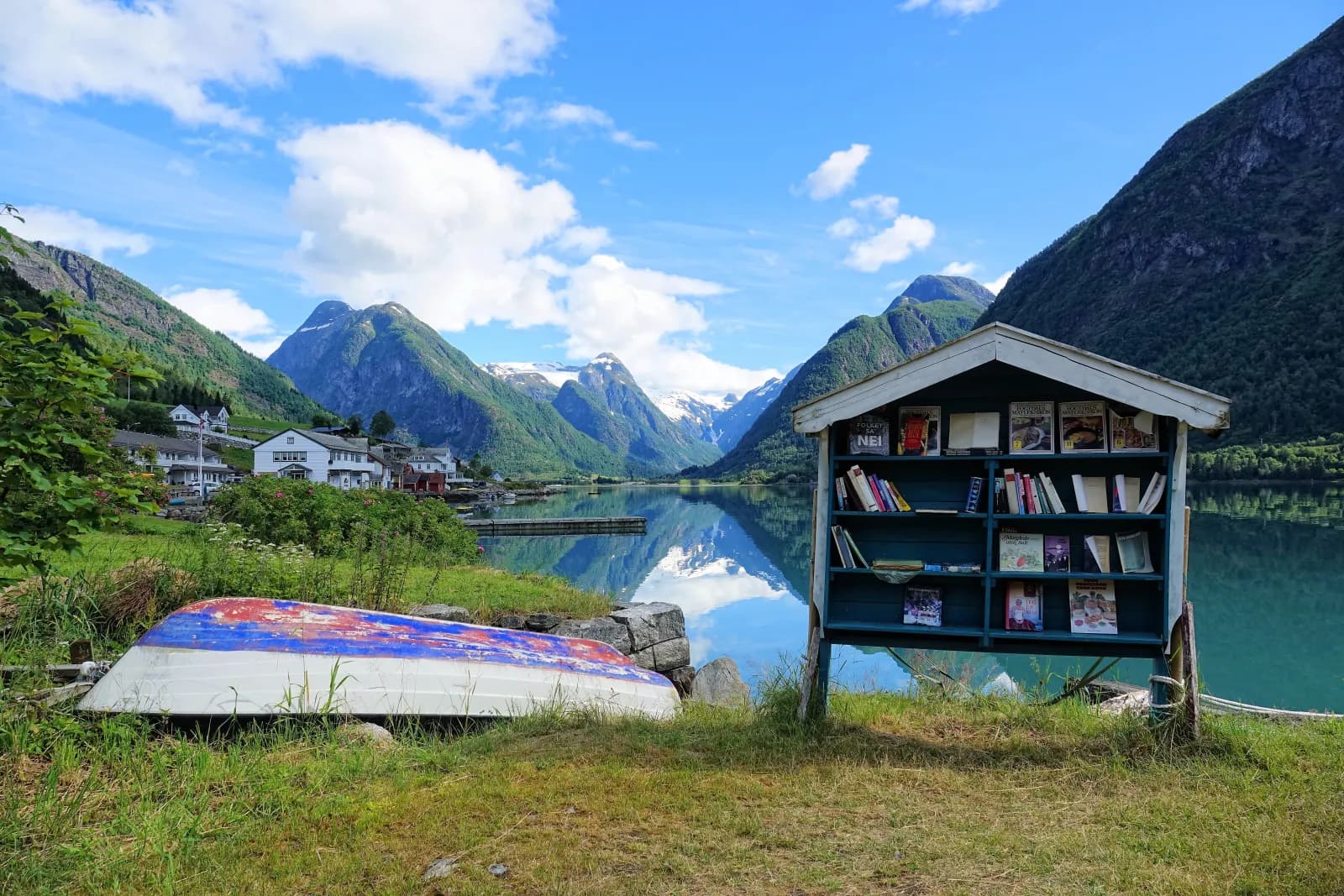
Turn off at the museum and follow the Fv 5617 for just under three kilometres along the water. That is Mundal, the village centre. Until the mid-1980s the only way here was by boat. The road from Skei was opened in 1986 by Walter Mondale, a former Vice President of the United States, whose surname comes from Mundal itself. In 1996 Mundal became the first book town in the Nordic countries. Old buildings in the centre have been given a new life as second-hand bookshops, and along the road there are bookshelves out in the open. Hotel Mundal, the wooden hotel from 1891, is closed for renovation.
Don't miss: The book town, open from May to September.
Motorhome tip: The county road is open to 19.5 metres as far as Mundal, but in places it is only about four metres wide, too narrow for a motorhome and a car to pass. Wait where the road is wider. Park in Mundal and walk. Beyond the village the road narrows to about 3.5 metres, with 12.4 metres as the maximum length.
7. Supphellebreen — the falling ice
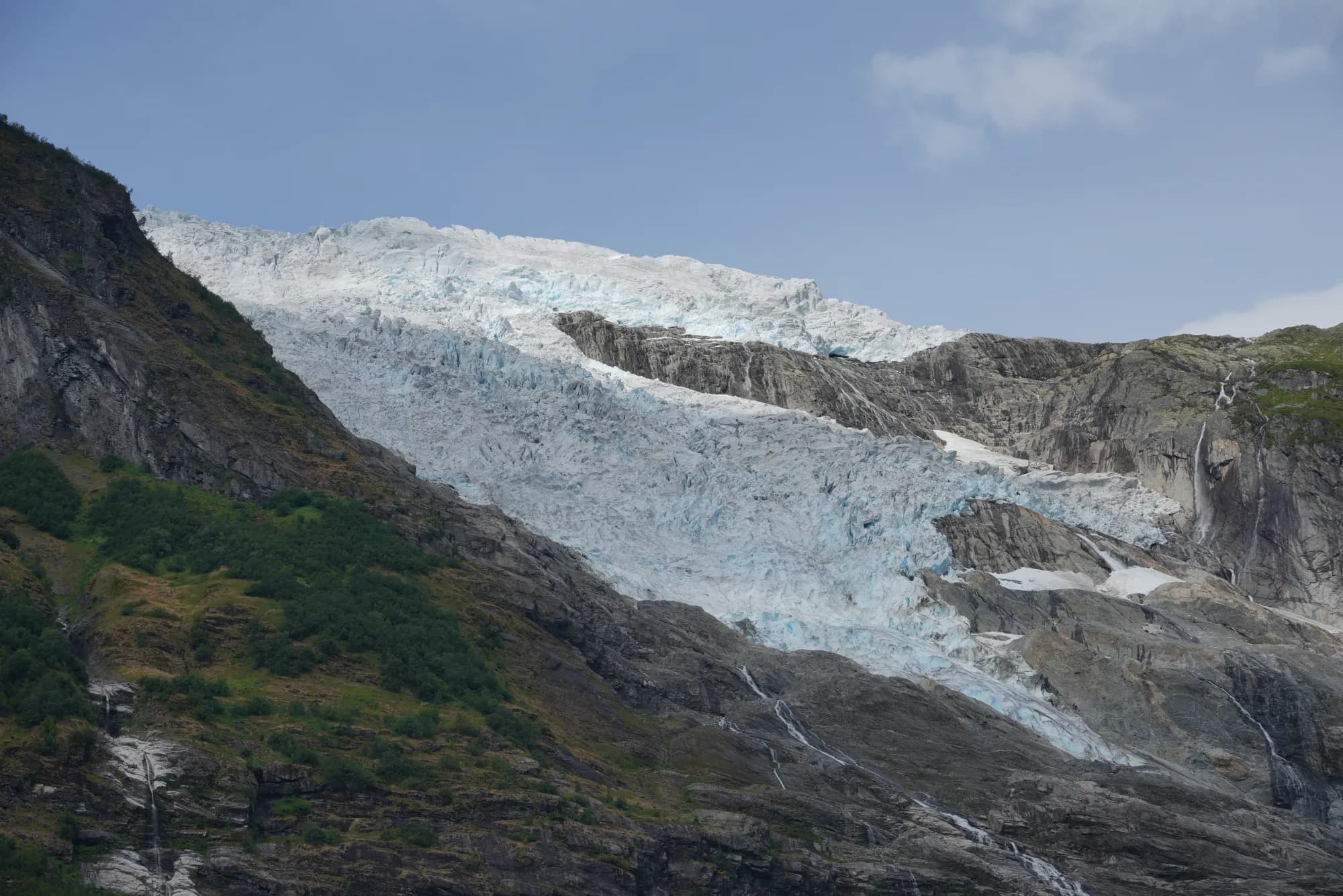
A municipal road runs just over six kilometres up Supphelledalen and ends right below the glacier. High above lies Flatbreen. For generations, blocks of ice have broken off its edge, crashed down the rock wall and frozen together into a separate glacier on the valley floor. At its lowest it reached about 60 metres above sea level, further down than any other glacier in southern Norway. Today little blue ice is left down there, but ice can still fall from Flatbreen.
Don't miss: The path up to Flatbrehytta (994 m above sea level). It is steep and hard going, with almost 1,000 metres of climbing. Allow 4–6 hours there and back. You only go out onto Flatbreen with a guide.
Motorhome tip: Parts of the road have 12.4 metres as the maximum length. There is parking and a toilet at the end. Do not walk in under the icefall — ice can come down without warning.
8. Bøyabreen — the glacier lake below the icefall
The Rv 5 heads north up Bøyadalen towards Fjærlandstunnelen. Just before the tunnel a short side road leads to Brævasshytta, which serves food. From there you look across the glacier lake to Bøyabreen. Down by the water only small remnants of the glacier are left, but the icefall still hangs on the mountainside above.
Motorhome tip: Park at the Bøyadalen rest area on the Rv 5. It has five spaces for large vehicles, and from there it is just under half a kilometre to walk. Do not go into ice caves or right up to the ice.
9. Skei — under the glacier to Jølstravatnet
Fjærlandstunnelen runs 6.4 kilometres through the mountain beneath Jostedalsbreen. A little later comes Kjøsnestunnelen, 8.6 kilometres long. It opened in 2022 and took the traffic away from the rockfall-prone road along Kjøsnesfjorden. Then the landscape opens up at Skei, at the eastern end of Jølstravatnet — one of Norway's deepest lakes.
Motorhome tip: Jølster Panorama, a kilometre and a half from Skei, lies down by the water, has hook-ups on all 80 pitches and is open all year round. Skei has fuel stations.
Practical info for motorhomes
Roads: The Rv 5 and the Fv 55 are open to vehicles and combinations up to 19.5 metres, and the Rv 5 is mostly seven to eight metres wide (Statens vegvesen's road database). The tunnels are what stand out: Frudalstunnelen (6.8 km), Bergstunnelen (2.6 km), Fjærlandstunnelen (6.4 km) and Kjøsnestunnelen (8.6 km). None of them has a signed height limit, but the first two climb at just under 5%. Statens vegvesen issues alerts when Fjærlandstunnelen or Frudalstunnelen is closed, so check vegvesen.no before you drive. The lowest points on the whole route are the short tunnels in Jostedalen, signed at 4.2–4.3 metres. The Rv 5 between Sogndal and Skei has no toll stations; the only toll road on the route is the private Brevegen to Nigardsbreen.
Parking: The rest areas on the Rv 5 have room for large vehicles: Vatnasete in Sogndalsdalen and Bøyadalen have five spaces each, and Berge, between Frudalstunnelen and Bergstunnelen, has two. Never park in a passing place.
Overnight stays: Use the campsites. In the Nigardsbreen nature reserve both overnight parking and camping are forbidden. Along a public road you may park on uncultivated land as long as it causes no significant damage or nuisance (Outdoor Recreation Act, section 4), and signs prohibiting parking or camping always apply. On cultivated land you need permission from the owner or user. The law's rules for tents — at least 150 metres from an inhabited house or cabin, and no more than two nights at a time without permission from the owner or user (section 9) — are a good guide for motorhomes too. Never drive off-road.
Campsites:
- Kjørnes Camping — three kilometres from Sogndal centre, by the fjord, closed in winter
- Uteplassen — Selseng in Sogndalsdalen, on the Rv 5 just before Frudalstunnelen, says it is open all year
- Gaupnetunet — Gaupne, room for 40 units
- Jostedal Camping — Gjerde in Jostedalen, normally 1 May–15 October, with a service point
- Bøyum Camping — Fjærland, by the glacier museum, with cassette emptying
- Jølster Panorama — by Jølstravatnet near Skei, open all year
Fuel: Fill up in Sogndal before you head in towards the glaciers. In Fjærland there is an unmanned pump by the glacier museum (cards only), and in Jostedalen the Joker shop at Gjerde has a fuel pump. Skei has fuel stations.
Waste disposal: Not in the toilets at rest areas and museums. Jostedal Camping has a motorhome service point, Bøyum Camping one for cassettes, and Jølster Panorama has its own disposal system. Norway's National Tourist Routes also mention Gaupne.
Ferries: None on the route. If you are coming from Lærdal and the E16, the Fodnes–Mannheller ferry on the Rv 5 takes about a quarter of an hour — timetables at norled.no.
Combine with
- Sognefjellet and Jotunheimen — that route ends in Solvorn, just under 20 km from Sogndal on the road to Gaupne. Drive it in reverse: the ferry over to Urnes and back to Solvorn, then the Fv 55 along Lustrafjorden and over Sognefjellet to Lom.
- Gaularfjellet and Balestrand — from Skei the E39 runs along Jølstravatnet to Førde, about 45 km, where that route ends. Drive it in reverse to Balestrand.
- Aurlandsfjellet and Nærøyfjorden — from Sogndal it is about 30 km to Lærdalsøyri with the Mannheller–Fodnes ferry. From there that route crosses Aurlandsfjellet when the mountain road is open.
- Gamle Strynefjellsvegen — from Skei the E39 and the Fv 60 cross Utvikfjellet to Olden, about 60 km, where that route begins.
Weather
Fjærland, right below the glacier, is the wet end of the route. Over twelve months of measurements between September 2025 and September 2026, the station at the glacier museum recorded about 1,800 millimetres of rain, roughly twice as much as Sogndal in the same months. Summer is mild all the same: in July 2026 the average at the museum was 14 degrees, and the warmest day reached 25. Bring rain gear and good shoes for the smooth rock. Check yr.no for Fjærland, Jostedal and Skei.
This route is part of Bobilvei's hand-picked motorhome routes in Norway. Every route is quality-checked with a focus on motorhome suitability, parking and local experiences.