- Route
- Trondheim – Levanger – Stiklestad – Steinkjer – Vist – Hustad – Kjerknesvågen – Straumen – Sakshaug – Skarnsundbrua – Mosvik – Leksvik – Vanvikan – Rørvik–Flakk (ferry) – Trondheim (E6, Fv 774, Fv 757, Fv 761, Fv 6936, Fv 755, Fv 715 and Rv 706)
- Length
- about 290 km round trip, including the Rørvik–Flakk ferry. The Golden Detour itself, through Inderøy between Vist and Røra on the E6, is around 30 km.
- Driving time
- Around 6 hours without stops, ferry included
- Recommended number of days
- 2–3. Two days are enough for a weekend; with three you can fit in more of the farm shops.
- Best season
- June–August, when the medieval churches and Egge museum keep summer hours. The roads are open all year, but many of the small businesses have shorter opening hours outside the summer.
- Difficulty
- Easy. Paved all the way, open to vehicle combinations of 19.5 metres, and no mountain passes. A narrower road around Kjerknes, tight farmyards and one ferry that cannot be booked.
- Last checked
- October 2026
Why this route?
Drive north from Trondheim and the country grows gentler with every mile: fields of grain, big Trøndelag farmhouses and stone churches from the 12th century. At the inner end of the Trondheimsfjord, Inderøy reaches out into the water, a peninsula with fjord on almost every side. Since 1998, farms, artists and small producers here have worked together under the name Den Gyldne Omvei, the Golden Detour — around 30 kilometres of county road that the E6 drives straight past.
The route is a loop. Up the east side of the fjord to Levanger, Stiklestad and Steinkjer, onto Inderøy from the north, and home along the west side over Skarnsundbrua and through Leksvik to the Rørvik–Flakk ferry. You drive hardly any road twice.
Plan around the opening hours. Gangstad farm dairy is mostly open on weekdays only, several of the other shops open three or four days a week, and the medieval churches open on Sundays in summer. You will find the current times at dgo.no.
Stops along the route
1. Levanger — the wooden town on the sound
Around an hour and a half from Trondheim, 80 km north on the E6, lies the town that was granted town status in 1836. The streets in the centre are full of wooden houses in Swiss chalet style and Jugendstil, many of them from the few years between the building act of 1896 and the requirement to build in masonry from 1904. Few places in Norway have kept so much from that period together. Levanger was awarded the Olavsrosa heritage mark for its wooden town in 2013, and in 2018 parts of the centre were listed.
Don't miss: A slow walk from Torget, the square, and through the streets around it.
Motorhome tip: Leave the motorhome at Levanger Camping on Moafjæra and walk around a kilometre and a half into the centre. The campsite is open all year, and just south of it there is a dump station with water. Levanger's police by-law bans camping on and beside roads and squares in built-up areas, unless signs say otherwise.
2. Stiklestad — where Olav fell
Around 17 km further on, east of Verdalsøra, lies the place where Olav Haraldsson fell on 29 July 1030, fighting a peasant army from Trøndelag. The following year he was declared a saint. The stone church at Stiklestad was built around 1180, and tradition says it stands over the spot where he died. Around the church you will find the cultural centre, a folk museum with more than 30 old buildings from Verdal and Innherred, and the reconstructed medieval farm Stiklastadir.
Don't miss: «Spelet om Heilag Olav», the open-air play staged in the amphitheatre during the Olsok days at the end of July. The amphitheatre seats more than 5,000, and tickets are sold in advance.
Motorhome tip: Stiklestad Camping lies by the Verdalselva river, around three kilometres from the cultural centre, and has room for around 60 motorhomes with electricity and 100 without. If you are only stopping by, the motorhome can stand in the ordinary, free car park at the cultural centre, but without electricity. In Verdal, too, camping is banned on and beside roads and squares in built-up areas, unless signs say otherwise.
3. Steinkjer and Egge — at the very north of the fjord
Drive back to the E6 and north, around 35 km. Steinkjer lies where the Steinkjerelva river flows into Beitstadfjorden, the northernmost part of the Trondheimsfjord. Most of the town you see was built after the war: German bombs reduced around four-fifths of Steinkjer to ruins on 21 April 1940.
Just north of the centre, up on the moraine ridge of Eggevammen, lies the farm of Egge. It was a chieftain's seat in saga times, and one of its owners, Kalv Arnesson, was among those who led the peasant army against Olav at Stiklestad. Up on the ridge you can walk among the burial mounds of a large grave field.
Don't miss: Egge museum. The summer season is short, only around seven weeks (in 2026 from 21 June to 9 August, every day except Monday, 11:00–15:00), but the grounds are a pleasant walk all year.
Motorhome tip: Fill up and empty the toilet in Steinkjer; we have not found a dump station on Inderøy. Then drive six kilometres south on the E6 to Vist and turn off towards «Den Gyldne Omvei».
4. Hustad and Gangstad — onto the detour
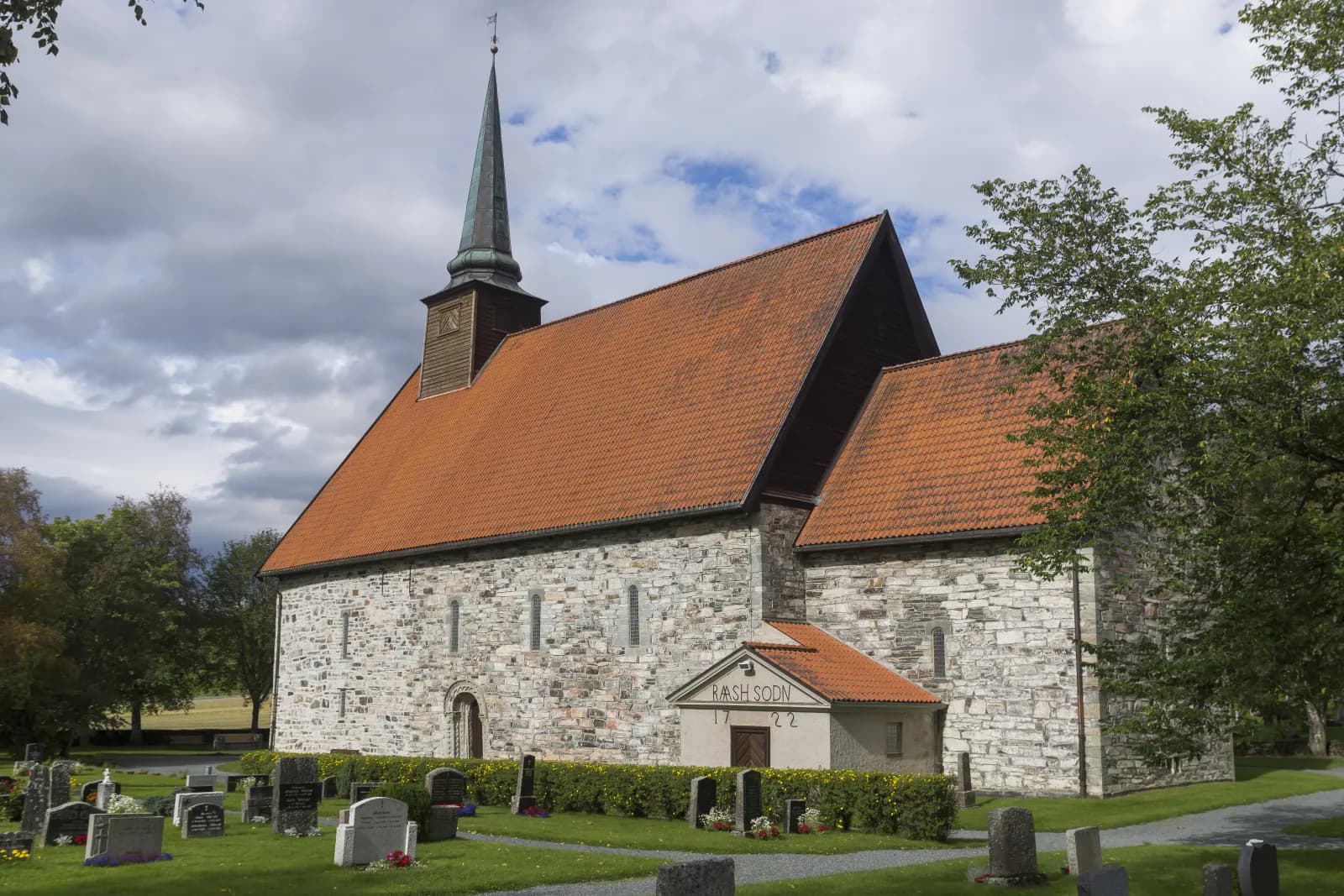
The Fv 761 takes you west towards Sandvollan. After just under four kilometres, a narrow side road climbs to Hustad Church, the smallest surviving stone church in Trøndelag. It was built in the mid-12th century, in the farmyard of a powerful family's estate. Since the church was closed in 1887 it has never been restored, and the interior built up over several centuries is just as it was. The churchyard still has its old log fence; nowhere else in Trøndelag has a fence like it survived. In summer the church is open on Sunday afternoons (in 2026 from 15 June to 10 August).
A couple of kilometres away is Gangstad farm dairy. It started in 1998 as the first in Norway allowed to make cheese from its own cows' milk. Its blue cheese Nidelven Blå was named the world's best cheese at the World Cheese Awards in Trondheim in 2023.
Don't miss: Ice cream from the dairy, sold in the farmyard in summer. The farm shop is open on weekdays 09:00–15:00; at weekends it is usually closed.
Motorhome tip: Hustadvegen is a narrow dead end of just under a kilometre that ends in the farmyard by the church. The Golden Detour promises parking at all its members, but we have not found anywhere to turn a large motorhome there. With a large motorhome, don't drive up, or ask Fortidsminneforeningen (the Norwegian heritage society) first. Gangstad has parking for customers.
5. Kjerknesvågen — the harbour on the north-west side
The Fv 6936 runs around twelve kilometres west through Kjerknes to the harbour. The road is narrower here, with long stretches of only 5–5.5 metres of asphalt, so slow down when you meet large vehicles. Kjerknesvågen Kai is run by a quay and boat association and has twice been voted Norway's second-best guest harbour. This is also home to the jekt «Pauline», a sailing reminder of the days when these cargo boats carried goods around the fjord.
Don't miss: Waffles from the kiosk on the quay. It is open at weekends from May to September, and more often in midsummer.
Motorhome tip: In summer you can stay with a motorhome at the harbour, with electricity, water, showers and a sanitary building open around the clock. You pay with Vipps or book online. There are only a few pitches, so arrive early on a summer weekend. A couple of kilometres south of the harbour, Berg Gård & Inderøy Brenneri has a farm shop with lamb and pork from its own farm abattoir, rapeseed oil and mustard. In autumn 2026 it was open Thursday–Saturday.
6. Straumen — Nils Aas and Muustrøparken
The Fv 6936 south and the Fv 755 east take you around eleven kilometres to the municipal centre of Straumen, where a narrow strait separates Børgin from the main fjord. The sculptor Nils Aas (1933–2004), who made the Haakon VII monument in Oslo, grew up here. Nils Aas Kunstverksted, opened in 1996, shows his work alongside changing exhibitions. Next door is Muustrøparken, with twelve of his sculptures. Aas also drew the municipal coat of arms, four golden flounders. The fish mattered here: flounder from Børgin once travelled alive by train from Røra to restaurants in Oslo.
Don't miss: Lunch at Kjerringa me' Straumen, a café and second-hand shop in Klokkarstu from 1755, the oldest house in Straumen. It is open Friday–Sunday.
Motorhome tip: Straumen is small and easy to walk around. The Golden Detour points to parking at Straumen torg, at Muustrøparken, at Herman Løchens plass by Straumbrua and at the town hall; pick the one with the most room, and walk. Straumen has a filling station.
7. Sakshaug — the church with the view
A kilometre and a half west of Straumen, with the fjord below, stands Sakshaug old church. Work began after 1130, and the church was consecrated in 1184. The stonemasons who built it left the same marks as in Nidaros Cathedral. In 1871 the parish got a new church. The old one was stripped of its woodwork and stood as a ruin for almost 40 years, before it got a roof again and was restored. It is now being restored once more, until 2027, and will get its limewashed façade back. In summer it is open on Sunday afternoons, and from early July to early August also Tuesday–Friday around midday. Individual visitors go in free.
Don't miss: Inderøy Mosteri right next door, with apple juice and cider and a farm shop that is open most days. Walk up to Øyna, too, for the view over the fjord.
Motorhome tip: There is only a small, free car park by the church. With a large motorhome, use the simple motorhome parking at Øyna, a few hundred metres away, which the Golden Detour points to — you can also stay the night there — or park in Straumen.
8. Skarnsundbrua and Mosvik — across the sound
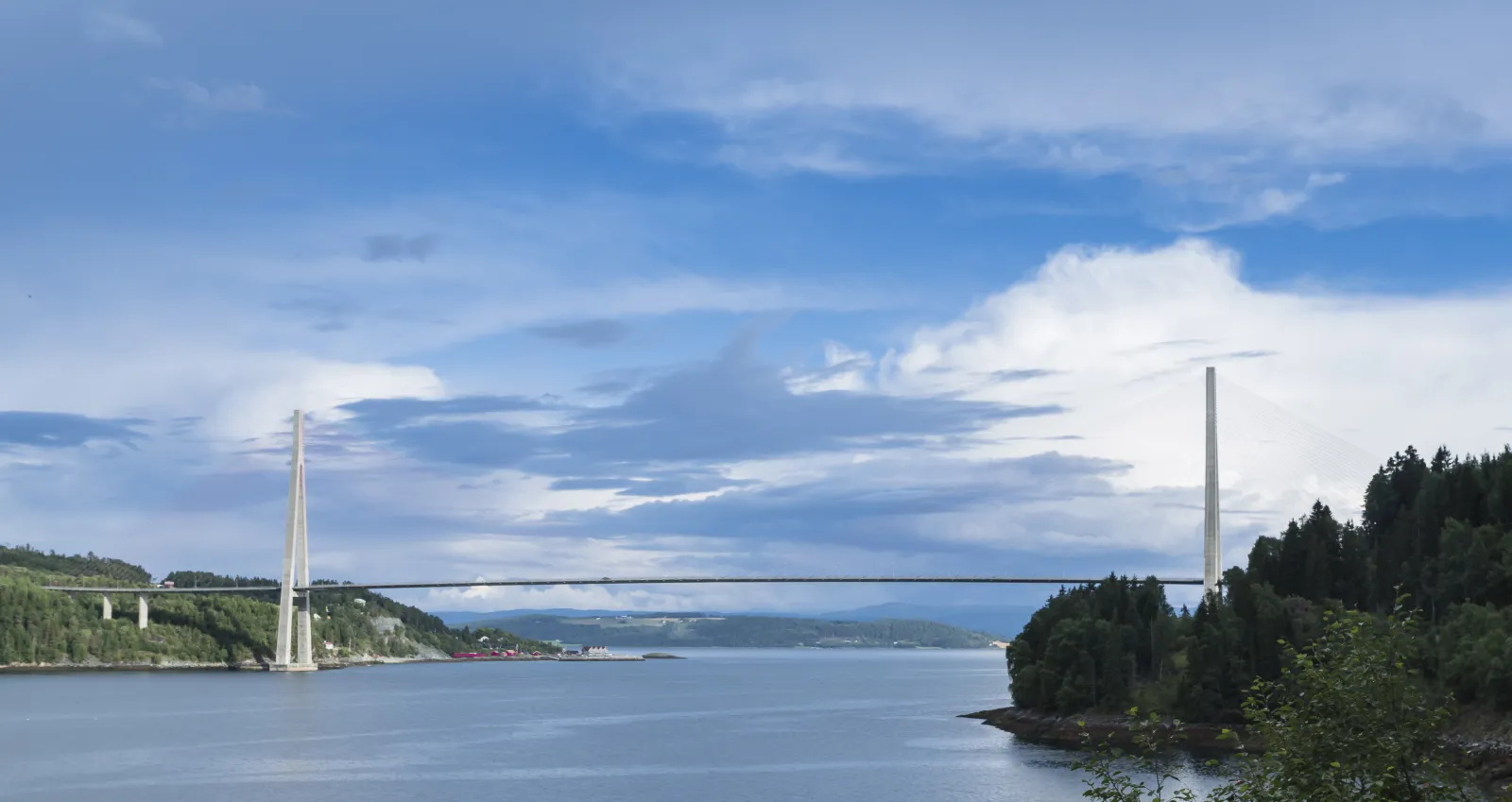
The Fv 755 takes you west past Utøy and down to Vangshylla, around eleven kilometres. Skarnsundbrua opened in 1991. It is 1,010 metres long, and its 530-metre main span made it the world's longest cable-stayed bridge when it was finished. No cable-stayed bridge in Norway is longer, and it is a listed structure. The tolls were removed in 2007. On the other side lies Mosvik, a forestry village where jekts were built and fitted out for the fjord trade in the 18th and 19th centuries.
Motorhome tip: The Skarnsundet rest area, with a hard surface, is on the Mosvik side just west of the bridge.
9. Leksvik and Vanvikan — along the fjord to the ferry
From Mosvik the Fv 755 runs through the forest to Leksvik and on along the fjord to Vanvikan, around 65 km. From there it is eight kilometres on the Fv 715 to the ferry quay at Rørvik. The ferry to Flakk takes 25 minutes, and from Flakk it is around 20 minutes into Torvet in Trondheim.
Motorhome tip: Between Leksvik and Vanvikan you drive through Sprangakslatunnelen from 1962, signed at 4.1 metres — the lowest out on the loop, but a good margin for an ordinary motorhome. The ferry cannot be booked; if it is full, take the next one.
Practical info for motorhomes
Roads: The whole loop is paved, and the E6, the county roads and the municipal roads up to Hustad and Sakshaug are open to vehicle combinations of 19.5 metres (the road database of the Norwegian Public Roads Administration). The Fv 761 and Fv 755 are mostly 6–7 metres wide; the Fv 6936 around Kjerknes has long stretches of only 5–5.5 metres. The lowest signed height out on the loop is 4.1 metres, in Sprangakslatunnelen; on the E6 it is 4.4 metres. In central Trondheim, the road database records a 3.2-metre sign where Havnegata passes under the railway at Brattøra. So head out towards the E6 over Bakke bru and Innherredsveien, and come back in from Flakk via Ila and Kongens gate — not through Havnegata. The hills are short and under ten per cent. At Nesvatnet in Levanger, the E6 runs on a temporary road after a landslide in August 2025, open to all vehicles. A new four-lane E6 between Kvithammar and Åsen is due to open in the winter of 2026–27. Check vegvesen.no/trafikk before you set off.
Parking: Many of the places on the Golden Detour are farms and small businesses with room for a few cars. Never drive into a farmyard with a motorhome, and don't park where you block tractors and vans. Good places to leave the motorhome are Levanger Camping, the large, free car park at the Stiklestad cultural centre, the car parks the Golden Detour points to in Straumen, the motorhome parking at Øyna and the quay at Kjerknesvågen. Never park in passing places.
Overnight stays: The Outdoor Recreation Act lets you pitch a tent on uncultivated land (utmark) at least 150 metres from an inhabited house or cabin, for at most two nights in the same place without the consent of the owner or user. It gives no right to park a motorhome; there, the signs and the landowner's rules apply. Along the roads on Inderøy it is mostly farmland and farmyards — cultivated land (innmark), where the right of public access does not let you set up camp. Use the harbour at Kjerknesvågen in summer, the campsites or the simple motorhome parking at Øyna. Never drive off the road into the terrain.
Campsites:
- Levanger Camping — on Moafjæra, around a kilometre and a half from the centre, open all year
- Stiklestad Camping — by the Verdalselva river, around three kilometres from the cultural centre
- Kjerknesvågen Kai — a few motorhome pitches with electricity at the harbour in summer, pay with Vipps or book online
Fuel: The E6 has stations in Levanger, Verdal and Steinkjer, and St1 in Steinkjer is open around the clock. On Inderøy there is a station at Straumen, and on the west side in Mosvik, Leksvik and Vanvikan. You never drive far without one.
Waste disposal: We have not found a motorhome dump station on Inderøy or along the Fv 755 to Vanvikan. Empty your tanks before you drive onto the detour: on Moafjæra in Levanger, at YX in Verdal or in Steinkjer (see bobilplassen.no). Kjerknesvågen Kai has water and sanitary facilities but lists no dump point. In Trondheim there are dump points at Lade and Nyhavna.
Tolls: On the E6 out of Trondheim you pass toll stations, among them at Ranheim, and the new E6 Kvithammar–Åsen will also be tolled. Skarnsundbrua is free, and the ferry fare includes the tolls. Without an AutoPASS agreement the bill goes to the owner, and a motorhome over 3,500 kg pays the car rate only with an agreement and a tag, and only when it is registered as M1 with the tag issuer. Agree with the owner how you will settle up.
Ferries: Rørvik–Flakk (AtB) — around 25 min, at least every half hour during the day. The ferry cannot be booked. You pay for the vehicle by length, under 6, 6–12 or over 12 metres, with AutoPASS; without AutoPASS or registration at ferrypay.no the owner gets an invoice by post. From 1 June to 31 August a higher summer fare applies. Timetables at atb.no.
Combine with
- Fosen and the Trøndelag coast — from Vanvikan it is eight kilometres to Rørvik. Drive the Fosen loop from there instead of taking the ferry home, and come back via Brekstad–Valset.
- Hitra and Frøya — the same start in Trondheim, but heading west, under the sea and out to the fishing villages.
- Trondheim – Røros — the inland route from the same city: up Gauldalen to the mining town and home over Tydal and Selbu.
- The Helgeland coast — if you want to go further north, it is around 300 km from Steinkjer to Brønnøysund, where that route begins.
- Falstadsenteret — on the site of the German prison camp at Falstad there is now a memorial centre that also works on human rights, around 17 km from the centre of Levanger.
Weather
Innherred has colder winters than the coast. At the weather station by Egge in Steinkjer, the January average is around minus two degrees, and the daily mean in July and August is around 14–15 degrees. April, May and June are the driest months. From September to January the most rain falls, around 75–95 millimetres a month. Check yr.no for Levanger, Straumen and Steinkjer.
This route is part of Bobilvei's hand-picked motorhome routes in Norway. Every route is quality-checked with a focus on motorhome suitability, parking and local experiences.