- Route
- Brønnøysund – Bodø (Fv17 Kystriksveien, Norwegian Scenic Route Helgelandskysten)
- Length
- about 400 km of road and around 50 km by ferry (five crossings), plus just under 30 km return to Torghatten
- Driving time
- 7–9 hours at the wheel and around 3 hours on ferries, plus waiting
- Recommended number of days
- 5–7
- Best season
- June–August. The road is open all year, but the Engabreen boat runs only in summer, and several rest-area toilets close in winter.
- Difficulty
- Moderate. No high mountain passes, but narrow sections, long tunnels and five ferries to fit into your days.
- Last checked
- October 2026
Why this route?
On Kystriksveien the sea sets the pace. Drive an hour, then wait on the quay for the ferry — after a couple of days you stop looking at your watch. Between crossings lie islets, white beaches and mountains rising straight from the sea.
Almost the whole stretch is Norwegian Scenic Route Helgelandskysten, and during one ferry crossing you cross the Arctic Circle. It takes longer than the E6. That is the point. With a motorhome your kitchen travels with you, turning the wait on the quay into a coffee break with a view.
Stops along the route
1. Torghatten and Brønnøysund — the mountain with a hole
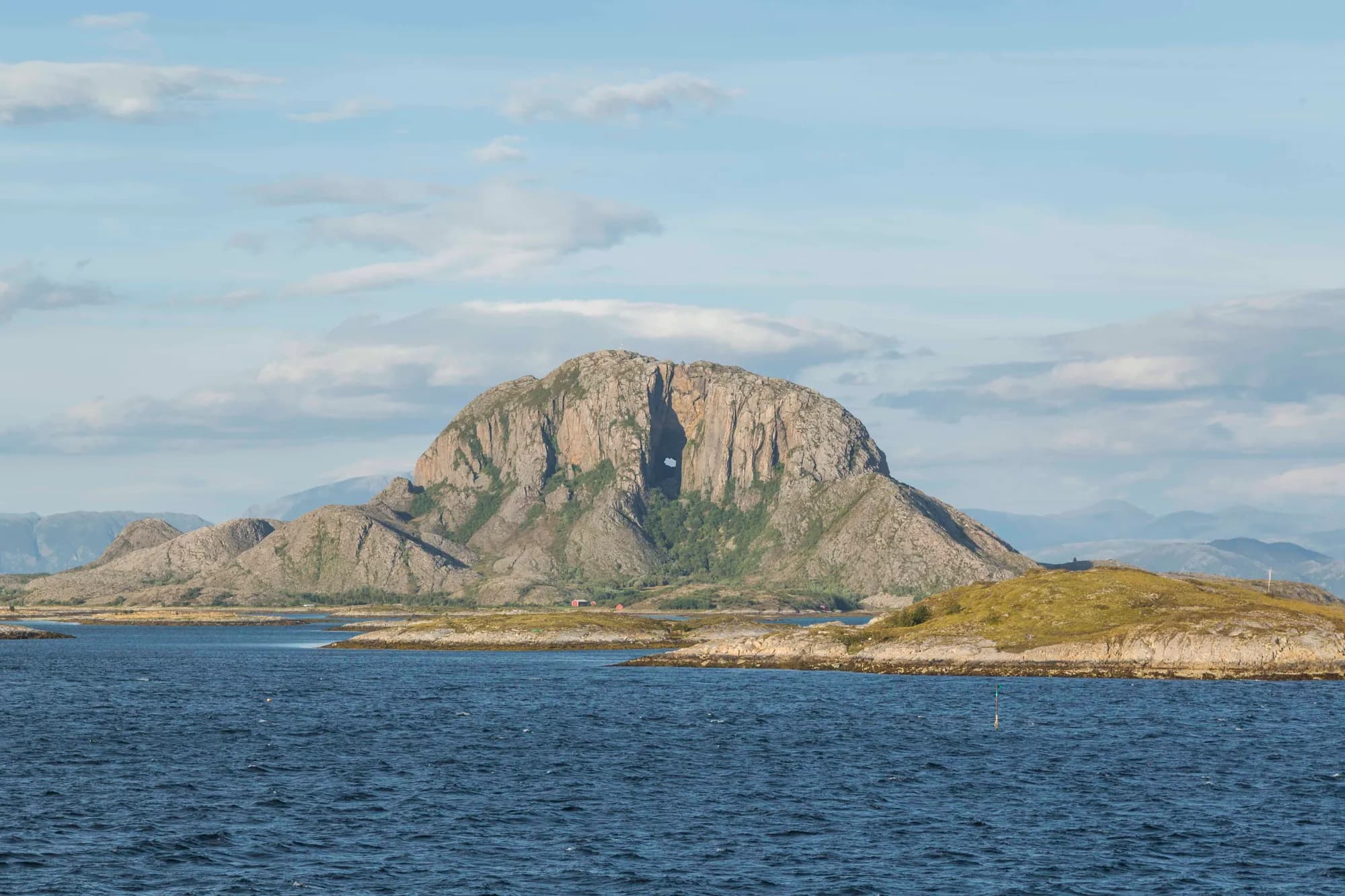
Southwest of Brønnøysund stands Torghatten, with a hole right through the mountain, around 160 metres long and 35 metres high. The path follows stone steps through birch woodland — allow just under half an hour uphill. Brønnøy municipality advises against walking through the hole in the winter half of the year and in heavy rain.
Don't miss: Trælvikosen just north of Brønnøysund, where a line of stones leads across the sandy seabed. Come at low tide.
Motorhome tip: Torghatten's large car park has bus spaces, and the campsite is nearby. Fill up and empty toilet and grey water in Brønnøysund before the ferries.
2. Tjøtta — two ferries and a quiet memorial
The ferries begin: a short crossing from Horn to Andalsvåg, then through Vevelstad to Forvik and around an hour across to Tjøtta. Here two war cemeteries stand side by side, with graves for several thousand Soviet prisoners of war and over a thousand who died when the prison ship Rigel was sunk nearby in 1944.
Don't miss: With an extra day, take the ferry to the World Heritage islands of Vega.
Motorhome tip: A couple of hours can separate departures from Forvik — check reisnordland.no.
3. Alstahaug and De syv søstre
A short detour takes you to Alstahaug, where Petter Dass-museet stands beside the medieval church and old parsonage. Just south of Sandnessjøen rise De syv søstre, seven peaks in a row. The highest, Botnkrona, is 1,072 metres, and all have marked paths.
Motorhome tip: Offersøy Camping lies beside the sea between Tjøtta and Sandnessjøen. Sandnessjøen has fuel and a dump station.
4. Nesna, Sjonfjellet and Hellåga
Levang–Nesna takes around 25 minutes. The road then crosses Sjonfjellet, the route's highest point, overlooking the sea and Lovund, and descends to Sjona fjord. At Hellåga, steps descend to the water from a wave-shaped service building — a fine lunch stop.
Don't miss: Grønsvik kystfort a little further north, a German coastal battery from 1942 overlooking the islands.
Motorhome tip: Sjonfjellet rest area has only three motorhome spaces. Hellåga has a dedicated dump station — empty here before the ferries north, never in rest-area toilets; that is prohibited everywhere along the scenic route.
5. Kilboghamn–Jektvik — across the Arctic Circle
The ferry crossing people remember. For around an hour the ferry heads north, crossing the Arctic Circle somewhere along the way. Step onto the deck.
Motorhome tip: You cannot book, and departures can be several hours apart, particularly at weekends and outside summer. Arrive early in July.
6. Svartisen — the glacier by the fjord
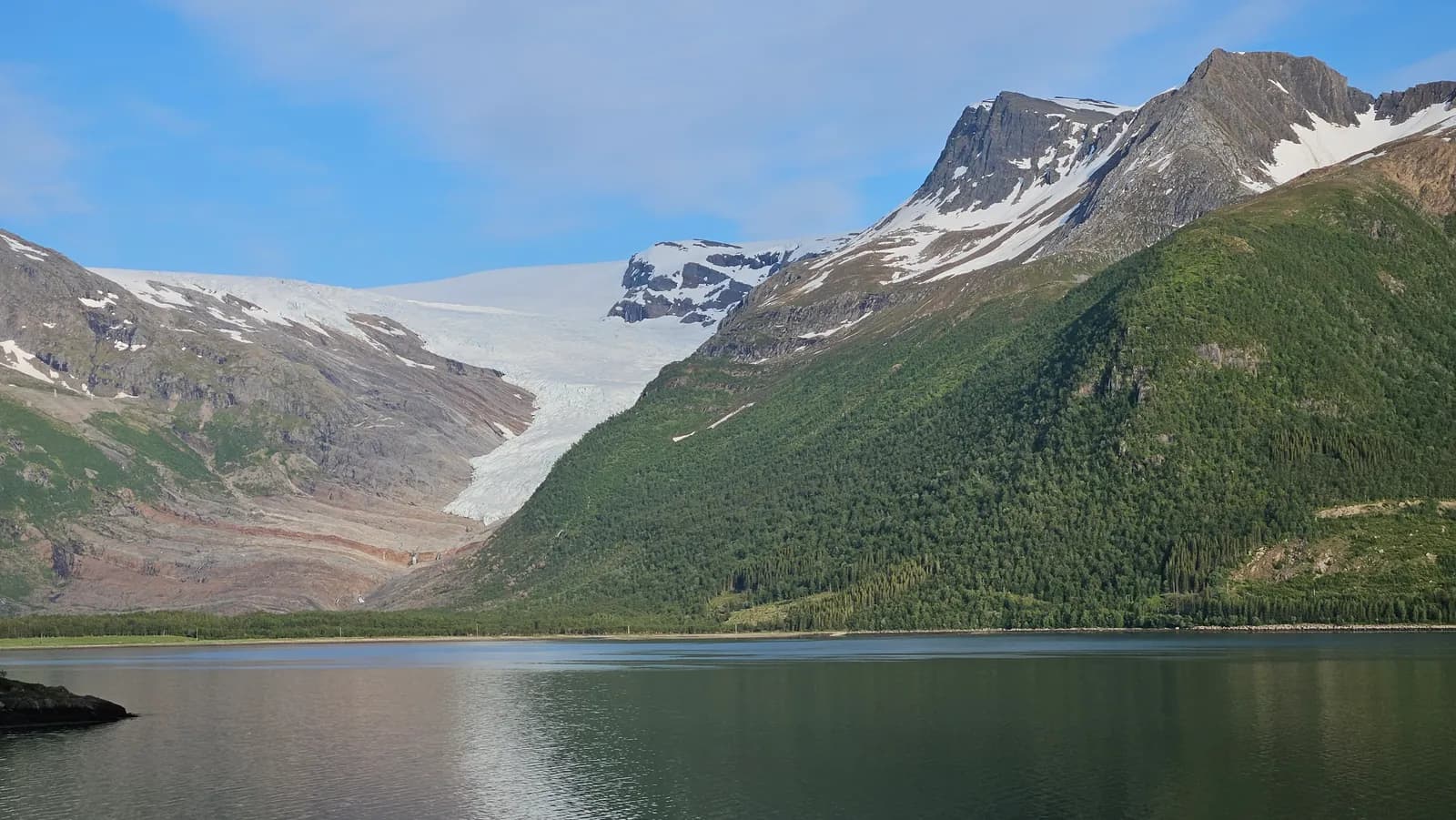
After ten minutes on the Ågskardet–Forøy ferry, Holandsfjorden opens up. Across the water lies Engabreen, an arm of Svartisen reaching far down towards the fjord. Braset rest area looks straight across to it.
Don't miss: The boat across the fjord from Holandsvika just north of Braset, and the walk towards the glacier. The boat usually runs late May–September. Stay at least 100 metres from the glacier front.
Motorhome tip: Dump station at Holand. After Svartistunnelen, Fv17 between Glomfjord and Ørnes is narrow and winding. Drive slowly.
7. Ureddplassen and Storvika — architecture beside the open sea
North of Ørnes come two of the scenic route's finest rest areas. Ureddplassen has a broad terrace facing the sea. Here stands the memorial to submarine Uredd, which sank in Fugløyfjorden with its crew and Linge agents aboard. On clear days you see Lofotveggen. Soon afterwards comes Storvika, with a long sandy beach below the road.
Don't miss: The midnight sun from Ureddplassen around Midsummer's Eve.
Motorhome tip: Storvika has a fuel station with waste disposal.
8. Saltstraumen — the maelstrom
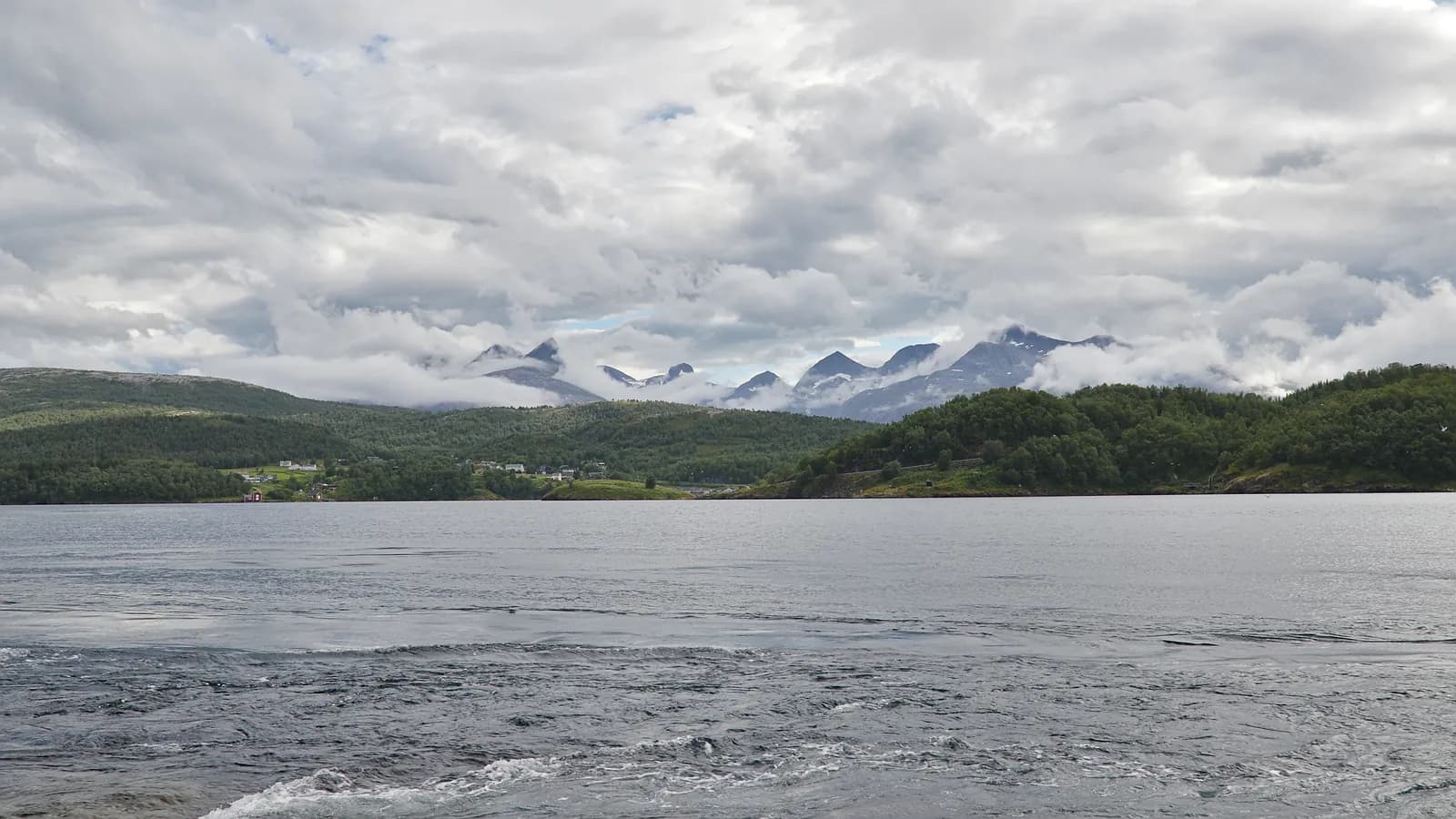
Saltstraumen is a maelstrom: tides squeeze through a narrow sound, and the surface boils with whirlpools. Times of strongest flow are on visitbodo.com; arrive half an hour early. It is strongest around new and full moon. Five kilometres further on Fv17, at Godøystraumen, the scenic route itself ends.
Motorhome tip: Parking beside the current. Pluscamp Saltstraumen Camping is a few hundred metres away, with drop-in motorhome pitches.
9. Bodø — the end of the route
Kystriksveien ends in Bodø, where Lofoten begins for many travellers. Norsk Luftfartsmuseum is worth a couple of hours.
Motorhome tip: The direct Bodø–Moskenes ferry takes just over three hours and is the only connection in Nordland where you can book a place. Book well ahead in summer at torghatten.no; with a booking you must queue at least 45 minutes before departure.
Practical info for motorhomes
Roads: Fv17 is open all year. The highest point is Sjonfjellet north of Nesna, where convoy driving may apply in winter. The lowest signed tunnel height is 4.0 metres, and the road allows vehicle combinations of 19.5 metres (Statens vegvesen's road database). Check vegvesen.no/trafikk before driving.
Parking: Most rest areas have plenty of room, but are made for breaks. Never park in passing places.
Overnight stays: Use campsites when you can. Where parking is allowed, you can usually sleep in the motorhome, but follow signs — rest areas generally limit stays to one day. Out in nature: at least 150 metres from inhabited houses, at most two nights in one place without the landowner's consent, and never drive off-road into the terrain.
Campsites:
- Torghatten Camping — at the foot of Torghatten, open all year
- Offersøy Camping — between Tjøtta and Sandnessjøen, April–September
- Topcamp Havblikk — central Nesna
- Pluscamp Saltstraumen Camping — by the maelstrom, 30 km from Bodø
Fuel: Fill up before the ferries. Most settlements have stations, including Brønnøysund, Sandnessjøen, Nesna, Glomfjord and Ørnes.
Waste disposal: Nasjonale turistveger lists dump stations at Brønnøysund, Sandnessjøen, Nesna, Hellåga, Øresvik, Holand and Storvika. Fill fresh water at campsites; do not expect drinking water at every dump station.
Ferries:
- Horn–Andalsvåg — about 20 min (Torghatten)
- Forvik–Tjøtta — about 1 hour (Boreal)
- Levang–Nesna — about 25 min (Torghatten)
- Kilboghamn–Jektvik — about 1 hour (Torghatten)
- Ågskardet–Forøy — about 10 min (Torghatten)
None can be booked, and July can bring queues. Timetables at reisnordland.no. In summer motorhomes pay by length. Ask whether the vehicle has an AutoPASS tag or FerryPay — then the bill goes to the owner, so agree how to settle up. Otherwise pay by bank card aboard; if you do not, the owner receives an invoice. Approaching from the south on Fv17 adds Holm–Vennesund; from the E6, Fv76 reaches Brønnøysund without a ferry.
Combine with
- Lofoten — Bodø–Moskenes drops you near Reine and Å.
- Vesterålen and Andøya — drive north through Lofoten and continue to Andenes.
- Saltfjellet and the Arctic Circle — the inland road between Mo i Rana and Bodø, over the treeless mountains on the E6 and past Saltstraumen.
- Kystriksveien through Namdalen — the southern part of Kystriksveien, from Steinkjer to Holm. The Holm–Vennesund ferry and around 50 km more bring you to Brønnøysund, where this route begins.
Weather
Summers are cool: the normal July daily mean is around 14 degrees in both Brønnøysund and Bodø. In Bodø, May–July is driest; more rain arrives from August. Bring a warm jumper for the ferry deck. In Bodø the midnight sun lasts from early June into July. Check yr.no for Brønnøysund and Bodø.
This route is part of Bobilvei's hand-picked motorhome routes in Norway. Every route is quality-checked with a focus on motorhome suitability, parking and local experiences.