- Route
- Ørsta – Bondalen – Sæbø – Sæbø–Leknes (ferry) – Urke – Øye – Norangsdalen and Lygnstøylvatnet – Hellesylt – Ljøen – Stranda (Fv 655 and Fv 60)
- Length
- about 90 km from Ørsta to Stranda, including the ferry across Hjørundfjorden. If you want to see Volda too, it is 10 km each way from Ørsta.
- Driving time
- Around two hours without stops, plus waiting time for the ferry
- Recommended number of days
- 2–3
- Best season
- May–September. The roads are open all year, but the campsite at Sæbø does not open until June, and the ferry from Hellesylt to Geiranger only runs in season.
- Difficulty
- Moderate. No mountain passes and no hairpin bends, but from Leknes to Hellesylt the road is narrow, down to 3.5 metres at its tightest, with passing places and six narrow avalanche shelters signed as low as 3.9 metres. Three old bridges on the route take only one vehicle at a time.
- Last checked
- October 2026
Why this route?
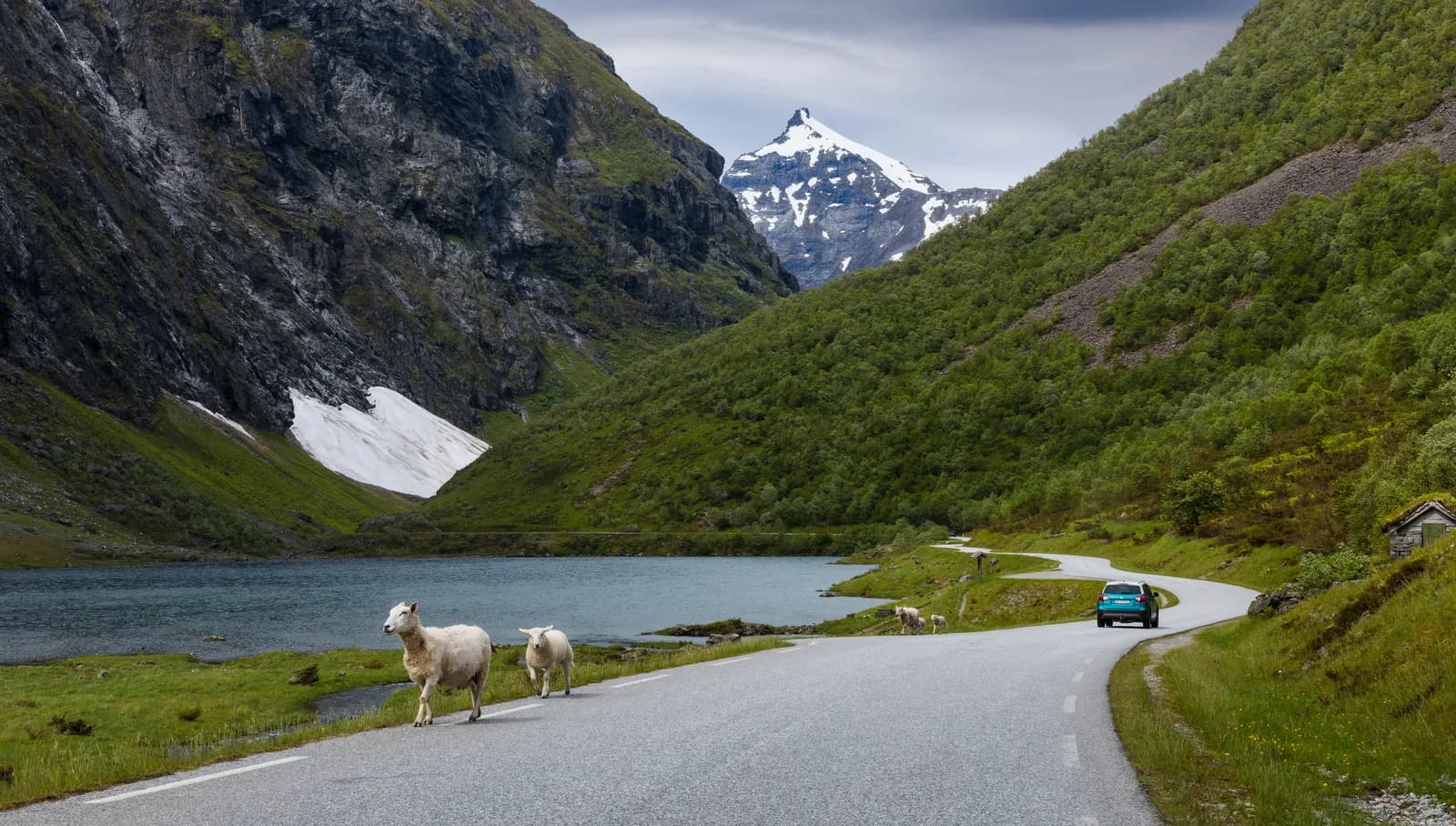
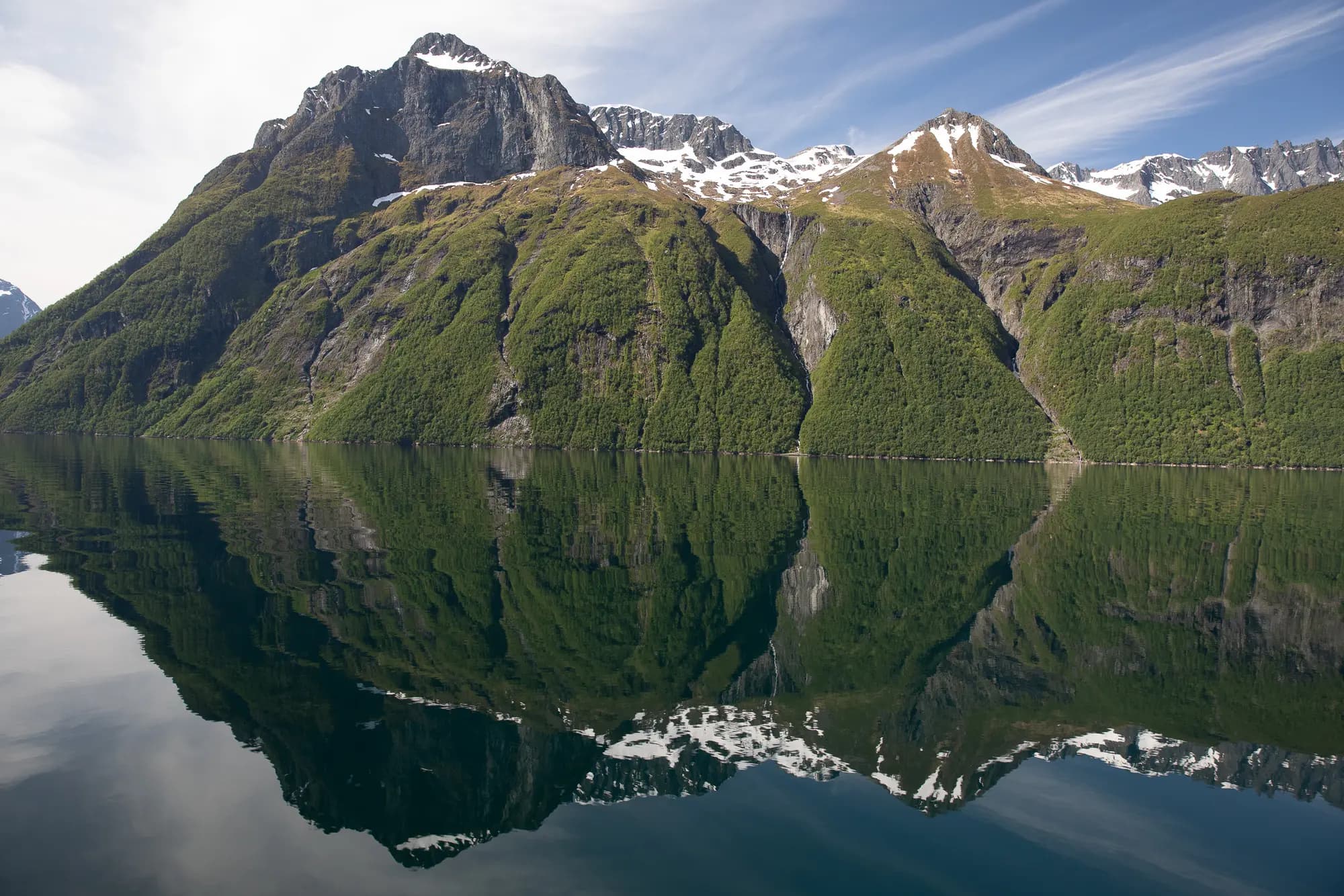
There is no main road along Hjørundfjorden. The mountains of the Sunnmøre Alps rise straight out of the water to around 1,600 metres, and the villages round the fjord are linked by ferries and short stubs of road. You cross the fjord in a quarter of an hour, drive along Norangsfjorden to Øye and then follow a narrow county road up through Norangsdalen. The valley has long had a reputation as the wildest in Sunnmøre. Halfway up lies a lake that did not exist before 1908.
The driving itself takes a couple of hours, but the narrow road and the mountain walks make two or three days a good fit. The route ends in Hellesylt and Stranda. From Hellesylt the ferry leaves for Geiranger, where Trollstigen and the Geirangerfjord takes over, and from Stranda it is about an hour and a half to Ålesund with the ferry.
Stops along the route
1. Ørsta and Volda — the Nynorsk towns
Ørsta and Volda are just under ten kilometres apart, with the airport at Hovden in between. Ivar Aasen was born on the farm Åsen in Hovdebygda in 1813. Today Aasentunet stands there, a museum and centre for Nynorsk writing, in a white concrete building designed by Sverre Fehn that opened in 2000. Volda has Volda University College and the Aarflot museum, with the printing press Sivert Aarflot started in 1809.
Don't miss: Aasentunet, five kilometres from the centre of Ørsta on the way to Volda. The museum is closed on some weekdays, so check nynorsk.no before you go.
Motorhome tip: Ørsta Camping, just south of the centre, has motorhome pitches with electricity. Fill up in Ørsta. Between Ørsta and Hellesylt the only fuel we have found is at the village shop in Urke.
2. Bondalen and Sæbø — over the pass to Hjørundfjorden
From Ørsta the Fv 655 heads east through Åmdalen and over Bondalseidet, where Ørsta's ski centre is, and then down Bondalen to the fjord. The valley sides are steep. In 1968 an avalanche swept away a whole hamlet in the lower part of the valley. Sæbø is the largest village on Hjørundfjorden. It was the centre of the old Hjørundfjord municipality, and it has Hjørundfjord church and the ferry quay.
Don't miss: The view from the quay while you wait for the ferry. The peaks on the other side rise straight from the fjord.
Motorhome tip: About five kilometres from Ørsta you cross Høgebrua, a stone arch bridge from 1923 signed with a clear width of 3.7 metres. Only one vehicle can cross at a time. Hjørundfjord Camping lies by the fjord and has pitches for motorhomes and caravans, electricity, showers, a washing machine and its own hut for gutting fish. It is open from 1 June to 1 October and at Easter.
3. Across the fjord to Urke — the village below Saksa
The ferry from Sæbø to Leknes takes about 13 minutes. From the quay it is two kilometres to Urke, on the north side of Norangsfjorden, where the sun gets in. The village is small, but in autumn the Hurtigruten calls here. The campsite closed in 2010 and reopened in 2014, after the villagers had done up the cabins as volunteers.
Don't miss: The walk up Saksa, 1,073 metres above sea level. In 2015 Sherpas from Nepal built stone steps through the scree on the path up. Urke Kaihus, the old quay house, is a café and pub in summer.
Motorhome tip: Urke Camping has twelve pitches for motorhomes and caravans, with electricity. It is run by the village shop next door, Urke Landhandel, which also sells groceries and fuel. Book by phone or email.
4. Along Norangsfjorden to Øye — the hotel at the head of the fjord
From Urke the road follows Norangsfjorden inland and passes through six avalanche shelters, roofs over the road built to take rockfall and snow slides. At the end lies Øye. Hotel Union Øye opened here in 1891, as more and more tourists found their way into the fjords. The wooden hotel in Swiss style drew guests from royal houses and the nobility all over Europe, and writers and polar explorers stayed here too, Karen Blixen and Roald Amundsen among them.
Don't miss: Slogen, 1,564 metres. It was first climbed in 1870. The path most people use today starts a little over a kilometre east of the hotel, and the walk is both long and steep.
Motorhome tip: The avalanche shelters are only 4.5 metres wide and signed at 3.9–4.1 metres. The two nearest Øye have the lowest signs, 3.9 metres. Know the height of your motorhome, and wait at a passing place if someone is coming the other way. The rest area at Øye has four spaces for cars and none for large vehicles. There is no campsite at Øye, so spend the night at Urke or in Hellesylt.
5. Norangsdalen and Lygnstøylvatnet — the summer farm under water
From Øye the Fv 655 climbs into Norangsdalen, a narrow valley between high, steep mountains. Before there were cars, tourists were driven through the valley to Hellesylt by horse and cart. The valley has been nicknamed «Dronningruta», the Queens' Route, after the Norwegian king and queen's silver wedding cruise in 1993.
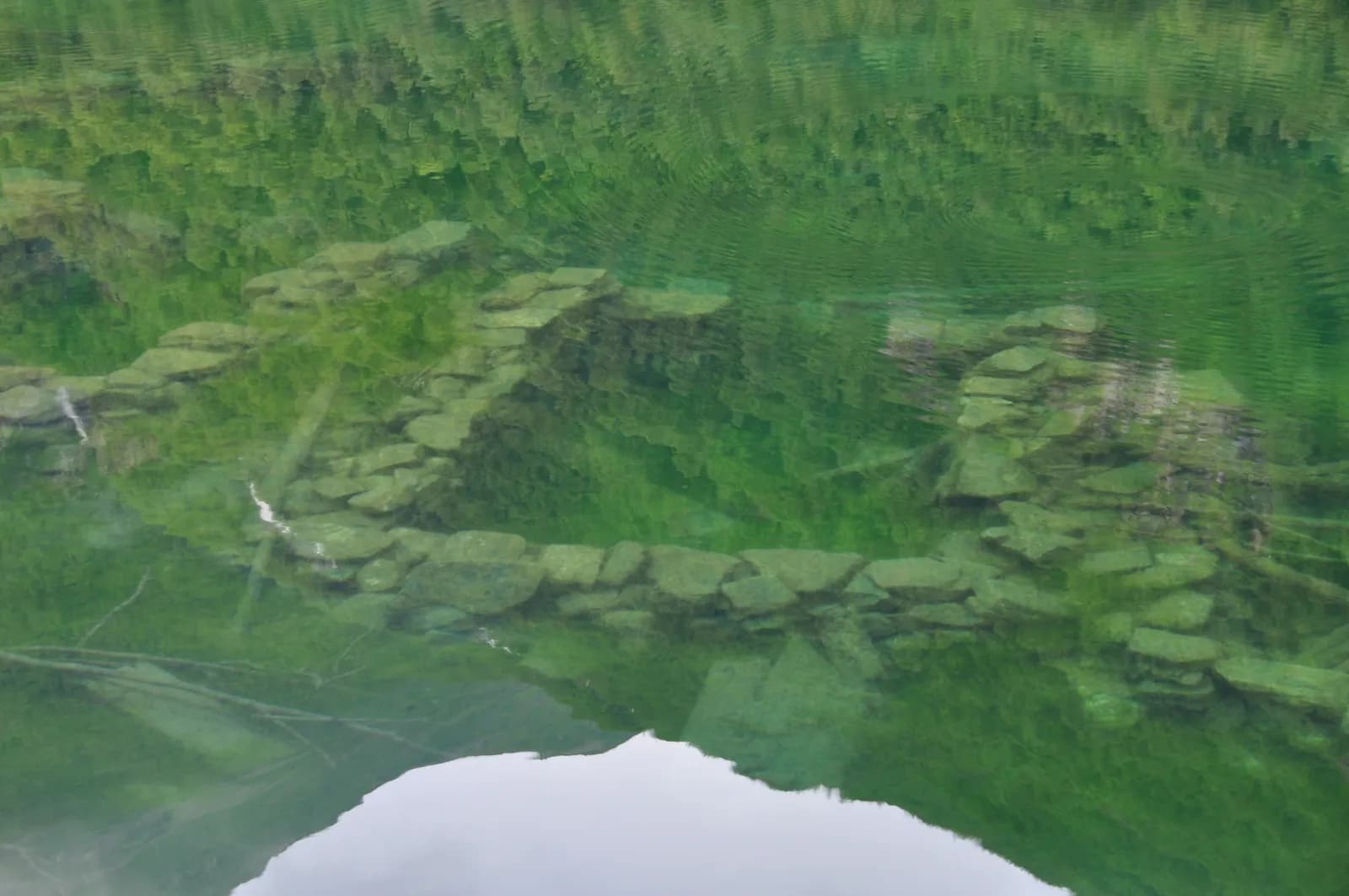
In May 1908 a rockslide came down the mountainside and dammed the river. That is how Lygnstøylvatnet was formed (often spelt Lyngstøylvatnet), and the summer farm of Lygnstøylen ended up on the bottom. The water is clear: below the surface you can still make out the walls, a stretch of the old road and a gate.
Don't miss: Stop at Lygnstøylvatnet on a calm day, when the surface lies still. Further up the valley are the summer farms of Urasætra and Stavbergsætra, where the houses are partly dug into the ground to withstand slides.
Motorhome tip: There are few places to stop, and the passing places are for letting oncoming traffic by, not for parking. Stop only where there is plenty of room beside the road, and watch out for sheep on the road. Just after Lygnstøylvatnet comes Lysholbrua, a stone arch bridge from 1895 signed with a clear width of 3.8 metres: one vehicle at a time. The road reaches about 320 metres above sea level at the watershed and then runs down Nibbedalen to the Fv 60, about five kilometres before Hellesylt.
6. Hellesylt — the waterfall in the middle of the village
Hellesylt lies at the head of Sunnylvsfjorden, and the Hellesyltfossen waterfall runs through the centre down to the sea. The wooden church, Sunnylven kyrkje, from 1859, was designed by Linstow, the architect of the Royal Palace in Oslo. From here the ferry runs through the Geirangerfjord to Geiranger.
Don't miss: The bathing beach with its bath house and diving tower, within walking distance of the campsite.
Motorhome tip: Hellesylt Camping has around 100 pitches and only takes drop-in guests, with no booking. It is open from 20 March to 20 October, and you pay at the machine on site. The ferry quay is about 200 metres away, so you can leave the motorhome and take the ferry to Geiranger and back as a foot passenger. If you want to take the motorhome along, see «Ferries» below.
7. Ljøen and Stranda — high above the fjord and down to Storfjorden
The Fv 60 climbs north from Hellesylt through Streketunnelen, 3.8 km long and dating from 1962. Between it and the new Ljøtunnelen from 2016 lies the Ljøen rest area, high above Sunnylvsfjorden. After Ljøtunnelen the road runs down Strandadalen to Stranda on Storfjorden. Stranda is an industrial village. Furniture factories came first, from 1907, and later the food industry grew big: Stabburet makes Grandiosa pizza here, among other things.
Don't miss: The view from Ljøen. The rest area has drinking water and is built for lorries.
Motorhome tip: We have not been able to confirm any campsite in Stranda, so plan to spend the night in Hellesylt. From Stranda the ferry crosses Storfjorden to Liabygda. The Fv 60 towards Sykkylven and Ålesund goes over Strandafjellet, a mountain pass with gradients of up to 10 per cent, where the roads authority may introduce convoy driving or close the road in bad winter weather.
Practical info for motorhomes
Roads: The Fv 655 and Fv 60 are open to vehicles up to 19.5 metres all the way, but that does not mean the road is wide. Ørsta–Sæbø is a good road, mostly over six metres. The narrowest stretch is from Leknes past Urke and a couple of kilometres further along the fjord, mostly 3.5–4.8 metres. Along Norangsfjorden towards Øye the road is mostly 5–7 metres, but through Øye itself, past the hotel and the rest area, only about 4–5 metres. The first stretch up from Øye is wider again. Through Norangsdalen the road is mostly 4–5.5 metres, wider down Nibbedalen and narrower again for the last stretch before the Fv 60. There are passing places all the way. The avalanche shelters between Urke and Øye are 4.5 metres wide and signed at 3.9–4.1 metres; the two nearest Øye are the lowest. Three old bridges have signs giving their clear width, so only one vehicle can cross at a time: Høgebrua (3.7 m) about five kilometres from Ørsta, Lysholbrua (3.8 m) just south of Lygnstøylvatnet and Øygardsbrua (4.0 m) on the Fv 60 just before Hellesylt. There are no signed height limits on the Fv 60, but the roads authority has calculated the clearance in Streketunnelen at 4.3 metres, and the tunnel has a 6.8 per cent gradient. With a long motorhome or a trailer, expect to reverse to a passing place now and then. The Fv 655 is not closed in winter, but it can close at short notice in bad weather and when there is a risk of slides, as it did during the extreme weather «Hans» in August 2023 and during a storm in February 2024. Check vegvesen.no/trafikk before you set off.
Parking: The rest area at Øye has room for only four cars. In Norangsdalen there are few lay-bys, so stop only where there is plenty of room. The Ljøen rest area on the Fv 60 is built for lorries. In Hellesylt the motorhome is best left at the campsite. Never park in passing places.
Overnight stays: Norway's right to roam lets you pitch a tent at least 150 metres from an inhabited house, for up to two nights in the same place without asking the landowner. With a motorhome you stand only where parking is allowed, and you never drive off the road. Along the narrow road from Leknes to Hellesylt there are almost no such places, so use the campsites at Sæbø, Urke and Hellesylt.
Campsites:
- Ørsta Camping, Ørsta — motorhome pitches with electricity, just south of the centre
- Hjørundfjord Camping, Sæbø — 1 June–1 October and at Easter
- Urke Camping, Urke — twelve pitches for motorhomes and caravans, book by phone or email
- Hellesylt Camping, Hellesylt — 20 March–20 October, drop-in only
Fuel: Fill up in Ørsta, which has several stations. Along the Fv 655 the only fuel we have found is at Urke Landhandel. Hellesylt and Stranda have filling stations.
Waste disposal: We have not found any public waste disposal point along the route, and none of the campsites says on its website that it offers emptying for motorhomes. Empty your tanks before you set off. If you stay at one of the motorhome parks in Ålesund before the trip, you can empty your toilet there, and Geiranger, on the other side of the ferry, has a disposal point. It is worth asking the campsite where you stay.
Tolls: No toll points on the route. If you come from Ålesund, you will pass toll points in the Ålesund road package (Bypakke Ålesund).
Ferries:
- Sæbø–Leknes (Fjord1) — about 13 min. Runs all year, from early morning until late evening, and is free for all vehicles (Fjord1's price list, October 2026). Fjord1 offers no advance booking on this crossing.
- Hellesylt–Geiranger (Vestlandske) — about an hour through the Geirangerfjord. Runs only in season, mainly from May to October. Tickets are sold through Norway's Best, and Vestlandske recommends booking online to be sure of a place. Vehicles should be at the quay at least 30 minutes before departure. Fjord1 also offered this crossing from spring 2026 but has suspended the route until further notice, although Entur may still show Fjord1 departures.
- To and from Ålesund: Solavågen–Festøya (Norled, about 20 min) to Ørsta, or Sykkylven–Magerholm (Fjord1, about 15 min) from Stranda. On these ferries the fare depends on the length of the motorhome.
- Stranda–Liabygda (Fjord1, about 13 min) — across Storfjorden, if you want to carry on east.
Combine with
- Trollstigen and the Geirangerfjord — take the ferry from Hellesylt to Geiranger and drive that route in reverse over Ørnevegen and Trollstigen to Åndalsnes.
- Ålesund and Runde — Ålesund is about 60 km from both Ørsta (with the Festøya–Solavågen ferry) and Stranda (with the Sykkylven–Magerholm ferry), so the two routes make a loop.
- Gamle Strynefjellsvegen — from Hellesylt the Fv 60 runs south to Stryn, about 50 km. From there it is a short drive to Olden, where that route starts.
Weather
The Sunnmøre Alps make their own weather, and it can change quickly between the fjord and the valley. Snowfields from the winter can lie on the slopes of Norangsdalen well into the summer. The valley is prone to rockfall and slides, and after heavy rain the road can close at short notice. Bring waterproofs and warm clothes even in July, and check yr.no for Ørsta, Øye and Hellesylt before you go.
This route is part of Bobilvei's hand-picked motorhome routes in Norway. Every route is quality-checked with a focus on motorhome suitability, parking and local experiences.