- Route
- Bodø – Geitvågen – Mjelle – Festvåg – Misten – Kjerringøy – Bodø – Saltstraumen (Fv 834, Rv 80 and Fv 17, with a ferry across Mistfjorden in both directions)
- Length
- about 115 km from central Bodø via Kjerringøy to Saltstraumen. The side trip to Mjelle adds around 5 km, and if you are heading back to Bodø for the Lofoten ferry, it is about 30 km more.
- Driving time
- Around two hours at the wheel, plus two ferry crossings of ten minutes each and time waiting on the quay
- Recommended number of days
- 2–3
- Best season
- June–August. Kjerringøy trading post is open for the summer from mid-May to the end of August, and in Bodø the midnight sun stays above the horizon from 31 May to 12 July. The roads and the ferry run all year.
- Difficulty
- Easy. Short legs, no tunnels on the Fv 834 and no length limit below 19.5 metres. The road on the Kjerringøy side is narrow, and the ferry has to fit into your day.
- Last checked
- October 2026
Why this route?
Many people only ever see Bodø from the ferry queue. The town has an airport, the end of the Nordland railway and the ferry to Lofoten, and plenty of drivers go straight on board. That's a shame. Within 40–50 km lie a coast road towards the midnight sun, a 19th-century trading post that stands almost untouched, and a sound where the tide boils four times a day.
The legs are short and the roads mostly easy — only the Kjerringøy side is narrow — which is ideal if you have just collected your motorhome and want to get to know it before the long days. Take two days, preferably three: one for the town, one for Kjerringøy and one for Saltstraumen. From there the road continues to Lofoten, along the coastal route Kystriksveien or south on the E6.
Stops along the route
1. Bodø — the town that was built anew
Bodø became a market town in 1816. During the bombing in May 1940, large parts of the town went up in flames. After the war a new centre was laid out, with straight streets along the harbour. The cathedral from 1956 belongs to the rebuilding; it is made of concrete and has been protected since 2002. By the water stands the Stormen culture centre, and in 2024 Bodø was a European Capital of Culture.
Don't miss: Keiservarden (366 m above sea level). Kaiser Wilhelm II walked up here when he visited the town in 1891, and the cairn that commemorates his visit is a 2013 copy of the first one. From the large car park on Rønvikfjellet it is 5.5 km there and back, partly on stone steps laid by Nepalese Sherpas in 2016. On a clear evening you can see the Lofoten Wall to the west.
Motorhome tip: Bodø Havn, the port, runs a motorhome car park at Rønvik harbour and marina, about 2 km from the centre: around 15 pitches, with or without electricity. There is water on site and a toilet in the service building. You pay in the EasyPark app, and pitches cannot be booked. Camping on or beside the streets and open spaces in town is forbidden unless signs say otherwise.
2. Norsk Luftfartsmuseum — the propeller at Stormyra
Seen from the air, the museum building is a propeller, with civil and military aviation in separate halves. It is the largest aviation museum in the Nordic countries and stands at Stormyra, a couple of kilometres east of the centre, right by the airport. One of the aircraft is a U-2. It fits Bodø well — this is where an American U-2 was heading in May 1960 when it was shot down over the Soviet Union. In summer the museum is open every day.
Motorhome tip: The car park right outside is big enough for both cars and caravans, the museum says. You get four hours of free parking by registering your number plate when you go in.
3. Geitvågen — the town's bathing beach
Follow the Fv 834 north — in local addresses it is called Midnattssolveien, the Midnight Sun Road. After a little over 10 km you reach Geitvågen. Bodø people have been swimming here since the 1950s. A dam turns the lagoon into a large saltwater pool that the sun warms up. Straight out to sea lies the island of Landegode.
Motorhome tip: Geitvågen Bad & Camping is only open for a short season in the middle of summer — check the dates at geitvagen.com. While it is being renovated there are few pitches for large motorhomes, so ring before you come. The shared car park is on the right just after the turn-off.
4. Mjelle — the red sand
Garnet from the surrounding rock gives the sand at Mjelle a reddish tinge. The turn-off is signposted Mjelle/Mulstrand, about 20 km from town, and the road ends after just under three kilometres. The whole walk down to the beach and back is 2.2 km on a marked path — easy, and done in an hour.
Motorhome tip: The road in is narrow and paved almost all the way. The car park at the end is small, may charge a fee and is not for overnight stays. If it is full, turning a large motorhome is tight — come early on fine summer days. The side trip adds about 5 km.
5. Festvåg — the ferry across Mistfjorden
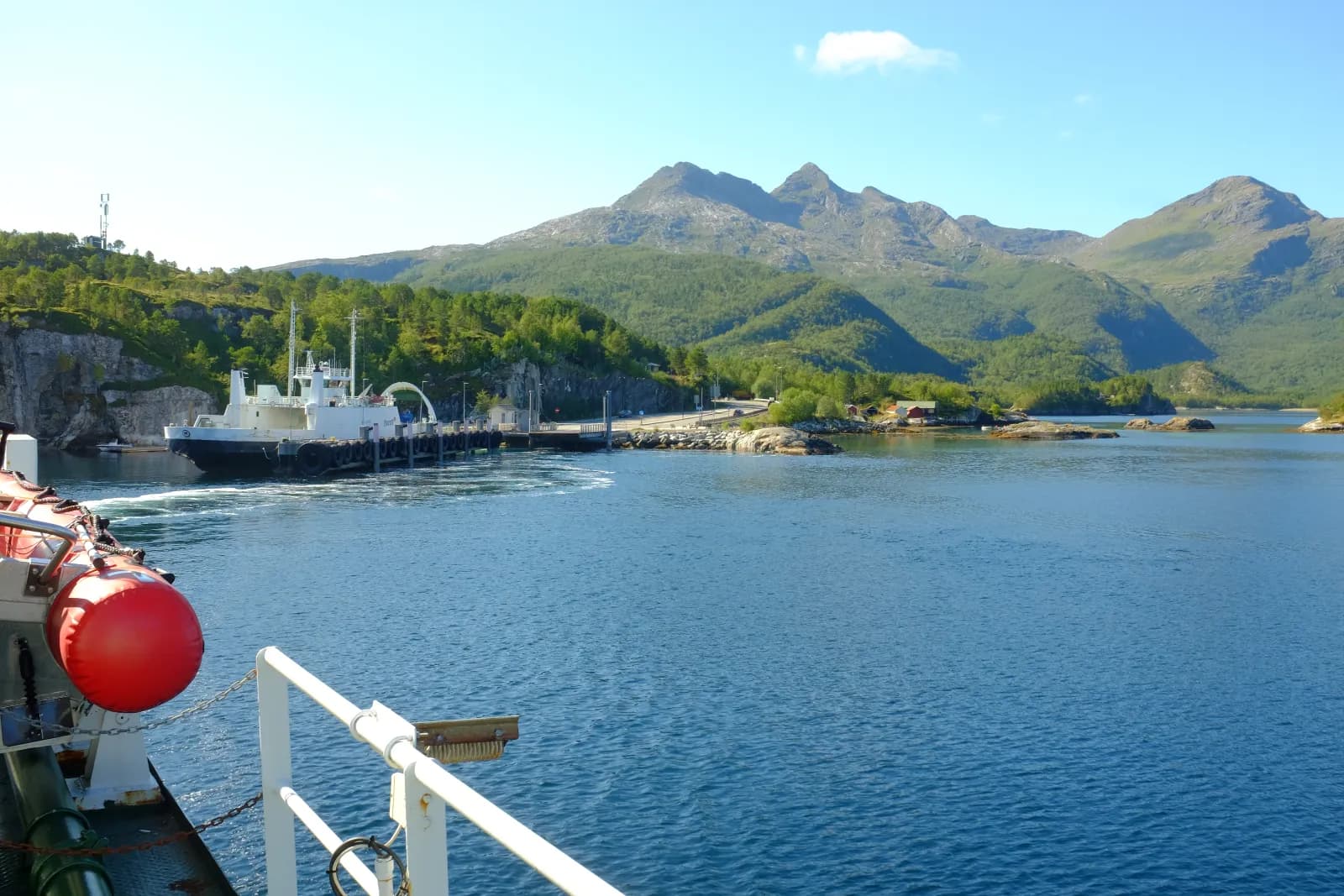
At Festvåg the road ends on this side of the fjord. The ferry over to Misten takes about ten minutes and runs all year, many times a day. On an ordinary weekday in October 2026 there were about 20 departures from Festvåg. The roads on both sides are open to vehicles up to 19.5 metres.
Motorhome tip: You cannot book a place: just join the queue. On fine summer days there can be a queue, so allow plenty of time. Outside the summer the ferry is free for vehicles; in summer you pay according to the length of your motorhome. There is a toilet at the ferry quay.
6. Kjerringøy trading post — Hamsun's Sirilund
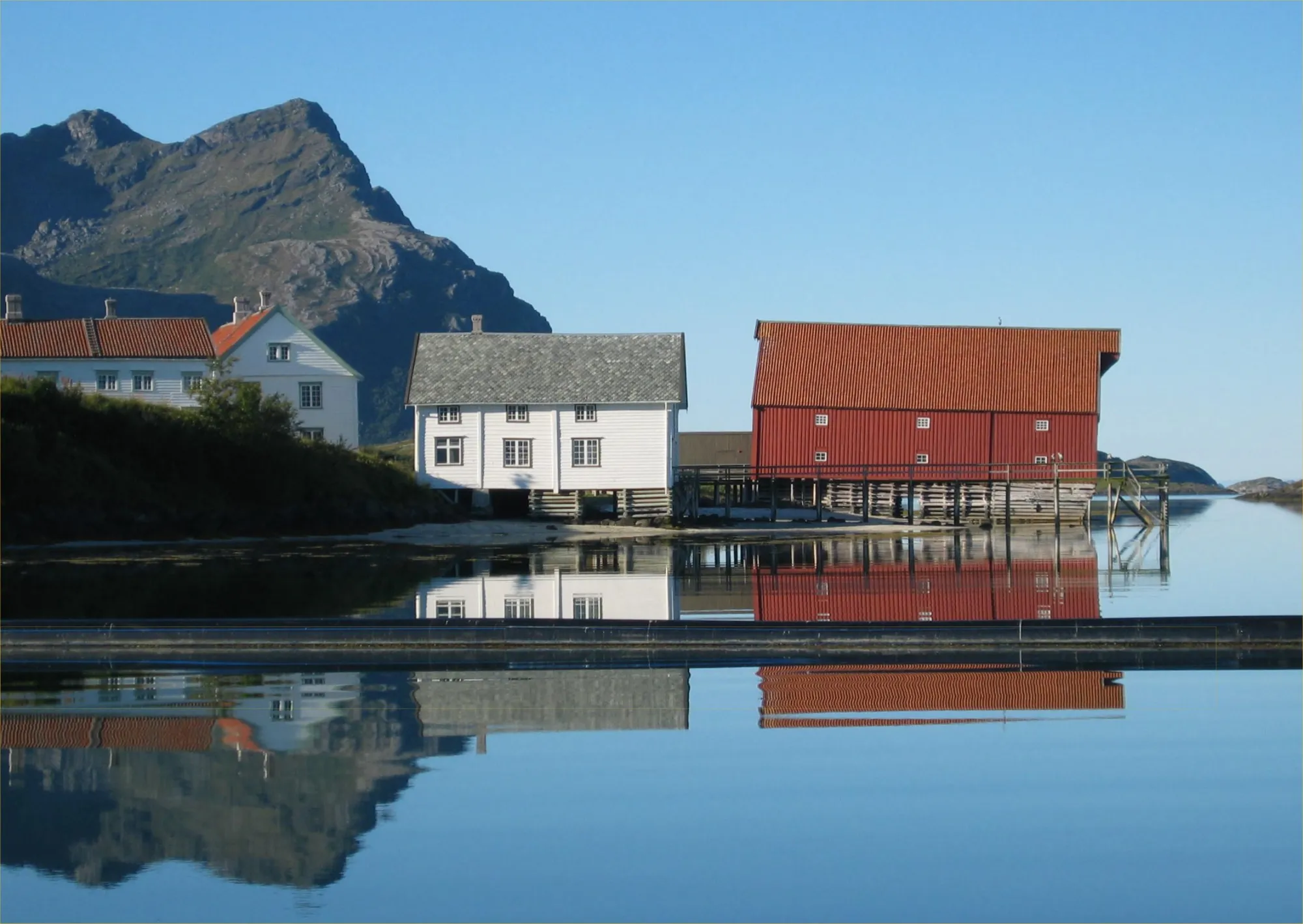
From Misten it is just over ten kilometres to the trading post. Fifteen buildings were protected in 1942. Many still have their old furnishings, and the shelves in the general store still hold goods from the 1800s — few places in Norway bring you this close to the trading life of the time. The large boathouse holds several Nordland boats, and one of them in the collection dates from 1820. The place is regarded as the model for Sirilund in Knut Hamsun's novels "Benoni" and "Rosa", and the film "I Am Dina" was partly shot here.
Don't miss: A guided tour of the main house, where you hear about the life of the merchant family and the distance between them and their servants. There is a café with local food in the old cowshed. Across the road stands Kjerringøy church, a white wooden long church from 1883.
Motorhome tip: Park by the church, across the road from the trading post. The car park is not large, so come early in high season. The road from Misten is narrow all the way — use the passing places. The village has a grocery shop but no fuel station. Plan your night in Bodø or at Saltstraumen, or at Geitvågen in the middle of summer.
7. Saltstraumen — the maelstrom under the bridge
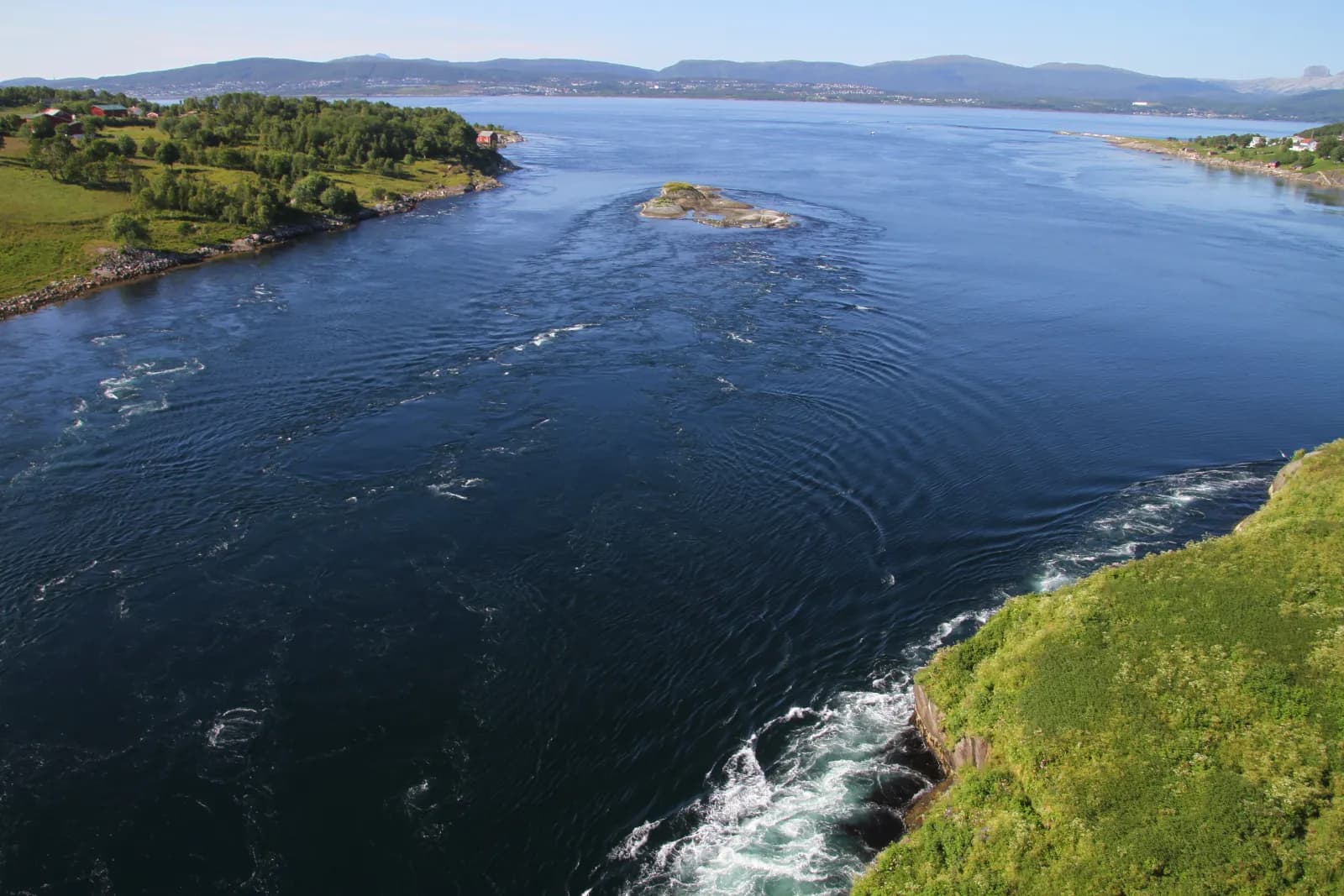
Drive back through Bodø, follow the Rv 80 east and turn onto the Fv 17 at Løding. The sound is 3 km long and only 150 m wide at its narrowest. Four times a day the tide between Saltfjorden and Skjerstadfjorden has to squeeze through here, and the surface fills with whirlpools — the largest up to ten metres across. The bridge over the sound opened in 1979. It is 768 metres long, has 41 metres of clearance beneath it and is a protected monument.
Don't miss: The right moment. The calendar at visitbodo.com shows when the current is strongest each day. Expect a strong current from an hour before the peak to an hour after, most of all at new and full moon. Follow the paths north of the bridge down towards the water to see the whirlpools up close, or walk out onto the bridge's footway and look down on them. The rocks can be slippery — keep well back from the edge.
Motorhome tip: Just north of the bridge there is a large free car park, with toilets and paths down to the current. Pluscamp Saltstraumen Camping is a couple of minutes' walk away, with 80 drop-in pitches for motorhomes and caravans. If you sleep at the campsite, you can catch both the evening and the morning current. Fish only from the marked spots; catching wolffish is banned in the protected area.
Practical info for motorhomes
Roads: The Fv 834, Rv 80 and Fv 17 are open to vehicles up to 19.5 metres all the way, and the Fv 834 has neither tunnels nor height restrictions (Statens vegvesen's road database). From Bodø to Festvåg the asphalt is mostly 5.5–6.5 metres wide. From Misten to Kjerringøy it is around five metres, and the last kilometre and a half to the trading post is 4–5 metres. Two motorhomes cannot pass each other everywhere on the Kjerringøy side, so use the passing places the whole way. Towards Saltstraumen you drive through Bodøtunnelen on the Rv 80 and two tunnels on the Fv 17; the road database gives no height below 4.4 metres on the way there. Going in and out of Bodø you pass toll points (Bypakke Bodø), and tolls are charged in both directions. With an AutoPASS tag and agreement you only pay for one passage per hour, and most motorhomes then pay the ordinary car rate, even above 3.5 tonnes. Without a tag, a heavy motorhome pays the higher rate at every passage. Ask the owner whether the motorhome has a tag, and agree how you will settle up. Check vegvesen.no before you set off.
Parking: The car parks at Mjelle and by the church at Kjerringøy are small, and overnight stays are not allowed at Mjelle. At the aviation museum and at Saltstraumen there is plenty of room. Never park in a passing place — it is forbidden.
Overnight stays: Use the campsites and the motorhome car park when you can. In Bodø the local police by-law bans camping in public parks, green spaces and recreation areas, and on or beside roads and open spaces in built-up areas, unless signs say otherwise. Outside town, the Outdoor Recreation Act gives you the right to pitch a tent on uncultivated land at least 150 metres from an inhabited house or cabin, and for no more than two nights in one place without the consent of the owner or user — a good rule of thumb for motorhomes too. Only stop where parking is allowed, and never drive off the road into the terrain.
Campsites:
- Bodø Havn motorhome car park — in Rønvik, around 15 pitches, with or without electricity, payment via EasyPark, no booking
- Geitvågen Bad & Camping — on the Fv 834, a little over 10 km north of Bodø, only a short season in the middle of summer
- Pluscamp Saltstraumen Camping — right by Saltstraumbrua, 80 drop-in pitches
- Camp Saltstraumen Elvegård — on Straumøya, about 700 metres from the current, room for around 50 motorhomes on grass
Fuel: Bodø has plenty of fuel stations, the last one close to the Fv 834 in Rønvik. There are none along the Fv 834 or on Kjerringøy, so fill up before you head north. On the way to Saltstraumen you pass two stations at Tverlandet, and there is a YX station at Saltstraumen.
Waste disposal: At the Esso station in Rønvik and at Tverlandet on the Rv 80, which you pass on the way to Saltstraumen. No dump station is listed along the Fv 834 or on Kjerringøy, and the old emptying point in central Bodø is closed. See bobilplassen.no.
Ferries:
- Festvåg–Misten — about 10 min, many departures all year, cannot be booked. Free for vehicles outside the summer; in summer motorhomes pay according to length (a scheme introduced in 2026). If the motorhome has an AutoPASS tag, the bill goes to the owner — agree in advance how you will settle up. Timetables at reisnordland.no.
- Bodø–Moskenes (on to Lofoten) — about 3 h 15 min direct. Part of the capacity can be booked, and with a booking you must be in the queue at least 45 minutes before departure. In high season cars can be left behind on the quay: book well ahead at torghatten.no.
Combine with
- Lofoten — the ferry from Bodø to Moskenes drops you near Reine and Å.
- Saltfjellet and the Arctic Circle — from Saltstraumen, follow the Rv 80 to Fauske and the E6 south over the mountains to Mo i Rana. East of Løding the Rv 80 passes under two bridges with a signed height of 4.1 metres, plenty of margin for an ordinary motorhome.
- Helgelandskysten — the Fv 17 continues over Saltstraumbrua and south as Kystriksveien, the coastal route, with five ferries down towards Torghatten.
Weather
Bodø lies open to the sea, and the weather changes quickly. The July average is 13.6 degrees over the day and night; August is about as warm, June cooler. May to July are the driest months; from August more rain arrives, and September is almost twice as wet as July. The midnight sun stays above the horizon from 31 May to 12 July — an evening at Geitvågen or on Keiservarden is well worth staying up for then. Check yr.no for Bodø and Kjerringøy.
This route is part of Bobilvei's hand-picked motorhome routes in Norway. Every route is quality-checked with a focus on motorhome suitability, parking and local experiences.